Getting passengers from one gate to another kilometres away, delivering baggage across multiple terminals and sequencing aircraft landings and take-offs on runways are tasks that artificial intelligence tools can help manage as Singapore’s passenger capacity increases.
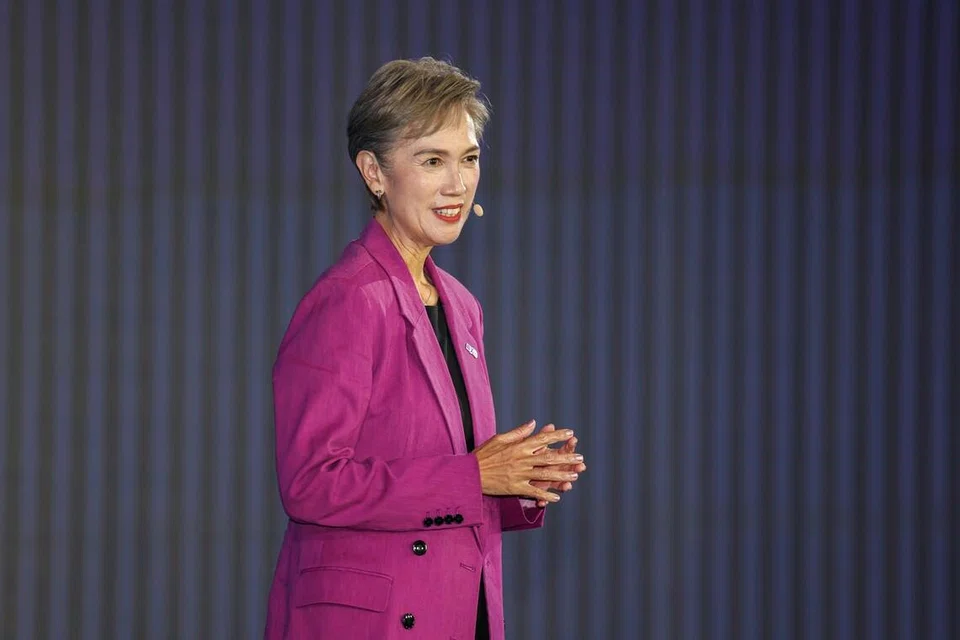
Minister for Digital Development and Information Josephine Teo said the solutions to these challenges will position Singapore well on the world stage, as she outlined the nation’s four key AI missions.
“The national AI missions will be driven by problem statements worth solving, not just for Singapore but for the world. They aim to be beachheads for deep game-changing AI adoption in their sectors,” said Mrs Teo.
“Work has already begun in aviation,” she said. “Our connectivity challenges clearly demonstrate where Singapore can be a living lab for the world.”
She was speaking on May 20 at the two-day Asia Tech x Summit tech conference at the Capella Singapore hotel in Sentosa, organised by the Infocomm Media Development Authority of Singapore.
“We will need a next-generation air traffic management system that prioritises safety and not just volume,” said Mrs Teo.
Changi Airport Terminal 5, which is being constructed, is slated to be operational by the mid-2030s. The new terminal will allow Changi Airport to serve many more passengers yearly.
Tuas Port, set to be the world’s largest automated container terminal, also has rich data sets of complex operations useful for developing new solutions, said Mrs Teo.
The port is being developed in four phases and will be completed in the 2040s. When phase 1 of the development completes in 2027, it will have 21 berths that can handle 20 million shipping containers. When it opened in September 2022, it had three operational berths.
Singapore’s four key AI missions, announced by Prime Minister Lawrence Wong in Budget 2026, span advanced manufacturing, financial services, connectivity and healthcare.
Together, these sectors contributed 40 per cent to Singapore’s gross domestic product (GDP) in 2025.
In advancing manufacturing, Mrs Teo said the scope and scale for impact will be significant, thanks to developments in embodied AI and robotics.
Embodied AI refers to AI that can perceive, move and interact with the physical world through machines such as robots, vehicles or smart devices.
“Physical AI can help with simulations for process redesign. Better digital twins can improve predictive maintenance, reduce material wastage and production downtime,” said Mrs Teo.
These plans are captured in an updated version of the National AI Strategy 2.0 (NAIS 2.0), released on May 20. Singapore’s national AI blueprint was last updated in December 2023, following its launch in 2019.
Updated priorities in 10 key pillars have also been captured in the 44-page document, titled Update To National AI Strategy – AI For The Public Good For Singapore And The World.
“We are fleshing out how to push the boundaries in each component of our AI ecosystem in industry,” said Mrs Teo.
Details of how the two other sectors under the national AI missions could be transformed were also fleshed out in the updated blueprint.
In financial services, for instance, AI can help Singapore fight increasingly sophisticated financial crimes, develop financial management tools and enable next-generation cross-border payment systems to strengthen the nation’s reputation as a financial hub.
In healthcare, AI can support diagnoses and clinical decision-making, improve resource planning and provide patients with more personalised guidance in managing their health.
THE STRAITS TIMES