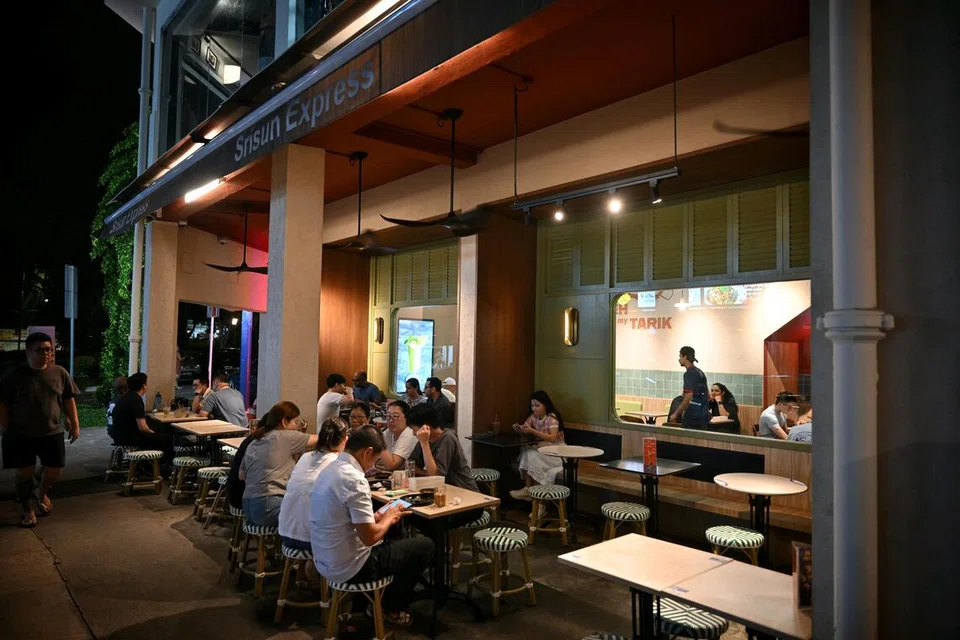
At Srisun Express in Serangoon Gardens, the scene feels noticeably different of a typical 24-hour eatery. Warm timber panels and bright colours soften the dining room, while long banquettes encourage groups to settle in.
The atmosphere feels closer to a polished restaurant than a typical supper stop — except that the food remains reassuringly familiar, the service casual and the convivial culture of the prata house intact.
This environment is deliberate. For decades, the late-night prata shop has functioned as an informal gathering space: students linger over teh tarik after midnight, taxi drivers stop between shifts and friends gather long after dinner.
Wallet-friendly, filling and endlessly customisable, prata is also one of the city’s most democratic foods.
But that familiarity shapes expectations. Diners still demand prices from a decade ago, even as restaurant costs keep rising.
For entrepreneur Jayanthi Goven, 40, it comes down to branding. She describes Srisun Express as something of a thirdwave prata house — a place that keeps the accessibility of a neighbourhood eatery while rethinking the experience.
“When you think about a prata shop, immediately you think of bright lights and oily tables. It’s a place you just want to eat and go,” she says. “I wanted to change that idea. I want people to actually sit down in a really nice space and enjoy their prata.”
The caveat? Ms Jayanthi had almost no experience running an F&B business. She studied English Literature and briefly worked as a teacher. But the moment that clarified her thinking came much earlier, while helping at her mother’s stall in a neighbourhood coffee shop.
“There was once when we had to increase the price of the prata, and customers were really upset — it was just 10 cents!” she exclaims. “Then it got me thinking: How come in the malls you’ve got two pieces of prata with chicken curry selling at $8.90, and people are willing to pay?”
A MILO TOWER MIRACLE
The contrast stayed with her. The food itself was the same; what changed was the setting, presentation and experience.
Years later, that realisation became the foundation of Srisun Express.
In 2014, a small Indian-Muslim restaurant space in Kovan became available after changing hands several times.
Jayanthi saw a chance to test her theory.
“When I took over the place, it was running at a loss. So I told myself, you know what, I’ve got a month. I’m going to work on it. I’m going to come up with a new menu.”
She was 25, with no investors, no bank loan and little food-business experience.
At one point, the restaurant was losing as much as $30,000 a month. “After five months, I thought, ‘You know what, I can’t do this anymore’,” she reveals.
One evening, sitting outside the quiet restaurant, she seriously considered giving up. A staff member urged her to hold on.
Jayanthi tried another round of ideas: halal certification, food bloggers, Groupon promotions, and eventually iced Milo towers inspired by the beer towers common in bars.
A photo of the Milo tower circulated widely online. Curious diners arrived, crowds formed, and the struggling outlet began to find its footing.
“Any publicity is good publicity,” she laughs. More importantly, the response confirmed the idea she had carried since that 10-cent moment: change the context around something familiar, and people may value it differently.
The Kovan outlet’s success gave Jayanthi the confidence to expand. Srisun Express opened in Serangoon Gardens in 2016, but growth brought new problems.
For one, prata remains intensely price sensitive.
“You’re dealing with manpower, rent, utilities, ingredients — everything goes up,” she says. “But customers still expect the same prices.”
Consistency also became harder to control as the number of outlets increased.
Different cooks produced slightly different gravies; recipes varied subtly. Customers noticed. “They would say the masala potato here looks different from the one at another outlet,” she recalls. Ms Jayanthi’s solution was a central kitchen. She invested at least half a million dollars in a facility that prepares curry bases, sauces and other staples before distributing them to the restaurants. It standardised flavours and let the outlets concentrate on speed, service and the theatre of prata-making.
A REFRESHED BRAND IDENTITY
If the early years of Srisun Express were about survival and experimentation, the redesign of its Serangoon Gardens outlet gave Jayanthi a chance to articulate what she had been trying to build all along. For inspiration, she looked beyond prata shops to New Bahru, the lifestyle destination housed in a former school compound in River Valley.
“There were so many people there just sitting down, people-watching, hanging out,” she explains. “And I thought: Why can’t a prata shop feel like that?”
Warm timber panels and bold colours replaced the utilitarian interiors typical of late-night eateries. Banquette seating encouraged groups to linger. The point wasn’t to make prata exclusive, but to give one of Singapore’s most familiar foods a setting that let people experience it differently.
“I’d like to think of Srisun as a thirdwave prata house,” she relates.
The next step may take the idea elsewhere. Ms Jayanthi is exploring smaller quick-service stalls in shopping mall basements, focused on Indian rojak — a format that would require fewer staff while reaching new neighbourhoods.
For someone whose journey began with a 10-cent price increase at her mother’s stall, the idea has travelled a long way. “Every day there’s a new problem,” she says with a shrug. “But you just keep working on it. You just have to remember why you started.” THE PEAK