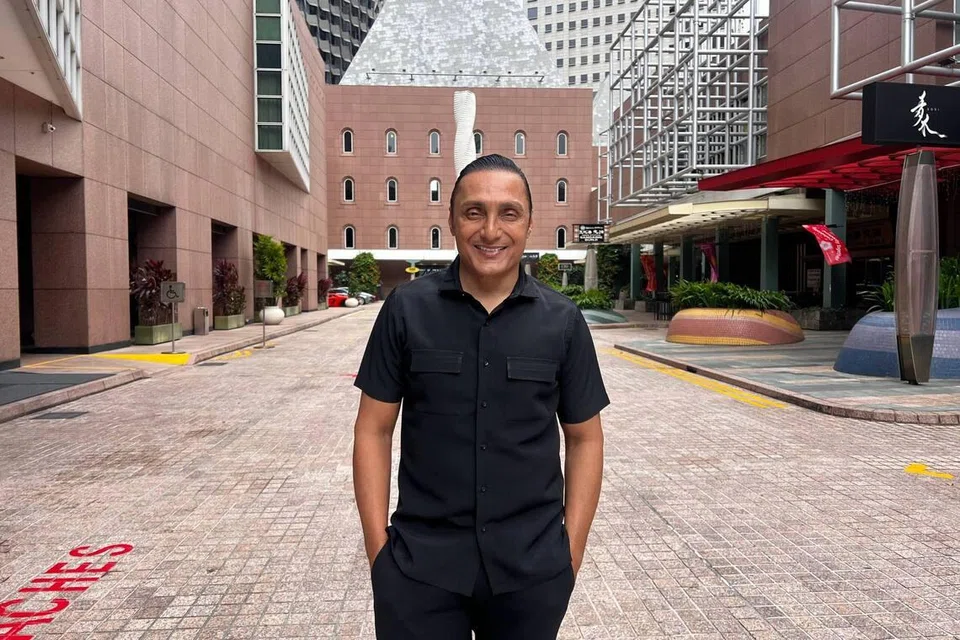

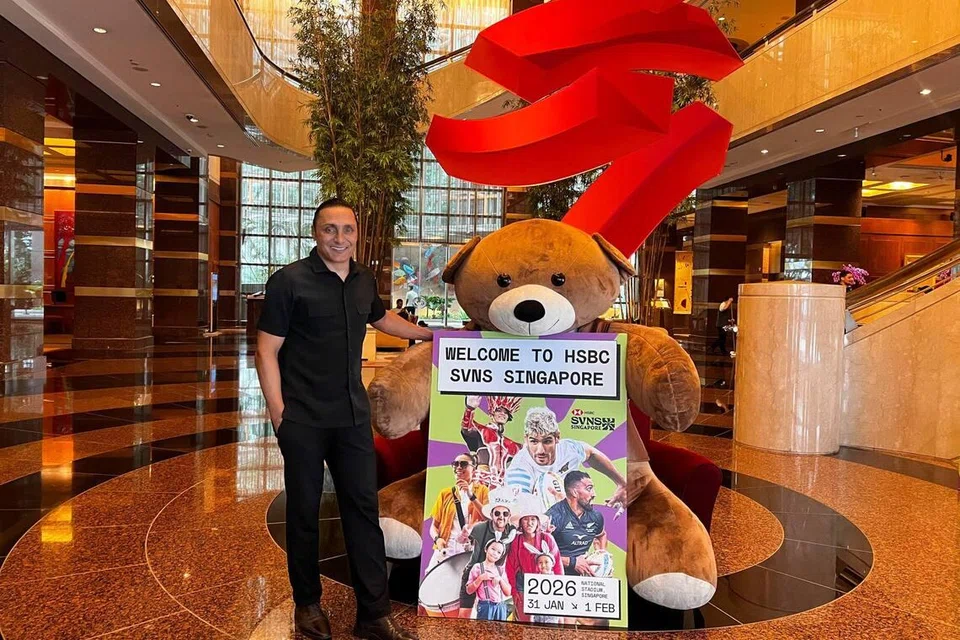
As the HSBC SVNS weekend kicked off in Singapore, inside the polished lobby of Conrad Singapore Marina Bay sat Rahul Bose, an esteemed figure in Indian cinema and president of Rugby India.
He was in transit, preparing to fly out of Singapore, when tabla! had the chance to catch up with him for an insightful conversation – during which he spoke candidly about the current realities of rugby in India, what he hopes to build through the organisation in the years ahead, and what is in store for his fans this year.
As the president of Rugby India since December 2021, Bose has spent the past four years building a sporting culture in a country where cricket reigns supreme, and rugby remains peripheral.
While acting is the primary profession that most of his fanbase knows him for, it becomes abundantly clear over the course of our conversation that rugby is his compass, speaking of the sport with a fervour that evoked a much younger Bose who grew up obsessed with rugby.
“I think what really spoke to me about this game, when I was 14 years old, were all the wrong things,” he said. “It was a game where you were allowed to be fairly violent on the field. You could express yourself physically, with such abandon, and it would be celebrated!” he exclaimed.
As a kid, Bose also had other juvenile motivations that encouraged him – “Girls loved it in my school, the more you broke a bone or injured yourself and bled, the more girls came to visit you at your hospital bed,” he said with candour.
However, the adolescent thrill soon evolved into a psychological awakening for the now-58-year-old, largely owing to the sport’s structure. “There was a certain poetry, a rhythm, an ebb and flow of the game that I absolutely fell in love with,” he said.
“It gives me indescribable pleasure to see the sport being played with fire and enthusiasm amongst players who are from all corners of this country. To see those from the socio-economically depressed strata of society empower themselves through this game.”
Bose was a part of the early, stumbling beginnings of rugby in India.
In 1998, he played for India in one of its first international appearances, taking on roles as a scrum-half and winger in a team that barely registered on the global map. Today, the federation, nearly 28 years after being founded, is still finding its footing.
The scale of the challenge is immense. Rugby in India is played across hundreds of districts, often among athletes from economically disadvantaged backgrounds, with limited infrastructure and minimal commercial backing.
“We’re interested in retention,” Bose said, describing efforts to keep players engaged across hundreds of districts.
“There are two ways you can look at the spread of a sport in any region. One is to spread laterally, and one is to spread longitudinally – We’re interested now in retaining players who touch a ball for the first time, those who’ve had success at the sub-junior level while encouraging participation at the district level.”
There are signs of improvement. India’s women’s team has climbed in Asian rankings, and now, an Olympic qualification feels more realistic. “Earlier, it was not even in sight,” Bose noted, “ but now we can afford to lift our heads and look to the future with real promise.”
“Once you win, sponsors will come. Once you win, fans will come,” he said, adding that this is a test of how long the team can actually stay the course, “when there are very few people to support you.”
This cadence Bose has achieved in the sporting world is mirrored in his work in film. However, being an actor, he said, demands a different kind of temperament. “You switch on and switch off in between scenes at least 20 times,” he said. “To be intense on screen, you have to have silence.”
Rugby, on the other hand, is more absolute. “You don’t feel it unless you’re lying flat on your back with nothing left to give,” he said.
Even now, Bose stays close to the field by making his rounds, watching the game unfold. “I just love watching the entire biology of the game,” he said. “The day I lose interest in that, I will walk away.”
His ambitions for the sport are an Olympic qualification and eventually a medal. But the path cannot purely be focused on results. “Everything you do has to be transparent, truthful and full of integrity,” he said.
While he manages the demands of leading a major sporting organisation, his film career has not taken a back seat. Following his recent appearances in the Tamil film Amaran and the Bengali film Madam Sengupta, Bose has two “big films” slated for release this year – one an action-comedy, the other a political thriller - showcasing two diametrically opposite roles.
Between the two however, regardless of film occupying a significant chunk of his day, rugby takes precedence. “I don’t think there’s been a single day that I haven’t taken or made my first phone call for rugby by 9am, largely because nobody would pick up before that,” he said with a chuckle, adding that even when he is on set, he is working around the clock for the sport.
When I remarked, half in jest, that he seemed to have more hours in a day than most, he laughed. “You need about 30 to 35 hours a day. But time is notional. You can fit 35 hours into a day, provided you use your day constructively.”