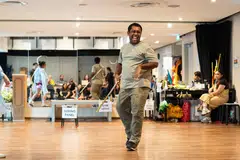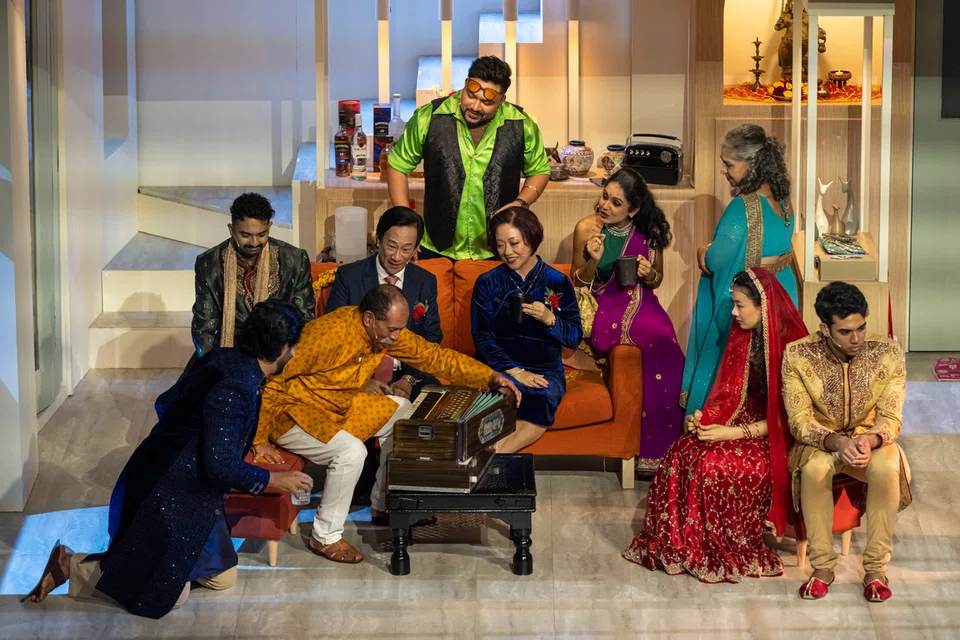
A marriage procession escorts audiences into the Esplanade Theatre Studio, with both the bride and groom’s parties greeting guests and offering nuts. Thus begins, HuM Theatre’s Rafta Rafta, a comedy play for Esplanade’s Kalaa Utsavam 2026.
The play sees the couple and their dysfunctional family react to something that happens, or rather does not happen, on their wedding night. What follows is a series of innuendo, as well as some heavy clashes between family members and the lovebirds.
Wedding guests who attended were truly in for a fun ride, with the cast giving it their very best, thrusting into each of their roles with aplomb.
Some of the best comedic relief came from performances by Shaikh Yasin and Kishore Kumar, who play Atul’s co-worker Etash and brother Jai respectively.
Karthikeyan Somasundaram plays Rocky Menon, Atul’s boss and someone we have all met and love to hate. Luckily, his wife Molly, played by Ashie Singh, is fiery and keeps him in check.
While Gerald Chew’s portrayal of Wei Ling’s father Kock was sweet and loving, he was ever so slightly upstaged by Eleanor Tan’s Doris, her mother. Tan plays into the complexities and flaws in the character so well, always leaving audiences confused as to whether or not to be on her side.
For director Daisy Irani’s Lopa and Subin Subaiah’s Eeshwar, Atul’s parents, there’s no doubt in anyone’s mind that they are truly a couple on and off the stage. The chemistry and banter are through the roof, and you can’t help but root for them to say the wrong thing.
Speaking of chemistry, Rishi Vadrevu’s Atul and Vanessa Kee’s Wei Ling are absolutely adorable as newlyweds. Your heart swoons whenever they’re together, even during their quarrels, because the performances are just that good.
Both Rishi’s and Kee’s comedic chops, I feel, are quite underrated. Even when they are acting alongside some of the theatre giants in the cast, they still manage to create laughs as they play into some of the anxieties and embarrassment that Gen Z may feel, especially when dealing with more adult topics.
One of the best scenes in this play, to me, happens early on. We see Atul’s parents and the newlyweds turning in for bed, side-by-side. You can see the tenderness that comes from Atul to Wei Ling, as well as the more hilarious, one-sided babying from the older couple.
Atul will gently take off Wei Ling’s bangles, looking her in the eyes and whispering sweet nothings. Meanwhile, Lopa will be struggling to pull off Eeshwar’s pants, while he lies limp in bed.
The set design of this play also deserves a special mention, as the house in which most of the play takes place is perfect for all the gags and shenanigans that take place throughout.
While it is jam-packed with laugh-out-loud moments, I feel as though they could have pushed it harder. In fact, when dealing with some of the more dramatic plotlines, its identity began to waver.
Additionally, there was also a slight cultural disconnect for me. The families have no real inter-racial tensions which is nice to see. However, it does seem strange when they become engrossed in societal expectations of what it means to be a man or a good wife.
Perhaps it was done in a way to show that regardless of race, there are common issues of reputations and traditions. However, I do hope in the next iteration of this play, and I do hope its soon, they could add some more of these contexts.
The play was staged over Nov 18-22.