In 1971, former Prime Minister of Singapore Lee Kuan Yew nominated the “father of obstetrics and gynaecology (O&G) in Singapore”, Dr Benjamin Henry Sheares, as the second President of the Republic, much to the joy of the citizens and surprise of British and Australian diplomats, as Dr Sheares was not a political figure.
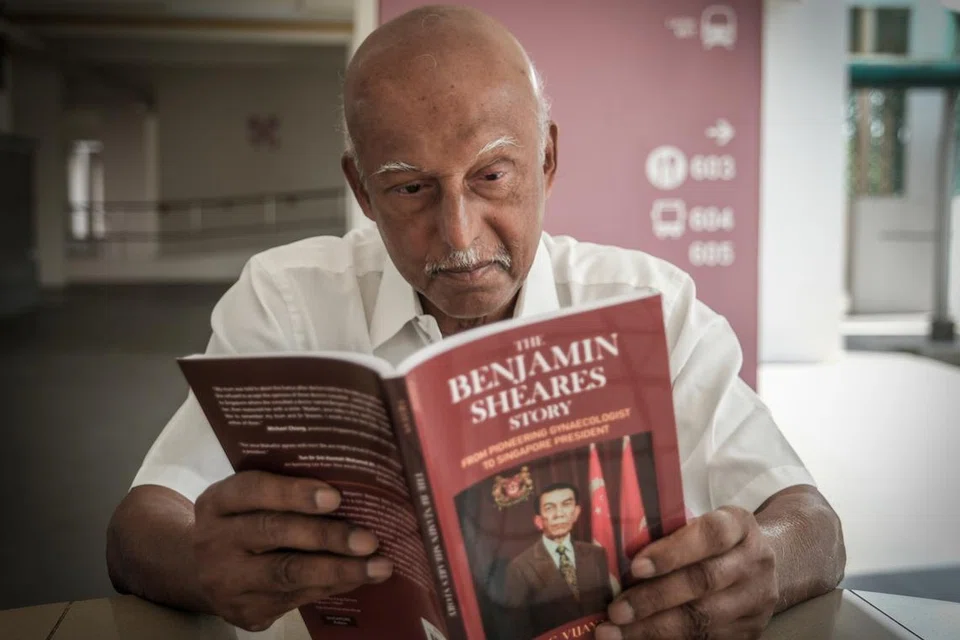
Lauded journalist Kandaiah Cumaraswamy (K.C.) Vijayan has taken on the challenge of producing one of the first full-length literary pieces on Sheares in his book, The Benjamin Sheares Story.
Dr Sheares was Singapore’s second president from 1971 to 1981, but was also equally well-known as a masterful obstetrician and gynaecologist. He was nominated for three consecutive terms as President, until he passed away in 1981 due to health complications during his final term.
“I can understand why he (Mr Lee) chose him three times,” said Mr Vijayan, 75. “He (Dr Sheares) personified what was Singapore and had the power of person, able to command the attention of all sections of society.”
Mr Vijayan spent three years researching, interviewing and writing this book, and it shows, as each chapter encompasses not only the milestones of Dr Sheares’ life but also how the world’s context at the time affected them.
Additionally, by speaking with family and friends close to Dr Sheares, Mr Vijayan weaves in humorous and emotional anecdotes that humanise him, who could otherwise remain a larger-than-life historical figure.
For example, Dr Sheares was of Eurasian descent, with a British father and an Eurasian mother, and was also technically the first Tamil-speaking president. He learned the language from his father, Mr Edwin Sheares, who lived in Madras for many years before settling back in Singapore. The book features one instance of Dr Sheares joking in Tamil with his Indian gardener after the gardener was scolded by his wife, Mrs Yeo Seh Geok.
The book also contains archival images of Dr Sheares, including childhood memories and meetings with influential figures such as the late Queen Elizabeth II. However, do note that this book is not for the casual reader and is information-dense, serving more as an educational biography than a memoir.
Below are two topics in the book that stood out:
Dr Sheares’ Medical Journey
Despite Dr Sheares being known for his work in obstetrics, he didn’t enter this specialisation by choice.
Granted, he was always interested in medicine, with a comical account in the book where, as a child, he tried to “treat” his younger sister as a doctor, feeding her a one-cent coin as a tablet and getting spanked by his mother as a result.
He came across O&G after “begging for a transfer” from a position as a medical officer in Malacca, and the only position available was at the Kandang Kerbau Hospital (KKH), Singapore’s maternity hospital at the time.
He was so dedicated to his craft that he often found it hard to take breaks or a vacation. His nephew, Mr Maurice Sheares, gave an account of how, while watching a film with the family, a message flashed at the bottom of the screen saying, “Dr Benjamin Sheares, please take urgent call at manager’s office”, at a time before pagers existed.
Dr Sheares was an advocate for voluntary sterilisation during the baby boom in Singapore during the 1950s and 1960s, with KKH seeing over 60,000 births in one of the years.
Despite backlash from certain conservative communities, he managed to convince the parliament to pass the Voluntary Sterilisation Act unopposed in 1969. Even with some friction due to his views, he was still described as showing “gentlemanly conduct even under provocation”.
Mrs Sheares
Mr Vijayan dedicates an entire chapter to the First Lady, Mrs Yeo, Dr Sheares’ second wife. “If you ask me, I think her whole chapter can be made into a movie or a musical,” he said.
Mrs Yeo immigrated from Quanzhou, China, to escape the Japanese occupation and became a nurse at KKH, where she met her husband. She was not one for the publicity her husband’s position brought her, and yet was the first First Lady to receive a sole invitation from a foreign country, as well as to be asked to deliver official speeches, something that First Ladies are not now obligated to do.
Additionally, she took charge of the family’s investments and financial decisions, with their house bought in her name, as Dr Sheares was more focused on his presidential and medical work.
Dr Shan Ratnam: Sheares’ Indian-Singaporean counterpart
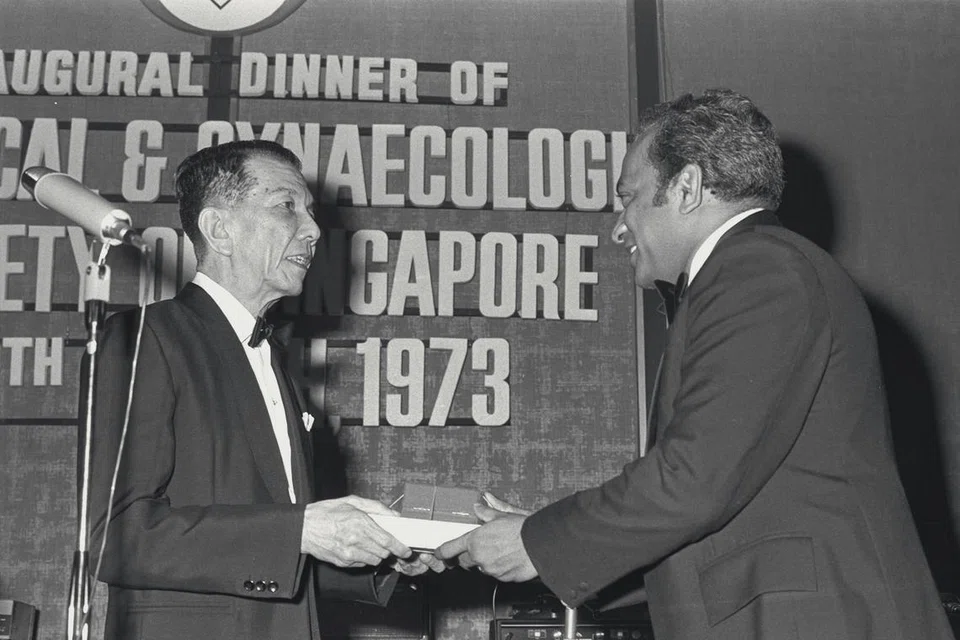
Dr Sittampalam Shanmugaratnam, more commonly known as Dr Shan Ratnam, was a professor and head of the Department of Obstetrics and Gynaecology (O&G) at the National University Hospital and a medical marvel, standing toe-to-toe, at times, with the former president Dr Benjamin Sheares.
Despite a nearly 20-year age difference, Dr Ratnam became a good friend and colleague of Dr Sheares.
He describes Dr Sheares as a very humble and patient man. “When others had created a mess, Dr Sheares would be called in, and all that you could see in him was a twinkle in his eye,” Dr Ratnam said about Dr Sheares in the book The Benjamin Sheares Story by K.C. Vijayan.
On Dr Sheares’ medical conduct, he said: “His dissections were always precise and right through the operative procedure; he would explain every step to his assistant.”
Dr Ratnam was not directly Dr Sheares’ student, but learned many skills through, even using Dr Sheares’ own developed procedure to push the boundaries of what seemed to be possible or socially accepted further in 1971.
In Rolf Olsen’s 1976 documentary Shocking Asia, Dr Ratnam explained how an “attractive woman” walked in for a consultation while he worked in a gynaecology clinic, and said she wanted a sex-change. After psychological treatment was to no avail, he used the Sheares’ Operation, a vaginoplasty or artificial vagina construction method pioneered by the former President, to perform one of the first sex-change surgeries in Asia.
Dr Ratnam is also largely known for work with in vitro fertilisation (IVF), aiding in the birth of Singapore’s first successful “test tube baby” in 1983. Fertility was his forte, as he also used grants to research and aid men with low sperm counts in 1986.
Aside from their parallels in the O&G field, Dr Sheares and Dr Ratnam’s slow death in their medical career and lives also shared similarities. As Dr Sheares’ health declined, Dr Ratnam had to ask him to stop his teaching duties, despite his pleading with him not to. Similarly, at the twilight of Dr Ratnam’s life, former health minister George Yeo had to ask him to stop operating.
Dr Ratnam continued to push for more advancements and education in the field till he passed away from pneumonia in 2001.
The Benjamin Sheares Story: From Pioneering Gynaecologist To Singapore President by K.C. Vijayan is available in selected bookstores, such as Kinokuniya, or as an e-book on websites like Read A Book by Alkem.