
Whether one is prepared for it or not, artificial intelligence (AI) is restructuring the global workforce at a speed that has outpaced nearly every forecast.
According to RationalFX, the global technology sector has eliminated 244,851 jobs in 2025 – and by early May this year, over 100,000 tech jobs were reportedly cut globally.
Singapore, as a small and open economy with no natural resources, has more skin in the game than most. Having spent decades deliberately engineering itself into a knowledge hub, it is now dealing with a technology that is unspooling by the second.
At the ATX Summit 2026, running from May 20 to 22, tech leaders from around the world gathered to offer their read on what is to come next.
Agentic AI
Unlike conventional AI that responds to individual prompts, agentic AI can execute multi-step tasks autonomously with minimal human input.
On the first day of the summit, Sanjay Gupta, the president of Google Asia Pacific, argued that the hype has largely caught up with reality. “Agentic AI is real and creating value for consumer businesses now,” he said.
Citing DBS Bank as an example, Mr Sanjay pointed out their AI-powered co-pilot for its customer service officers – a tool that transcribes queries in real time, searches the bank’s knowledge base and surfaces recommended solutions on the spot.
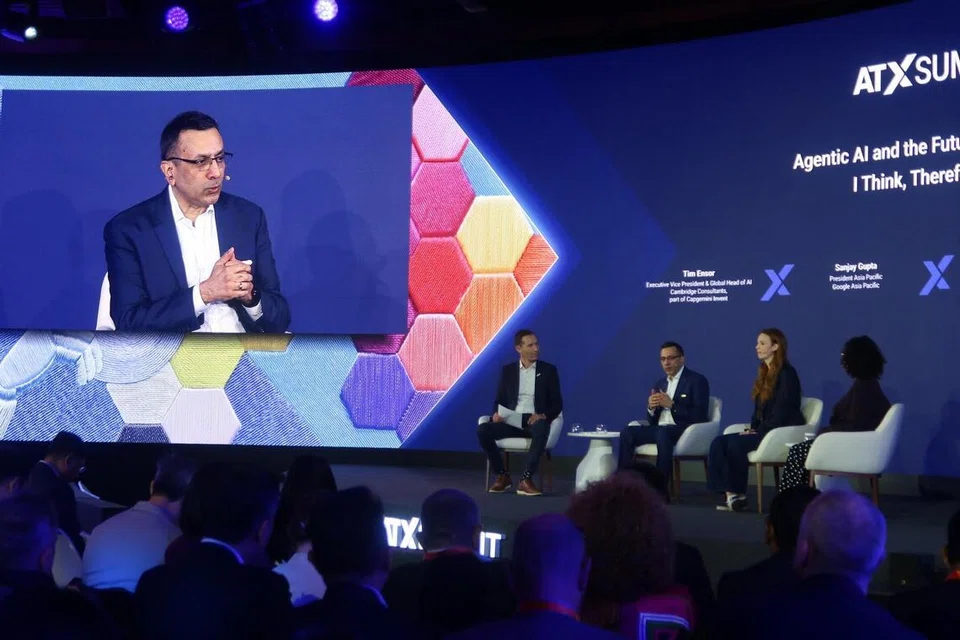
His more striking insight came from his own career. Before joining Google, Mr Sanjay ran Star and Disney’s media operations in India, a company of 3,000 employees. If he were building that business today, he said, the headcount would look the same on paper, but the workforce would not. Alongside those 3,000 people would sit many more AI agents, each supporting human employees the way a well-managed team would.
That shift demands the same rigour companies apply to their people – agents must be given the right data, policies and values to make sound decisions as well as be held accountable.
Embodied AI
If agentic AI is intelligence wired into the enterprise, the next frontier is coupling that intelligence to a physical body. This is embodied AI – systems in which artificial intelligence controls a physical form, such as a humanoid robot or autonomous vehicle, allowing it to perceive and act in the real world.
Om Nalamasu, the chief technology officer (CTO) of Applied Materials, a hardware company based in the heart of Silicon Valley, said that the industry’s progression runs roughly as follows – 2024 was the year of proof of concept, and mostly failed ones at that. 2025 was the year of the demo. 2026, where we sit now, is the year of the pilot – which is to say, the technology is real and moving fast, but it has not yet reached reliable deployment at scale.
“We have gone from whether we can build these systems to how we build them,” he noted, “and more importantly, how do we deploy them safely and reliably with the right governance models.”
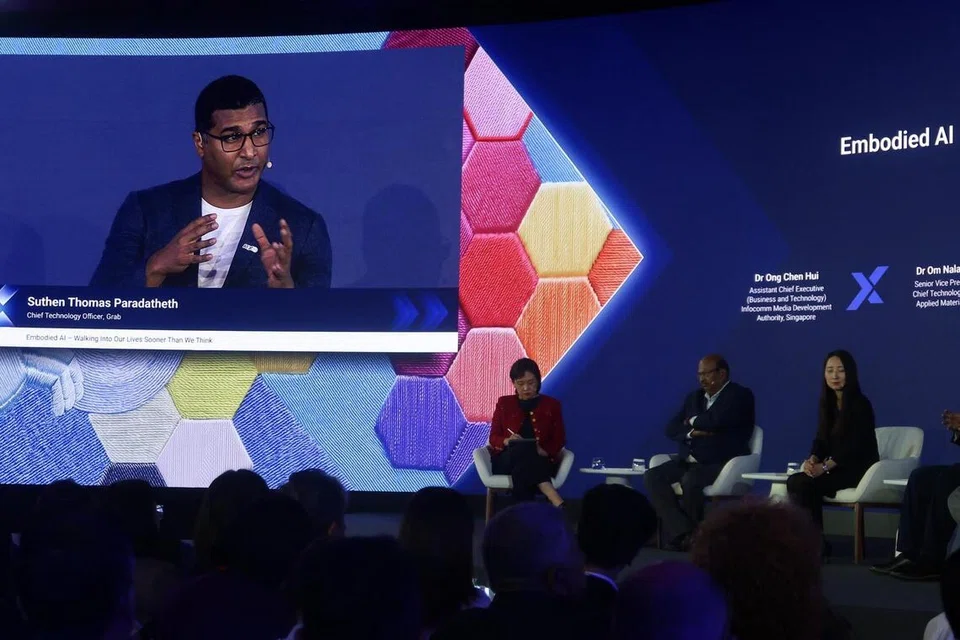
Suthen Thomas Paradatheth, CTO of Grab, offered an insider’s view. Grab, he explained, sees embodied AI as the next stage in its evolution as an internet platform.
In Punggol, Grab is already running a live autonomous vehicle (AV) pilot, the first service of its type in a residential area in Southeast Asia, with several thousand rides already completed.
But Mr Suthen was candid about what makes this category fundamentally harder to crack than anything Grab has built before. “If you write an internet application, you write it once, and then the acquisition of subsequent customers costs you next to nothing. With robots, every robot you build costs you money,” he said. These supply chain disruptions do not slow down a software update, but they do price you out of a fleet.
Suthen’s solution here is to “start with the idea of falling in love with the customer problem. Don’t fall in love with the solution.”
Becoming AI Native
CEOs are currently giving AI projects unusual latitude, but that window is finite.
“There’s a lot of budget now, but they’re going to ask you what outcomes you achieve,” said Rameez Ansar, CEO and co-founder of digital telco Circles.
That pressure pushes companies toward use cases that deliver quick returns, while simultaneously demanding the courage to change entire processes rather than just automate the broken ones.
To combat this, “I try to talk about business problems and ban the word AI and get people to (think about) how to solve the problem. I think you have a better chance of coming up with a solution that’s AI-enabled – and with a tool that exists, that might just solve your problem,” Mr Rameez added.
Prakash Arunkundrum, HP’s chief strategy and transformation officer, echoed this, urging companies to think carefully about their hybrid AI strategy as well.
AI in Developing Nations
If the preceding conversations were about what AI can do, Karan Bhatia, Google’s global head of Government Affairs and Public Policy, turned attention to who gets to benefit from it.
When asked whether developing countries – unburdened by legacy systems – are better placed to leapfrog into AI-optimised governance, he said that democratising this technology in these countries is absolutely imperative.
He spoke about his father, who was born in a small village in Uttar Pradesh, where development came only through access to better agriculture, communications and healthcare.
The transformative potential of AI to deliver change at that scale, he argued, is enormous – and squandering it would be a historic failure.
The risk of misuse is real, he acknowledged, but so is the risk of “missed use”. A digital divide was already a concern for the last generation of technology. Allowing it to harden into an AI divide, he warned, “would really be a tragedy”.
Anoop Sagoo, CEO of Accenture (Southeast Asia), remarked while moderating a panel: “We live in a world where AI does the work for you, and you can lay back, go to conferences like these, sit on panels, transcribe what you hear and at the end of the day, ask AI to give you a summary.”
It was not lost on anyone in the room that the technology they were there to champion also has downsides that remain very much unresolved.