
In a bid to analyse the impact of South Asian youth in their early thirties and below, also known as Generation Z (Gen Z), the Institute of South Asian Studies (ISAS) at the National University of Singapore (NUS) conducted a wide-ranging online seminar across six panels from March 23 to 24.
Titled “Gen Z-Led Regime Changes Across South Asia,” the event saw over 20 academics offering early glimpses into real-time analyses of ongoing events in countries such as Nepal, Bangladesh, and Sri Lanka following extra-electoral regime changes.
In his opening remarks on the first day of the conference on March 23, Associate Professor Iqbal Singh Sevea, Director of ISAS, described the youth at the heart of various regime change movements as “a powerful demographic force” and “a generation deeply connected through digital platforms, increasingly aware of global standards of governance and opportunity.”
Pointing out that these youths are “often frustrated by limited avenues for meaningful political and economic participation,” he noted that these frustrations have helped generate new forms of mobilisation that challenge established political elites and institutional arrangements.
“In Sri Lanka, Bangladesh, and Nepal, large-scale protests led to the resignation or removal of sitting political leaders,” Assoc Prof Sevea said. “While the immediate triggers varied – from severe economic hardship and energy shortages to student protests and political grievances – these events point to deeper structural transformations within South Asian societies.”
Participating scholars and practitioners hailed from a wide range of disciplines, including political science, economics, history, sociology, international relations, anthropology, and media studies.
Panellists explored at length whether these movements signal the emergence of new political actors and ideas or ultimately reproduce existing structures of power.
The conceptualisation of the movements, the deeper drivers of dissent, the role of ideology and anti-corruption politics, and the ways in which decentralised and digitally coordinated mobilisation is reshaping political participation were also discussed.
Additionally, panellists examined gender as an important cross-cutting theme throughout the discussions, highlighting how gendered experiences and perspectives shape protest and political change.
Assoc Prof Sevea added: “The recent uprisings invite us to reflect on the limits of existing political structures and on the aspirations of societies seeking more responsive, inclusive, and legitimate systems of governance.”
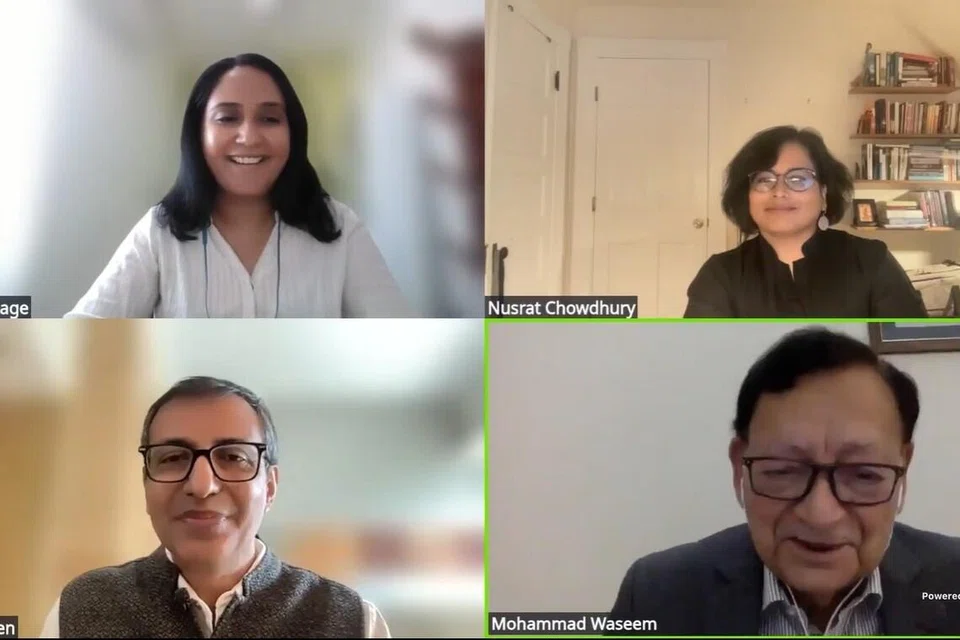
Speaking with tabla! Professor Mohammad Waseem, Professor Emeritus at the Mushtaq Ahmad Gurmani School of Humanities and Social Sciences at Pakistan’s Lahore University of Management Sciences, said that Nepal outstripped Sri Lanka and Bangladesh in the extent of its transformation from a legacy of dynastic rule, followed by a series of ruptures.
Regarding the ideological leanings of the protestors, Dr Rajni Gamage, Research Fellow at ISAS, remarked that while the governments that came into power may have had certain ideological affiliations, the protest demands themselves were not strongly ideological in terms of the traditional political left–right divide.
“Rather, the protesters’ main demands centred on their economic aspirations being met. What they perceived as the main obstacle to this was a corrupt political class that had remained in power for a long time and was willing to use force to maintain its position. The role of ideology appears to be declining in its hold on popular imaginations,” Dr Rajni said.
What many citizens, including young people, appear to want are governments capable of ensuring a sufficient degree of economic security in times of high global volatility, she added.
Noting the rise of personality politics among youth in Tamil Nadu, Professor Arun Kumar, a retired professor of Economics from India’s Jawaharlal Nehru University, said that frustrated youths are turning toward hero worship, which then transforms into political support.
With Tamil Nadu’s elections set for 23 April, the impact of Gen Z on the results remains to be seen.
“They have poor education and weak skills. So, they lack proper employment but have high aspirations which cannot be fulfilled, and as a result, they are frustrated,” Prof Kumar noted. “They look for a hero who can overcome all the difficulties and achieve success. What they want to do, the hero can do.”