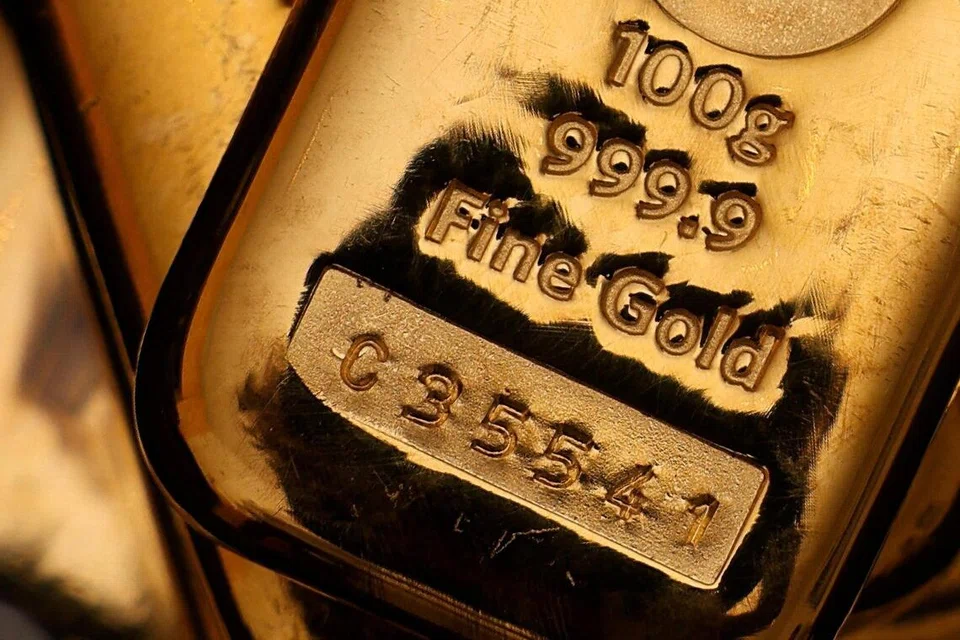
A DBS Bank survey found that 50 per cent of the central banks polled are more interested in tapping Asian gold hubs, drawn by new state-backed infrastructure for storing and trading the precious metal.
The survey, commissioned by the bank and conducted in September by independent market research firm Kantar, was released on Nov 10. Slightly more than half of asset managers and banks expressed similar sentiment.
However, as only a quarter of central bank respondents said they were actively evaluating Asia-based gold hubs for storing official reserves, implementation might still be a distance away.
Central banks are large buyers of gold, held domestically and overseas, to diversify their reserves and guard against inflation and other risks.
Li Zhen, head of foreign exchange and precious metals for global financial markets at DBS, said: “Trusted infrastructure, modern clearing and settlement, and financial product innovation are transforming access to gold.
“As the market evolves, investors and institutions will increasingly rely on trusted partners to provide the safeguards and certainty needed to participate with confidence.”
Although vaulting and storage infrastructure for precious metals has long existed in major financial centres like Singapore and Hong Kong, DBS said in a report drawing on the survey’s findings that infrastructure linked to the government or stock exchanges has been growing.
The report, Gold In An Age Of Transformation, also noted that Singapore and Hong Kong have intensified their efforts to establish themselves as leading regional gold hubs.
It added: “Hong Kong is leveraging its role as a gateway to mainland China, while Singapore continues to build on its strengths as a financial and wealth management hub, underpinned by its reputation for stability and sovereign neutrality.
“Recent initiatives to enhance clearing, settlement and custody capabilities reflect a broader ambition to support the growing concentration of regional demand and investment activity.”
Singapore set out plans in March to boost its position as a gold trading centre, as investor interest in storing and trading the commodity here grows.
These include developing gold-related capital market products, establishing internationally aligned standards for vaulting and logistics, and building a clearing system to support over-the-counter trades of gold bars.
Banks in Singapore are also reportedly making moves to expand their vaults. Bloomberg recently reported that DBS, South-east Asia’s largest lender, increased its vaulting space in 2026 in response to growing demand from its private wealth and institutional clients.
It also reported that OCBC Bank had approached precious metal storage providers about securing more space, citing anonymous sources.
Meanwhile, Hong Kong is working to expand its total gold storage capacity by more than 10 times to over 2,000 tonnes by 2030.
The city is also scaling its infrastructure to support larger trading volumes, with a central clearing and settlement system for gold to be launched in the first quarter of 2027.
DBS chief economist Taimur Baig said developing trusted market infrastructure will be critical as Asia’s role in the gold market grows and new investment channels emerge.
He said: “Singapore is well placed to support this evolution, building on its strengths in regulation, institutions and financial market infrastructure.”
The survey also found that most central banks and private financial institutions expected gold exchange-traded funds or derivatives to be poised for the strongest growth over the next 12 months.
Notably, tokenised gold was viewed among investments with the strongest growth potential, even though it accounts for only around 4 per cent of the aggregate gold exposure across surveyed financial institutions.
Tokenised gold refers to physical gold that has been turned into a digital token, which can be traded electronically.
“With awareness (of tokenised gold) already relatively widespread, the gap between awareness and adoption suggests there remains room for institutional participation to deepen as the ecosystem develops,” the DBS report said.
The lender announced in June that it will offer tokenised physical gold to retail customers as demand for the precious metal increases.
Global gold demand surpassed 5,000 tonnes in 2025, reaching a record US$555 billion (S$710 billion) in value, according to the World Gold Council. Asia accounted for more than half of physical bar and coin investment, as well as jewellery demand. THE STRAITS TIMES