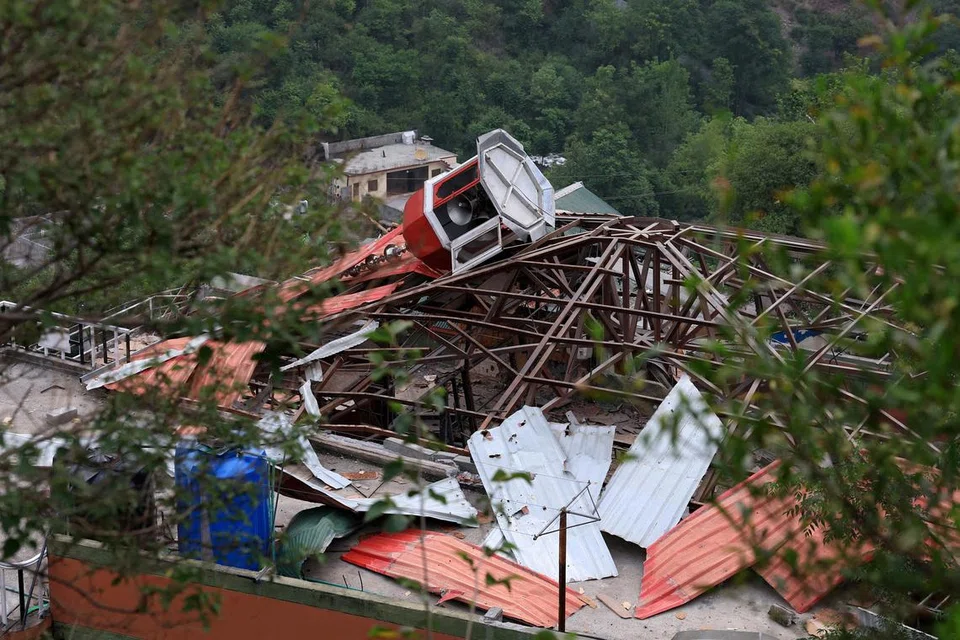

A loud explosion rocked Pakistan’s eastern city of Lahore on Thursday morning, just a day after India carried out airstrikes on what it called “terrorist infrastructure” deep inside Pakistani territory.
The blast, which occurred near Walton Road and reportedly close to Walton Airport, sparked immediate alarm as videos of smoke plumes and panicked residents began circulating online.
Pakistani authorities claimed to have shot down an Indian drone, though the claim remains unverified.
The incident marks a chilling new chapter in a rapid escalation of hostilities between the two nuclear-armed rivals, following the deadliest military exchange between India and Pakistan in decades.
On Wednesday, India struck nine targets across Pakistan and Pakistan-administered Kashmir, in retaliation for a terrorist attack in Pahalgam, Kashmir, that killed 26 civilians – mostly Indian Hindu tourists – two weeks earlier.
The question now gripping both nations and the international community: Will this spiral into an all-out war?
Pakistan claims that India’s May 7 airstrikes and subsequent shelling killed 31 civilians and wounded dozens more, including a three-year-old girl allegedly killed in a mosque.
India, meanwhile, reported 13 civilian deaths due to Pakistani retaliatory shelling.
While cross-border exchanges of fire are not new, what distinguishes this round is the unprecedented depth of India’s strikes into Pakistan – up to 30 kilometers beyond the Line of Control (LoC).
Islamabad has denounced the strikes as “an act of war,” with Prime Minister Shehbaz Sharif vowing revenge. “We will avenge our dead,” he declared in a televised address.
Yet, Pakistan’s Defence Minister Khawaja Muhammad Asif has also signalled a willingness to de-escalate, telling The New York Times that diplomacy may still have a path forward.
India, for its part, has framed its action – dubbed “Operation Sindoor” – as “measured and proportionate.”
Foreign Secretary Vikram Misri emphasised that the strikes targeted terror groups like Lashkar-e-Taiba and Jaish-e-Mohammed, which India accuses Pakistan of sheltering.
As a sign of how seriously both governments are treating the situation, India conducted blackout and emergency evacuation drills in border cities including Amritsar, home to the revered Golden Temple.
In Pakistan’s Punjab province, hospitals and civil defence authorities remained on high alert even as schools reopened in other regions.
Pakistani officials also claimed to have downed five Indian aircraft – an assertion India has dismissed as misinformation.
Still, the air and ground operations across the LoC continued overnight with artillery and small arms fire exchanged in regions like Kupwara, Uri and Akhnoor.
The United Nations Security Council, along with global powers including China and the United States, has called for restraint.
US President Donald Trump described the situation as “a shame,” and said he hopes the countries can resolve their issues and offered to mediate.
Iran’s Foreign Minister Abbas Araghchi is currently shuttling between New Delhi and Islamabad in a quiet effort to reduce tensions.
“The ball is now in Pakistan’s court,” said Mr Harsh V. Pant, vice-president of the Observer Research Foundation in India. “Whether the situation escalates depends on how Islamabad chooses to respond.”
Across the border, Dr Qamar Cheema, executive director of the Islamabad-based Sanober Institute, warned: “India has attacked Pakistan’s mainland. Pakistan will strike back with full force.”
In India, Operation Sindoor has been widely applauded, especially for its symbolism. The name refers to the red vermillion worn by married Hindu women – a nod to the 25 widows of the men killed in Pahalgam.
The press briefing on the operation, led by two women officers alongside Foreign Secretary Misri, has been lauded for its empowering optics.
In Pakistan, however, the mood is grim and defiant. Images of civilian casualties, including of the three-year-old girl, have triggered outrage.
Professor C. Raja Mohan of the National University of Singapore warns that global diplomacy will play a critical role in what happens next. “Do world powers act now to prevent Pakistan from retaliating, or only after it does?” he asked.
Both countries possess nuclear arsenals, making the stakes of miscalculation dangerously high.
Military analysts say that any misstep – from a stray missile to an accidental incursion – could lead to a rapid escalation neither side wants but may be unable to avoid once begun.
Still, past precedent offers some hope. After India’s 2016 “surgical strikes” and the 2019 Balakot bombing, both countries managed to back down.
AFP, Reuters