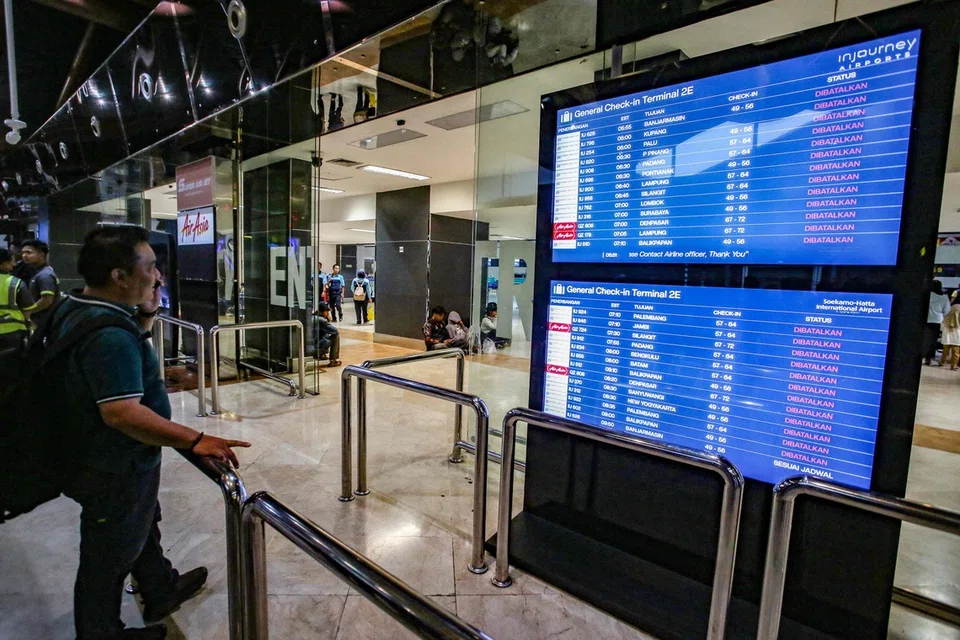
Flight disruptions caused by volcanic ash from Anak Krakatau stretched into a second day on Sept 7, with seven Indonesian airports, including Jakarta’s main international gateway, due to remain closed until at least 6pm local time, or 7pm Singapore time.
The seven airports are: Soekarno-Hatta and Halim Perdanakusuma in Jakarta, Radin Inten II and Muhammad Taufiq Kiemas in Lampung, Husein Sastranegara in West Java, and Budiarto and Pondok Cabe in Banten.
An eighth airport, Atung Bungsu in South Sumatra, which had also been closed because of the ash, resumed normal operations at 9am on Sept 7, the Transport Ministry said.
Transport Minister Dudy Purwagandhi said the decision to keep the seven airports closed was based on the latest data from Indonesia’s meteorological agency, BMKG.
Tests for volcanic ash were being conducted every 30 minutes as the authorities continued to monitor conditions.
Changing wind directions at different altitudes meant ash was continuing to linger around airports near Anak Krakatau, making it difficult to predict when they could safely reopen, Mr Dudy said.
“We cannot determine or ensure whether an airport is safe from the spread of ash,” he told reporters, adding that tests were also being conducted at other airports around the affected area.
Anak Krakatau, located in the Sunda Strait between Java and Sumatra, began erupting on Sept 4.
Volcanic ash was detected at Soekarno-Hatta early on Sept 6, prompting the airport to be closed.
The disruption to flights has grown considerably since Sept 6.
Mr Dudy said that about 2,300 flights and 263,000 passengers had been affected as at 9am on Sept 7, compared with about 1,700 flights and 170,000 passengers the previous day.
The authorities are now preparing for a rush of passengers once operations resume, including travellers stranded at airports overseas in places such as Singapore.
Mr Dudy said airlines were being encouraged to use alternative airports at Kertajati, Semarang, Surabaya, Yogyakarta and Solo to help ease the expected congestion.
Passengers whose flights are switched to these airports will be provided with free ground transport such as buses and trains.
Eight buses had already been prepared to take passengers to Kertajati on the morning of Sept 7, he said.
Airports also need to be cleaned before flights can resume. Mr Dudy said it took about two hours overnight to clear ash from runways, taxiways and aprons, and further cleaning could be needed if ash continued to fall.
Aircraft would have to be inspected to ensure that ash had not entered their engines before being allowed to operate.
Beyond aviation, the eruption is raising health concerns across areas exposed to the ash.
Indonesia’s Health Ministry said on Sept 7 that about 3.3 million elderly people are at risk of health problems from the volcanic ash.
The ministry said the fine particles could penetrate deep into the respiratory system and aggravate conditions such as asthma and chronic obstructive pulmonary disease, while also causing eye and skin irritation.
The authorities have advised residents in affected areas to wear N95 or KN95 masks and protective glasses outdoors, keep ash from entering their homes and dampen ash before cleaning it to avoid stirring particles into the air.
Schools in Jakarta and parts of Lampung and Tangerang have also switched to remote learning because of concerns over children’s exposure to volcanic ash.
Despite the widespread aviation disruption, ferry services across the Sunda Strait between Java and Sumatra continue to operate, Mr Dudy said.
Passenger numbers have fallen, however, with many travellers apparently choosing to cancel their journeys rather than switching from air to sea transport.
Anak Krakatau remains at Level III, or Siaga, the second-highest alert level, with people prohibited from going within 3km of the volcano.
The authorities have warned that further eruptions remain possible.
THE STRAITS TIMES