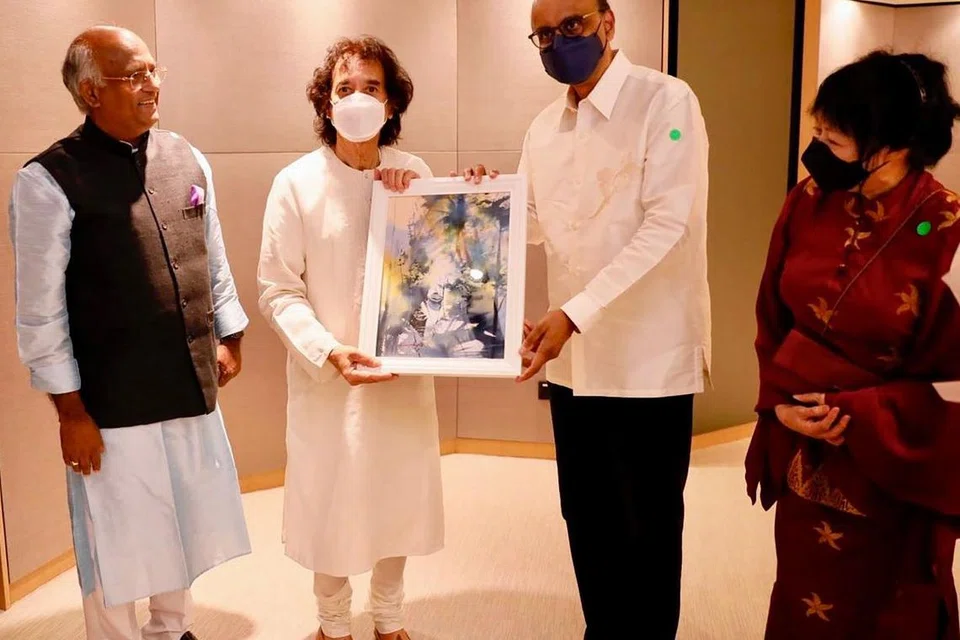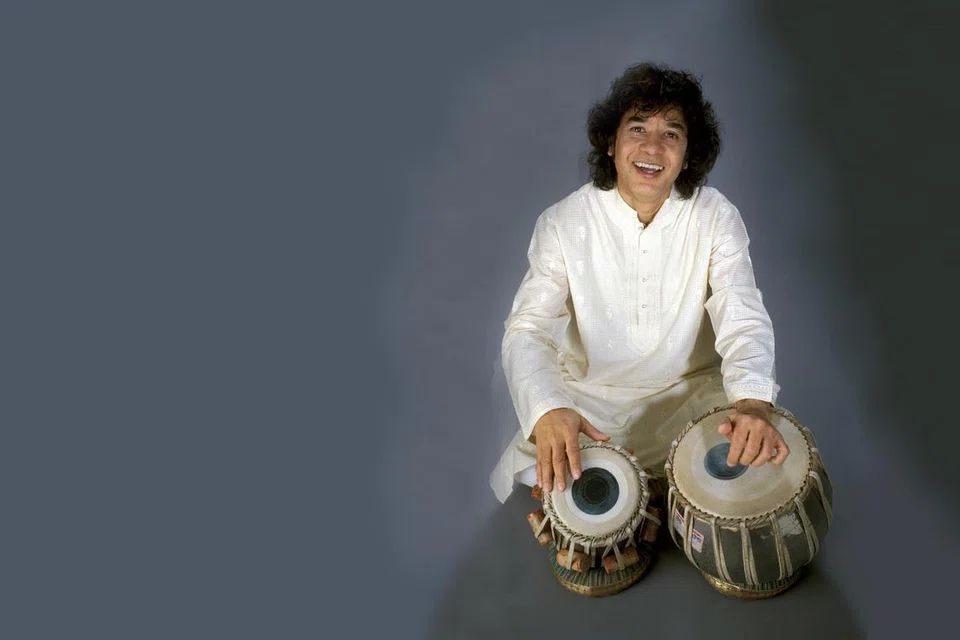
Musically inclined Indians living in Singapore still rave about the brilliant music that Zakir Hussain produced on the tabla during the Triveni concert at the Esplanade on Aug 15, 2022.
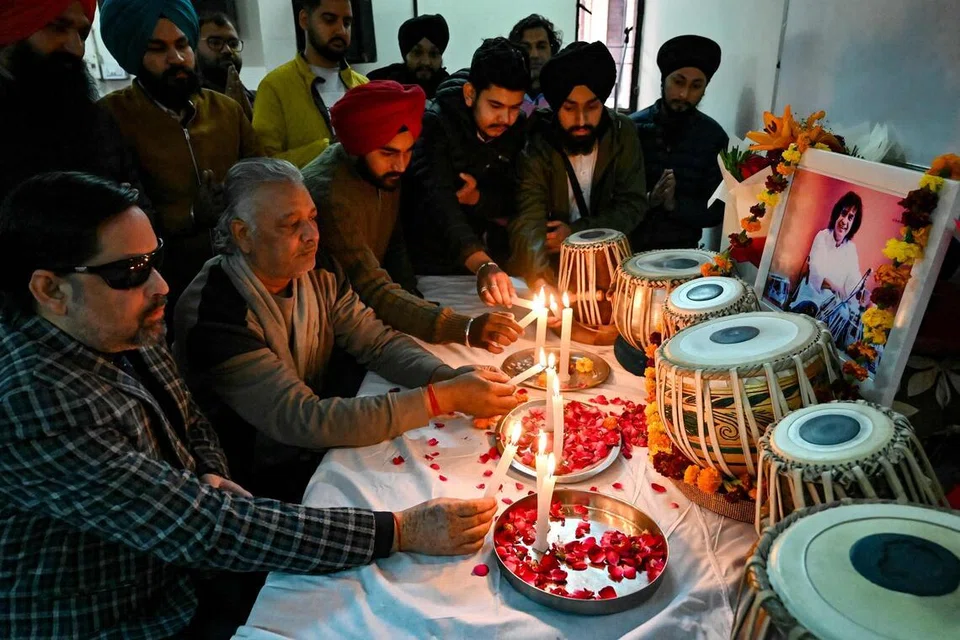
Zakir, whose “dancing fingers” made him one of the greatest ever tabla players, died aged 73 in a San Francisco hospital on Monday due to complications from chronic lung disease.
At the Triveni show, on stage with violin virtuoso Kala Ramnath and Saraswati veena exponent Jayanthi Kumaresh, he took the art of playing the tabla to remarkable heights – beyond its classical traditions.
“Triveni is the mythical site of the union of the sacred rivers Yamuna, Ganga and Saraswati in India, and the name aptly represented the confluence of the varied music strains the three maestros brought to the collaboration,” said Mr K.V. Rao, president of the Singapore Indian Fine Arts Society (Sifas), which organised the event.
“A hallmark of Zakirbai’s iconic career has been his groundbreaking work featuring brilliant musical dialogues between Hindustani (North Indian) and Carnatic (South Indian) music. He seamlessly stitched North and South Indian rhythm traditions to provide a bridge for veena and violin to meet. Triveni was a fluent, joyous and entirely original conversation, a music experience of the highest order.”
President Tharman Shanmugaratnam, who attended the event, was so enthused by the Triveni concept that he once co-related it to the “collective capability” that could spur India’s growth.
Speaking at the inaugural Arun Jaitley Memorial Lecture in July 2022, at the invitation of Indian Prime Minister Narendra Modi, Mr Tharman, who was then the deputy prime minister, said: “Listening to an outstanding musical performance called Triveni... I realised it was not about their individual genius, it was about each of them listening to the other, teasing, co-creating and co-empowering. It was a collective genius.”
Applying this idea to India as a nation, he explained: “India has no lack of individual top talents. But what it has to develop is that collective capability, co-empowerment, co-creation, and having a high degree of trust among each other. Co-empowerment and co-creation between the government and the private sector, between the centre and the states, and the panchayats at the district and village level, and across caste, class, faiths, white and blue collar, and gender.
“Develop this collective capability for the next 25 years. That is India’s promise. And if India succeeds, as I believe it will, it will not just uplift one-fifth of the world’s population, it will also show the way for many others.”
Mr Rao, 64, believes Zakir was pivotal in giving Indian music overseas exposure – as he collaborated with musicians of all genres, including African drummers, western guitarists and Latin and Caribbean percussionists.
The tabla maestro is most famous for his 1973 musical project with English guitarist John McLaughlin, violinist L. Shankar and percussionist T.H. “Vikku” Vinayakram that brought together Indian classical and elements of jazz in a fusion hitherto unknown.
The master collaborator has worked with The Beatles, Van Morrison and The Grateful Dead, among others. He has scored music for Francis Ford Coppola (Apocalypse Now), Ismail Merchant (The Mystic Masseur) and Bernardo Bertolucci (Little Buddha). His discography cannot be contained on a page.
Zakir first played in Singapore in 1973. He was on his way to Perth for a music festival and stopped by to play at a small hall. After that, he returned to the Republic several times, and the Esplanade became one of his favourite places to perform “because of its amazing theatre design and acoustics”.
“Like Ravi Shankar with the sitar, Zakirbhai took tabla to different corners of the globe,” said Mr Rao, who first met Zakir in 1996. “He was exceptionally humble, compassionate and daring. He respected co-artistes and was very supportive of them.”
A long-standing friend of Sifas, Zakir gave several lectures to its students and teachers on the finer points of music.
“He was extremely well-read and articulate. He could talk with authority on any subject,” said Mr Rao. “He endeared himself to everybody with his simple mannerisms and humour. He was very mature, very philosophical; a world citizen.”
I interacted with Zakir for more than an hour at the Mahatma Gandhi Memorial Hall during the Sifas press meet before the Triveni concert, and later at the Indian High Commissioner’s residence. I found him to be friendly and engaging, with lots of stories to tell. He was also full of energy and fit, bounding up stairs with agility.
His answers to my questions were rather elaborate, and I was forced to leave out chunks while writing my piece in tabla! titled “Tabla maestro breaks barriers” (Aug 19, 2022) – about the Triveni concert.
When I asked him what the tabla! publication meant to him, he said: “The paper types the words out in a rhythm that spells a connection to an instrument called tabla.
“The tabla is not just a drum but a world of wondrous discovery, knowledge and joy. These elements are completely and affectionately reproduced in this newspaper called tabla!”
Born on March 9, 1951, in Mahim, Mumbai, Zakir was the eldest son of Ustad Allarakha, one of history’s most iconic tabla players.
Zakir’s journey, from a child prodigy to an internationally celebrated percussionist, was a masterclass in balancing tradition and innovation. He lived in the United States for much of his life – mostly in California.
The New York Times, in reviewing the artiste’s performance at Carnegie Hall in 2009, wrote: “Zakir Hussain, the peerless Indian tabla player, favours an impish strain of virtuosity. He’s a fearsome technician but also a whimsical inventor, devoted to exuberant play. So he rarely seems overbearing, even when the blur of his fingers rivals the beat of a hummingbird’s wings.”
Music for Zakir was not just a career but a spiritual journey – a way to connect with people, traditions and cultures across the globe.
Mr Ashutosh Thakur, an assistant professor of economics at the Lee Kuan Yew School of Public Policy who attended annual workshops of Zakir since 2003, said: “Zakirbhai showed us how to surrender to art and tradition by always being a student, how to respect one’s elders, contemporaries and juniors alike, and also how to keep innovating by tastefully and musically challenging the sometimes overbearing shackles of tradition.”
To Mr Thakur, a consummate tabla player himself, Zakir was the most complete performer he had ever seen.
“Every single audience member, regardless of age, culture, race, ethnicity and musical background left every single performance of his completely awestruck and convinced that they had just witnessed something truly magical,” said Mr Thakur.
“Every time Zakirbhai played, he would have a fresh take; he would find new expressions and new rhythmic ideas.”
Zakir’s only other known student in Singapore, Vimal Venkatram, was too distraught to speak to tabla!. On Wednesday, he was on his way to San Francisco to attend his mentor’s funeral.
Zakir leaves behind his wife Antonia Minnecola, whom he married in 1978, and children Isabella Qureshi and Anisa Qureshi.