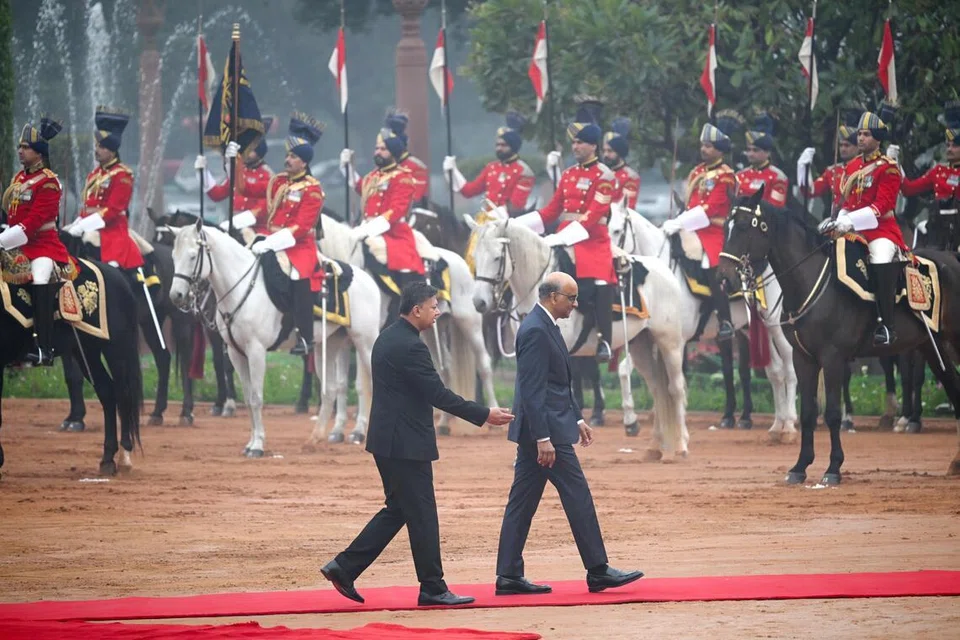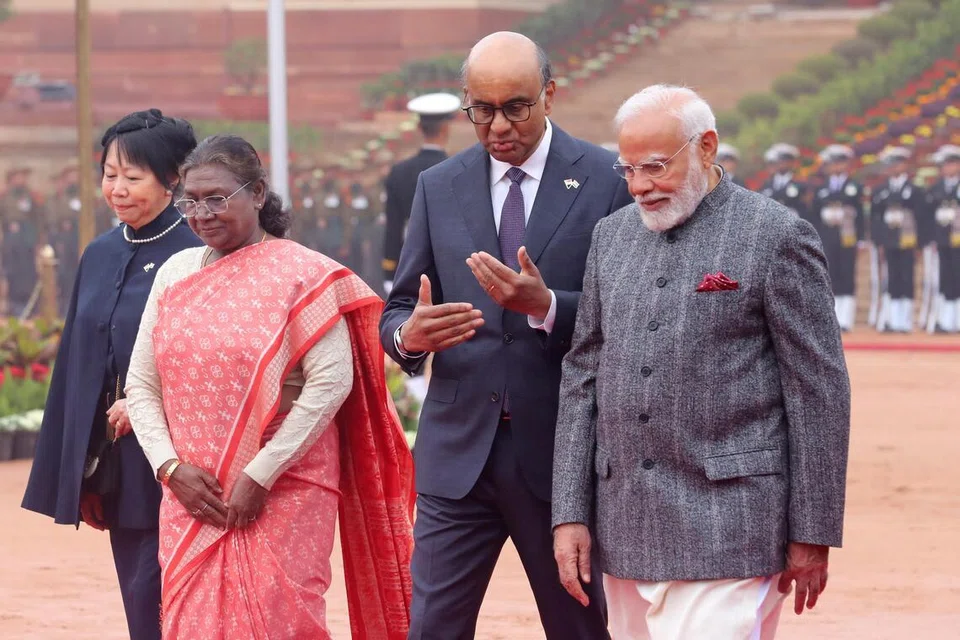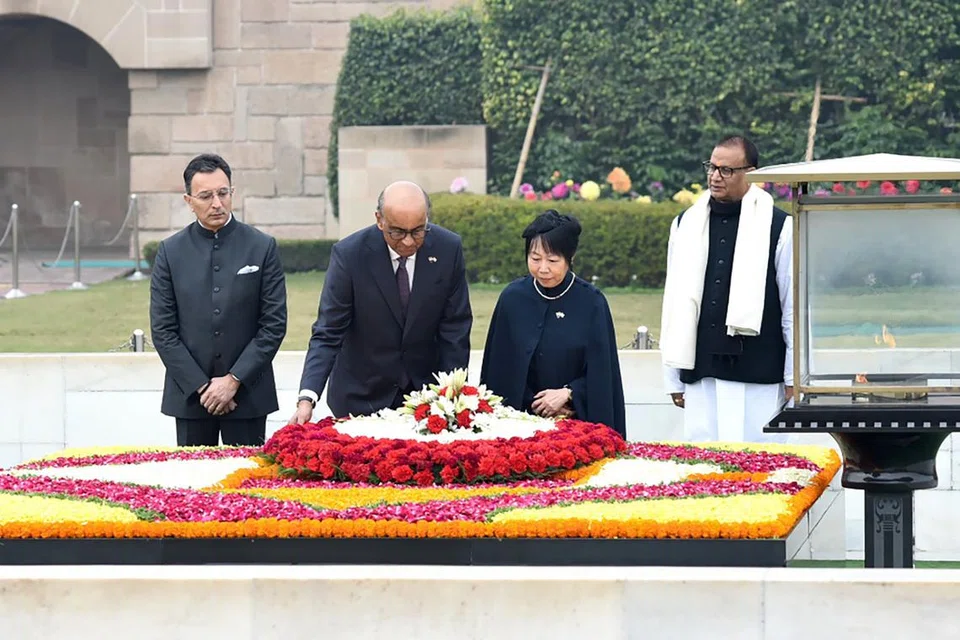
Singapore and India are natural partners and Singapore has invested in India’s ‘Viksit Bharat’ ambitions to become a developed country by 2047, said President Tharman Shanmugaratnam after receiving a ceremonial welcome at the Indian president’s official residence, Rashtrapati Bhavan, in New Delhi.
Mr Tharman is on a five-day state visit to India to mark 60 years of diplomatic relations between the two countries.
His motorcade was received by a procession of riders on horses and gun salutes, as he was welcomed by Indian President Droupadi Murmu and Prime Minister Narendra Modi.
The Indian government’s Viksit Bharat @2047 vision aims to turn India into a developed economy with a GDP expanding from $3.4 trillion to $30 trillion by 2047.
Mr Tharman emphasised the importance of exploring opportunities in the digital space, with particular focus on data sharing and financial collaboration.
One prospect was the potential establishment of a data corridor between Gift City in India and Singapore. This corridor would enable financial institutions in both countries to exchange data securely and efficiently, fostering greater collaboration in the financial sector.
“Sustainability is a major priority for both India and Singapore,” said Mr Tharman, adding that both countries are exploring renewable energy corridors to enhance energy cooperation, which would further strengthen their shared commitment to combating climate change.
“I am optimistic for our relations with India because our leaders see eye to eye,” he said, adding that the eastern states are a priority for the Indian government.
Mr Tharman will be leading a delegation that includes senior leaders from business and academic institutions, representing nine organisations to the eastern state of Odisha as part of his state visit.
The delegation consists of representatives from ST Engineering, ITE Education Services, Sembcorp Industries, Keppel, Capitaland, Surbana Jurong, PSA India, Energy Research Institute @ Nanyang Technological University and Global Finance & Technology Network.
“We go with our eyes open to learn as much as we can and see where there can be fruitful opportunities for collaboration,” Mr Tharman said.
He will also visit the World Skills Centre in Odisha, a place he said has “great promise” and which holds “special significance among the eastern states”.
“The people (of Odisha) are hungry. They have got natural advantages and natural resources,” he said.
As part of his visit, he met around 200 overseas Singaporeans living and working in India on Jan 15. Speaking to them at the reception marking Singapore’s 60th year of independence, he said we need to understand the opportunities in different parts of India – because there will be opportunities for Singaporeans to add value with their skills and experience wherever they go.
And in engaging with India’s diversity, do so with mutual respect, he said, adding, “Whatever we do in India, do it with some humility”.
“This is a continent that has its own deep history, depth of culture, and they’ve got ways of doing things that we can learn from as well – so it’s a two-way learning relationship,” Mr Tharman said.
“When we as Singaporeans, businesses, entrepreneurs, professionals and individuals, engage with India, we’ve got to appreciate and immerse ourselves in India’s diversity. That’s a tremendous strength of India, and we’ve got to get to know it.”.