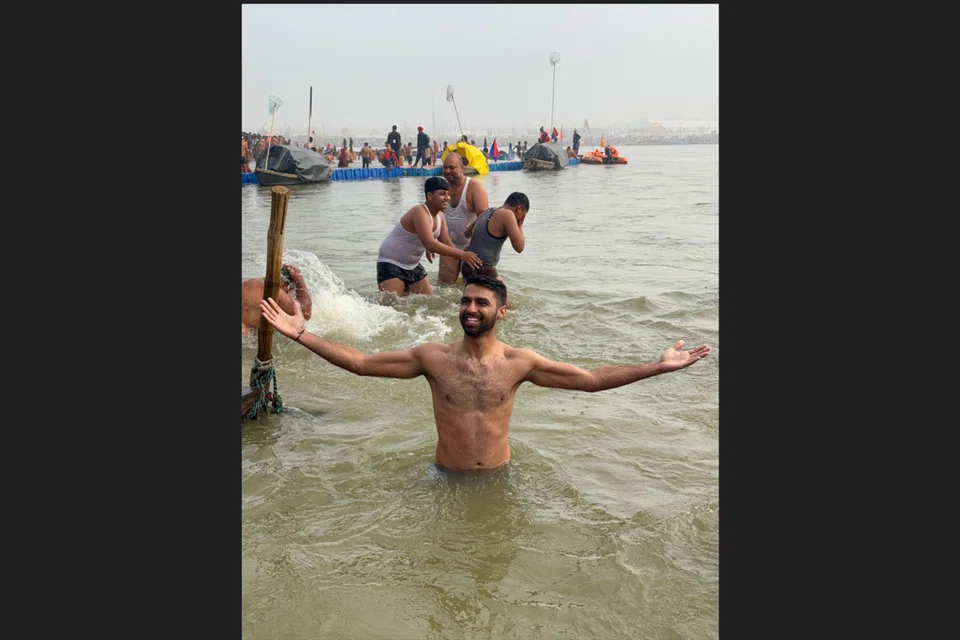
On Jan 16, when more than four million people took a holy dip at the Maha Kumbh Mela in Prayagraj, Uttar Pradesh, one among them was a Singaporean.
Content creator Avi Dixit was fulfilling a wish that about 400 million people from around the world are having this year.
Hindu devotees believe that taking a dip in the waters at the confluence of the sacred rivers Ganga, Yamuna and the mythical Saraswati during the Maha Kumbh, or Great Pitcher Festival, that occurs every 12 years, would deliver salvation from the cycle of birth and death, in addition to the absolution of sins.
This year’s Maha Kumbh, which started on Jan 13 and ends on Feb 26, is extra special because the sun, moon, Jupiter and Saturn are in alignment after 144 years.
“It was incredible to take a dip at the world’s largest religious festival because there are thousands doing it with you and the atmosphere is electric,” said Mr Dixit, who is also a member of the Singapore cricket team.
“I’m the only one in my family who has had the privilege to do this. Obviously, it means a lot to wash your sins away. The experience itself and how it was managed was unbelievable.”
Usually, during the Maha Kumbh, millions of people jostle daily to take a dip in the “Triveni Sangam”, the confluence of the three rivers. The 25-year-old received “special treatment” as he was flown to Prayagraj as a guest of India’s Ministry of External Affairs.
“They reached out to me on Jan 1,” said Mr Dixit, who was born in Delhi but moved to Singapore in 2011 with his parents and brother. “I was like yeah, absolutely. I was selected because I have a large social media following in South-east Asia and globally, and the MEA wanted me to help people know about what’s happening in India.”
Mr Dixit, who goes by @avidixit10 on Instagram, has played cricket at the South-east Asian Games, Asian Games and in World Cup qualifiers. He has 520,000 followers on Instagram, 1.4 million on TikTok and 500,000 on YouTube. He went to Prayagraj along with 20 content creators of Indian origin from 10 countries, including Malaysia, Trinidad and Tobago, Fiji and Mauritius.
“It was a 20-minute boat ride to the Triveni Sangam. It was very cold (9 deg C), but the water actually felt a bit warmer. Even then, only five from our group took the dip,” said Mr Dixit, who studied politics, philosophy and economics at Yale-NUS.
“The water was waist deep, and the rule is you either dip three times or seven times. I chose to do it three times. I spent a solid 10 minutes at the Triveni Sangam.”
Mr Dixit said the experience was a refreshing one, “because so many people around you are doing the same thing, and they’re all enjoying themselves”.
“I felt rejuvenated. A lot of people were praying loudly... it was a surreal experience.”
In all, Mr Dixit spent 21 hours at Prayagraj, during which he also visited two akharas (religious centres that are the custodians of spiritual practices and rituals at the Maha Kumbh).
A mix of religion, spirituality and tourism like no other in India, the Maha Kumbh, is a test in crowd management for authorities as the visitors stay in more than 150,000 tents set up across 4,000 hectares, or the size of 7,500 football fields.
Mr Dixit, who also visited Odisha as part of the MEA tour, said the organisation was excellent.
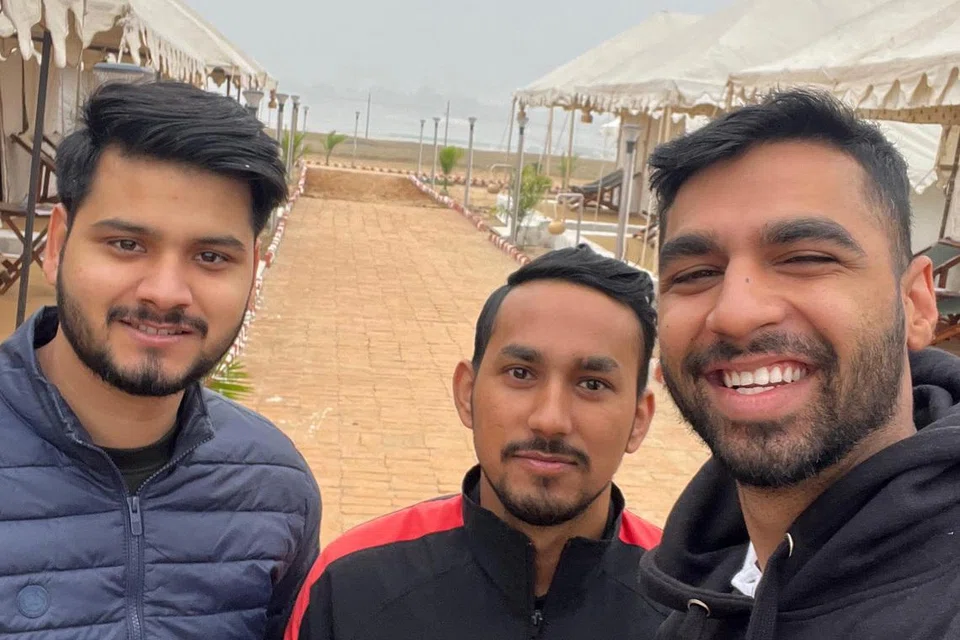
“From the airport to the Tent City, a one-hour drive, the journey was seamless,” he said. “The security was good, and the Tent City itself was like a five-star resort, with a TV, heater, chairs, two beds and bathroom facilities.
“As you drive across the bridge that leads to the Maha Kumbh grounds, you see rows and rows of tents on both sides of the river... it’s unbelievable.
“It’s also no joke that 400 million people will be at the mela. It shows the power of religion, the power of people coming together for an event.”