

MONOLISA
When aerospace firm Equatorial Space Systems co-founder Praveen Ganapathi Perumal was 12 years old, his older brother handed him a science fiction novel that would change his life.
The book, Rendezvous with Rama by Arthur C. Clarke, tells the story of a group of explorers who intercept an alien spaceship entering the Solar System.
“The book was a major influence in stoking my enthusiasm for science,” Mr Praveen said. “At that age, it inspired me to dream of working in space exploration.”
Now 31, Mr Praveen said the dream of humans colonising space “isn’t too far off”.
His work, as chief operating officer of Equatorial Space Systems, a rocket propulsion and space launch start-up in Singapore, has been towards that aim.
Equatorial has plans to launch suborbital rockets, or rockets that can reach the boundary of space before falling back to Earth, by the first half of 2024. It also aims to launch orbital rockets – rockets designed to reach space and orbit the Earth – by 2026, reported The Straits Times.
These rockets are designed to carry payloads such as research equipment and satellite parts.
Equatorial’s eventual goal is to send humans into space.
“Our ultimate goal is to create a human space flight that will enable two to four people to travel into space and back. In the next ten years, we hope to accomplish it,” Mr Praveen said.
Since 2020, the company has launched two rockets, and its next mission is the Rhumi project, which Equatorial hopes will be the world’s first hybrid rocket on a mobile platform.
The launch pad will be designed in the form of a truck that can be taken anywhere, explained Mr Praveen. Typically, space rockets are launched from fixed launch pads, which cost three times more than mobile launch pads.
Born and educated in India, Mr Praveen enrolled at the National University of Singapore where he earned a degree in Material Science and Engineering.
In 2017, at a career networking event, he met Mr Simon Gwozdz, a fellow science and space enthusiast. The two then merged their ideas and goals to form Equatorial that same year.
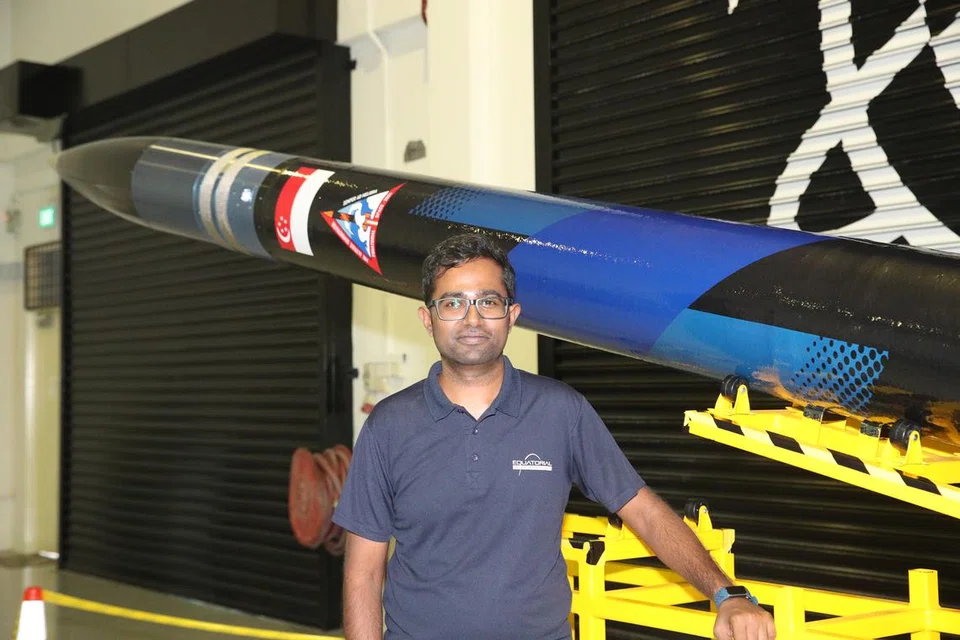
The first milestone for the start-up came in December 2020, when it successfully launched a Low Altitude Demonstrator prototype space rocket from Malaysia. It was the first such commercially built prototype rocket test flight in South-east Asia.
In 2022, Equatorial created a rocket that was launched in Tamil Nadu by Indian aerospace company Space Zone India.
“Space Zone India is collaborating with us on Mission Rhumi,” said Mr Praveen, adding that the two firms recently signed a memorandum of understanding for the project in the presence of Indian space scientist Mylaswamy Annadurai.
“Dorado, our own rocket, is what we plan to build next. The rocket is a suborbital one that has a 100km range and can lift up to 25kg,” he added.
Unlike in the past, when the aerospace industry relied on government initiatives, now, private companies are expanding in this arena, he said.
To date, the start-up has raised US$2.6 million ($3.6 million) from investors, including Elev8, Seeds Capital and Masik Enterprises.
Mr Praveen said this will serve as a springboard for further successes in the field.
“The progress I have seen in this field of work disproves the common idea that success requires a strong financial position. It takes (mostly) talent and interest to succeed in this field,” he said.