

I jumped the queue, and got the best experience at Naam Ras, the Sikh interfaith religious event that happened at the Singapore Expo last weekend.
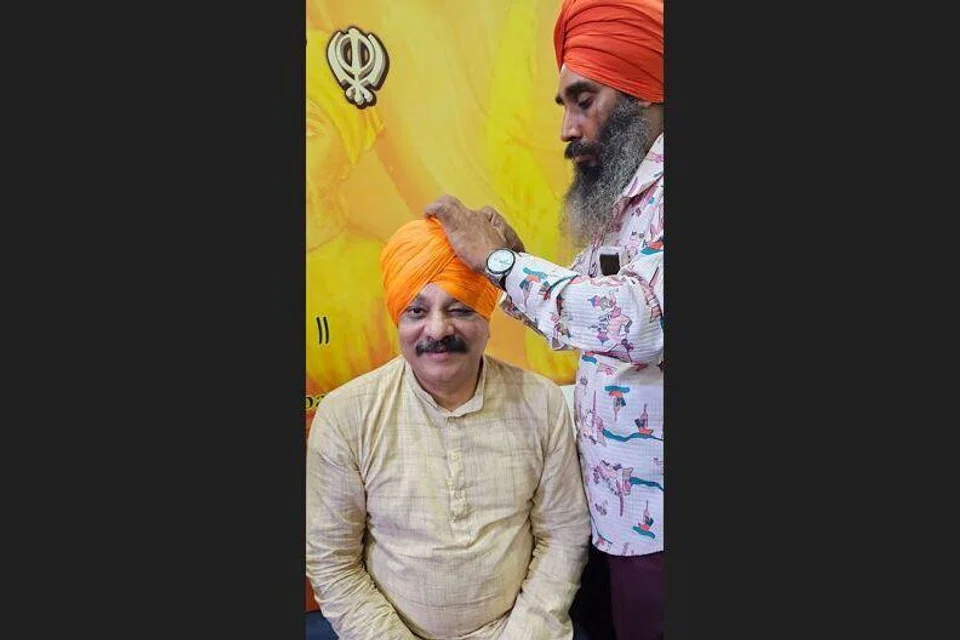
I got an expert to tie a turban around my head.
I have always been fascinated by the Sikh turban and how it is tied. What is the process? How long does it take?
I knew it was not an easy task. But I quickly learnt that the preparation takes more time than the actual tying.
First I chose yellow, my favourite colour. But everyone wanted that colour. So I settled for orange. The volunteer at the counter said okay and then cut out a five-metre strip of cloth. I was surprised by the length.
An expert took over and began pummelling and crumpling the starched piece of cloth and sprinkling water on it. He told me the move was to make it soft.
A few minutes later another volunteer joined him and both stretched the cloth to almost tearing point.
I was then asked to sit straight by Sukhwinder Singh, who had come all the way from the Golden Temple in Amritsar, as he went about tying the cloth around my head.
I was rebuked for trying to take selfies. “If you move your head, I walk off,” he threatened.
He asked me to bite tight one end of the cloth and look straight as he finished his work in less than five minutes.
He folded the cloth several times (a process called making the pooni) into a single layer and then wrapped it concentrically around my head in four layers (larh).
I learnt it is not a difficult process.
But you have to master the specifics – such as how many metres of cloth to use, how wide it should be, where to position each layer and how to tuck it in to finish in style. And when to let go of your bite and allow Sukhwinder to complete the job!
The key factor is tying the keski (base turban) properly, as this gives the foundation for the main turban (dastar). If the keski is loose or too tight, it will affect the positioning of the dastar.
Sikhs wear turbans as a sign of their faith and identity. The turban is worn to cover the hair and is seen as a symbol of respectability and honour. It is also a way to keep the hair clean and tidy, as hair is considered a gift from God.
The turban didn’t weigh heavy on my head. It kept me cool, and I looked cool.
For the rest of the three hours I was at the event, I walked around proudly in my paghri (a more angular version of the Sikh turban), drawing admiring looks and comments from friends and visitors.