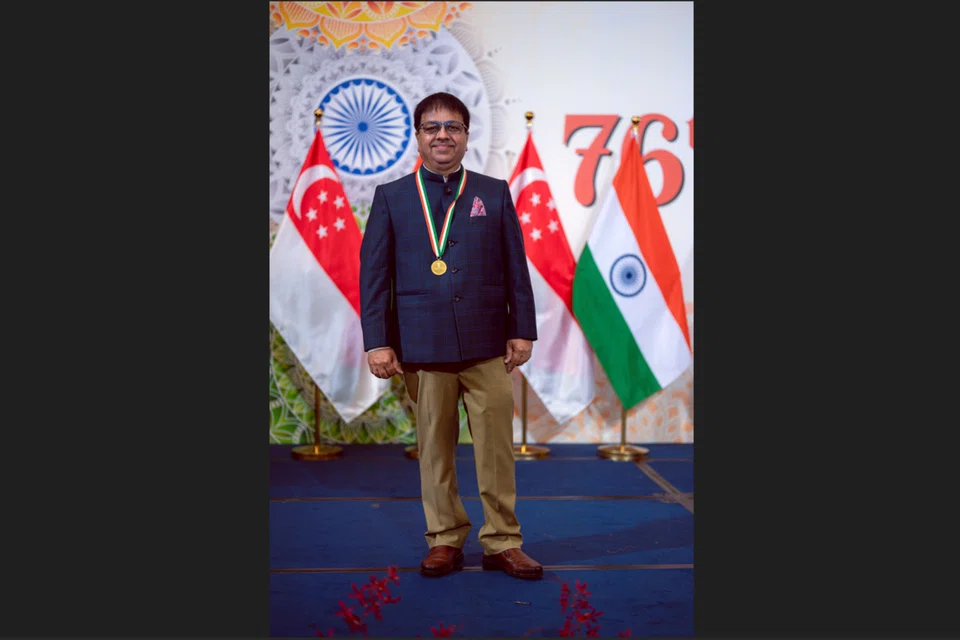


To Mr Atul Temurnikar, the Pravasi Bharatiya Samman, which was conferred on him by India’s President Droupadi Murmu on Jan 11 in Bubaneshwar, Odisha, is a recognition of his pioneering efforts in revolutionising the educational landscape in South-east Asia, and in offering world-class learning environments for the Indian diaspora.
“But more than that, the award (the highest honour bestowed upon overseas Indians for their exceptional achievements) is a motivation for more people to come forward and do that extra legwork for their communities,” said the chairman and co-founder of Global Schools Foundation (GSF) Singapore, which runs four schools here and 60 more in 10 other countries including India.
“There are around 35 million people of Indian origin living outside India, and not only them, but all communities need support. There are people who are underprivileged, people who do not have access to education, and that is where a lot of work needs to be done.
“Also, it’s a clear signal to the younger generation that, while they pursue their own dreams, they should also contribute to society. By helping somebody, or a group, they are playing an important role in lifting the community.”
Mr Termunikar, 60, who was born in Nagpur, Maharashtra, and graduated in engineering, did exactly that when he was posted to Singapore by technology giant HCL in 1991.
During his 10 years with HCL and later IBM, he learnt that most children who came to Singapore from India were admitted to a lower class because of a dichotomy in the education system, and this was creating problems for parents.
While Singapore has a Cambridge derivative, India has its CBSE (Central Board of Secondary Education) syllabus. Mr Temurnikar saw the issue as an opportunity to make a difference.
In 2002, he quit a high-paying corporate job to start Singapore’s first international school designed for Indian expatriates along with his wife Aparna.
The Global Indian International School (GIIS) at Mount Sophia offered students an education that bridged Indian values with global standards and blended the best of the Singapore and Indian systems.
Parents welcomed the school with open arms, finally finding a solution to their children’s educational struggles, and the GIIS brand took off. Today, more than 45,000 students of some 70 nationalities study in its schools.
“My initial thoughts were to take a two-year break from IBM and later put the venture on autopilot with a professional management team. But, as things progressed, I realised that education cannot be outsourced,” said Mr Temurnikar. “It has to be handled with your own mind, heart and soul.”
Mr Temurnikar quickly understood that he had to build a good team for it to succeed. “Our staff choices were purely skills-based,” he said. “We judged them on how they could contribute and whether they could take up leadership roles. Moreover, they had to be independent and innovation-driven. Fortunately, we got the right people, some of them have been with us for 20 years.”
Like all businesses, GSF faced several hurdles too. But Mr Temurnikar saw those as opportunities to do things in a different way: “We were always thinking about what could go wrong, and coming up with solutions.”
The focus was on making education innovative and accessible, and GSF introduced the CBSE-i curriculum, an international version of India’s national syllabus. It also developed a quality system called “7S Analysis” to ensure consistent standards across its campuses. This framework evaluates everything from infrastructure to teacher performance, ensuring each school meets the foundation’s high expectations.
Mr Sudhir Dhar, an IT professional whose son goes to GIIS, ranks the school among the top international schools in Singapore. “It has a strong academic and co-curricular programme which gives children a well-rounded development,” Mr Dhar said. “Its educational philosophy aligns with our family’s values and approach to learning.”
Over the past 20 years, mostly children of expats have benefited from GSF’s learning programmes – but it has also contributed towards promoting education among the underprivileged.
“We have to charge a fee as we have to deliver certain basic frameworks,” said Mr Temurnikar. “But I wouldn’t call GIIS expensive. We are midway between the low-end schools and the most expensive. We make sure the school fees are in the affordable range.”
This year, GSF will add two new campuses in Japan, in addition to the five it already has in the country.
“We have seven campuses in India and two in the UAE, and we are in discussions with a few more governments to set up our schools in different cities,” said Mr Temurnikar. “The advantage for us in this endeavour is the Singapore brand name that we carry. Parents and students know we deliver high-quality education. That’s how we have created massive loyalty in the world markets.”