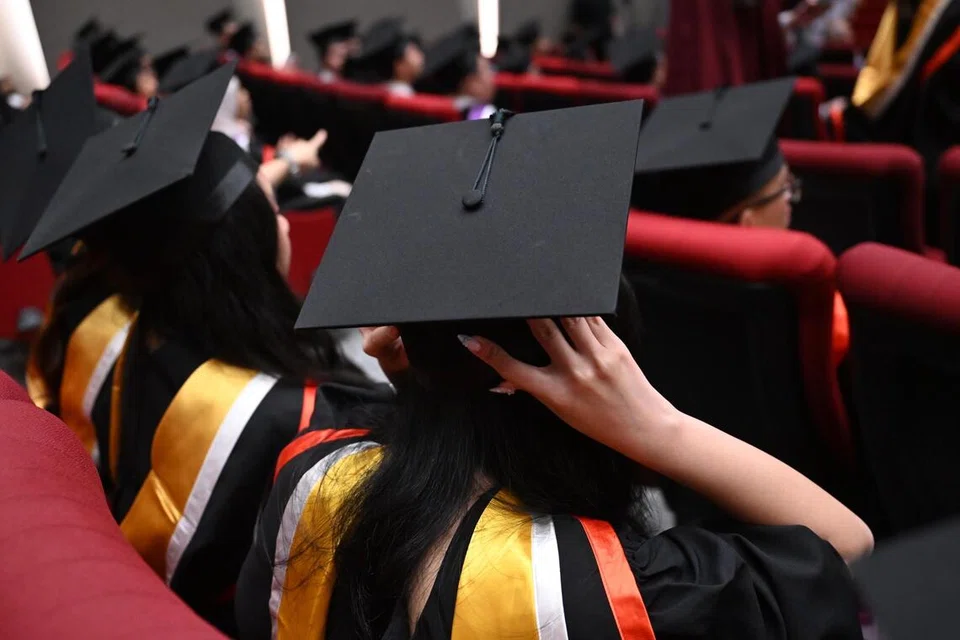
Around 3,000 credit-bearing internships are to be offered over the next three years to help students close the skill gaps created by AI automation, which is increasingly making entry-level roles redundant. The year-long work placements can be done as part of the curriculum before graduation
Such efforts are needed to build new bridges between school and work, as employers increasingly want new hires who can contribute earlier, said Senior Minister of State for Digital Development and Information Tan Kiat How on Oct 19.
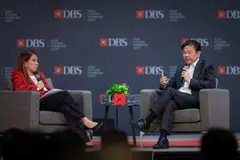
“These are not simply longer attachments. Like apprenticeships, they give students time to contribute to substantial projects, learn from experienced colleagues and develop professional judgment,” said Mr Tan, to a hall of nearly 500 students and company leaders at the Singapore Institute of Technology campus in Punggol.
He was speaking at the Singapore Computer Society TechConnect 2026, an annual event aimed at connecting students from institutes of higher learning (IHLs) with employers, practitioners and mentors from firms such as Nvidia.
Mr Tan echoed concerns made by Prime Minister Lawrence Wong earlier in October, who said that the “bottom rung” of career ladders might be broken because of AI adoption, and young people might not get sufficient training as a result. He urged companies in Singapore to pay attention to this issue, and be deliberate about mentoring junior hires.
“Junior engineers used to learn by writing simple programs, debugging code, testing applications or maintaining systems... AI can now assist with many of those junior tasks,” said Mr Tan, adding that young professionals need to be given the chance to develop such crucial experience and judgment.
“Employers still need experienced engineers, but those engineers need to begin somewhere. We cannot expect fresh graduates like many of you to arrive at your first job already possessing years of practical experience, nor can we simply tell our young graduates to learn more AI and expect everything to work out.”
He added that the responsibility for building the bridge between school and workplace must be shared between educational institutions, employers, industry associations and the Government.
The year-long internships have been available to polytechnic and ITE students since 2022, under the TIP Alliance+ programme led by the Infocomm Media Development Authority (IMDA). It is now expanded to include university students.
The internships will be co-designed between IHLs and employers, and will span various industries such as tech, finance and healthcare. Companies that have been involved in previous runs include OCBC Bank, consulting firm Accenture and PSA.
The cost of hiring is co-funded by IMDA, with firms receiving up to $1,000 monthly per intern for each eligible year-long internship.
The goal is also to push back against the common practice of trying to do as many internships as possible, said Mr Tan, warning that internships should not become an arms race to fill a resume.
“While internship experience is associated with better employment outcomes, accumulating more internships eventually produces diminishing returns,” said Mr Tan, citing an internal study done by the National University of Singapore.
“Employers have told me the same, quality matters more than quantity. What matters is what you learnt, contributed and built.”
He added that IMDA will monitor the outcomes of the year-long internships closely, and assess expansion of successful methods over time.
Undertaking a year-long internship gave polytechnic graduate Pei Joon Yi enough time to understand how to build web applications around real user needs and adapt them continuously after they are deployed, beyond just honing his technical skills.
The 20-year-old had graduated with a diploma in applied AI and analytics. He recently completed his internship at NTU’s Lee Kong Chian School of Medicine, where he participated in building AI applications.
He also helped to create a dengue triage chatbot MyanGuard at a regional hackathon organised by AI Singapore.
“Over the year, I became more familiar with the development process... With each project, I could build on what I had learnt previously instead of starting from scratch,” said Pei, adding that he had the space to develop soft skills such as communication and teamwork.
“The experience allowed me to continuously apply what I learnt, improve my skill sets, and become more independent in approaching new projects. This growth would have been harder to achieve during a shorter internship.”
During his address, Mr Tan also urged employers to move away from hiring based on educational qualifications, and recognise candidates for their skills and experience.
Among the 200 firms that have pledged to support skills-based hiring are DBS, Google, HSBC and Singtel.
Mr Tan said graduates can bring fresh perspectives, new ideas and AI skills that firms can benefit from. “Young talent is not simply an investment in tomorrow’s workforce; they can help organisations create value today.” THE STRAITS TIMES