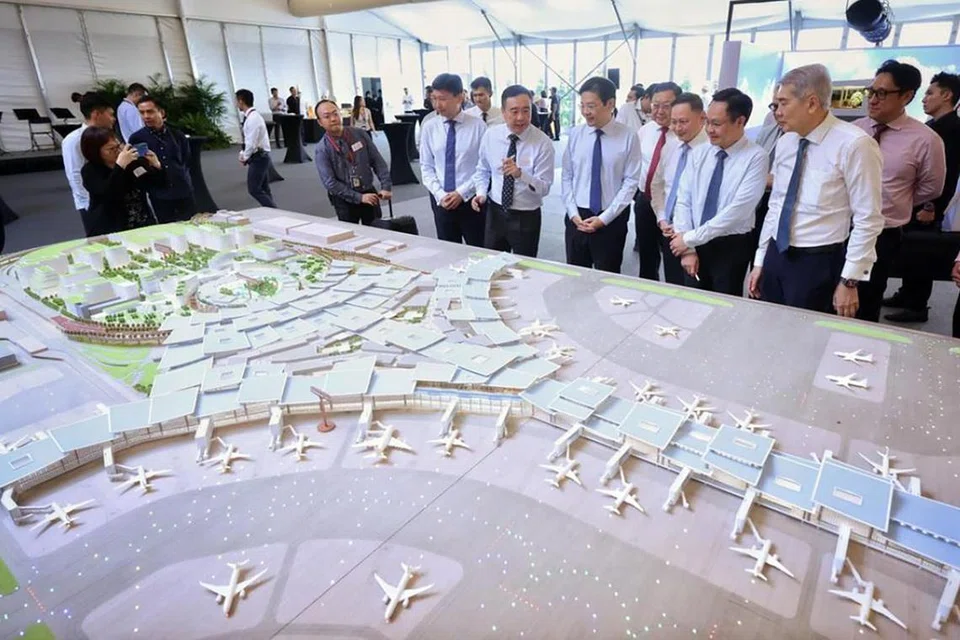

Prime Minister Lawrence Wong has broken ground on Changi Airport Terminal 5 (T5), an expansion project more than a decade in the making that will position the airport to ride an expected surge in air travel within the Asia-Pacific and beyond.
With the May 14 ground-breaking, work on the mega terminal has begun, following delays owing to the Covid-19 pandemic.
National carrier Singapore Airlines (SIA) and its budget arm Scoot will consolidate their operations under one roof at T5 when the terminal opens in the mid-2030s, said operator Changi Airport Group (CAG).
The airlines now operate across Terminals 1, 2 and 3, and SIA Group said the consolidation at T5 will provide space for its future growth and improve “operational synergies”.
There will be room at T5 and other terminals for other carriers to expand their operations, CAG added.
When asked about the other airlines that could operate from T5, CAG said it was too early to tell, as flight operations are dynamic and can change over the next decade.
Designed to handle about 50 million passengers a year, T5 will effectively double the size of Changi Airport and allow it to handle 140 million passengers yearly – boosting its current capacity of 90 million by more than 55 per cent.
Passenger traffic in the Asia-Pacific – already the world’s largest air travel market, taking about a third of the global share – is projected to double in the 2040s.
CAG said the extra capacity at T5 will enable Singapore to take advantage of this growth.
The Straits Times