
K. JANARTHANAN
When security guard Pichaymuthu Saloman returned home from his night shift on Christmas Day, he sat on the corner of the bed and wished his wife “Merry Christmas”, before carefully lifting her onto a wheelchair.
The 66-year-old then wheeled her into the bathroom where he slowly and meticulously washed her.
Showering his wife, Saroja Rosalind, 61, is a delicate 10-minute process, But, after more than three decades, Mr Saloman is used to it. He has to take precautions to ensure she doesn’t get injured.
Ms Saroja has been suffering from “stiff person syndrome”, a rare neurological disorder characterised by constant painful muscle contractions and spasms, for almost 30 years, and is bed-ridden. The condition has no known cure.
The couple married in 1984, and they have a daughter and son, Cynthia, 37, and Adrian, 36.
Sometime in 1990, when Mrs Saroja was working in a factory, her right eye suddenly swelled up.
“In 1991, my wife started having cramps in her legs. It would cause her immense pain and she would scream all night,” said Mr Saloman.
Doctors could not figure out the cause of the symptoms at first. It was only in 1995 that she was diagnosed as Singapore’s first stiff-person syndrome patient.
Medical bills went up. “Each time she was admitted to the hospital, the bill would come to a few thousand dollars,” said Mr Saloman.
She also had to undergo a hip replacement operation which cost $33,000. Mr Saloman paid a subsidised fee of $14,000, which wiped out his Medisave account.
He was then earning $1,800 a month as a storekeeper. Shortly after, he also had to deal with getting retrenched twice – in 1998 and 2001.
“It was only with certain medications that my wife’s pain was reduced. Only then did she stop screaming at night,” he said.
As her condition worsened – Mrs Saroja also suffers from diabetes – Mr Saloman wrote to the authorities to allow him to employ a helper despite not meeting the minimum required income. It took two years before the family was granted help.
His initial attempts to make claims under the CPF Dependants’ Protection Scheme, which supports members and their families in case of disability and death, were rejected.
All the while, Mr Saloman had to raise his children single-handedly. Despite being distracted and saddened by their mother’s daily struggle, they had to be reminded to focus on school and study. They are now working adults who help care for their mother, and with the family’s finances.
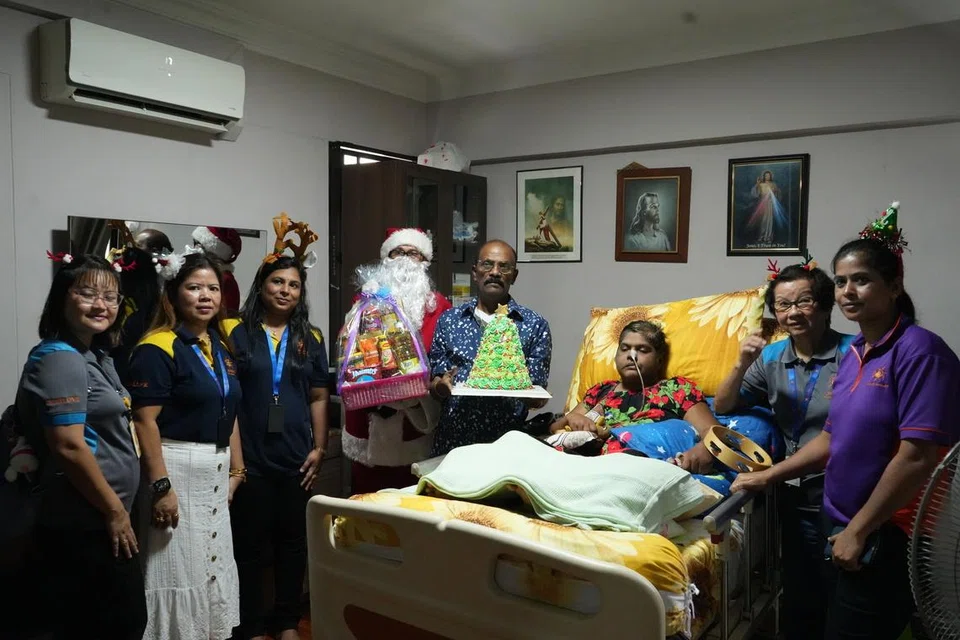
Circumstances have improved since those days. This Christmas, the family’s spirits were boosted by members of Sunlove Nursing Home, which has been providing and arranging outpatient care to Ms Saroja for the past six years.
Ms Maha Ramesh, assistant manager at Sunlove, said the nursing home also arranges for doctors to do home visits.
“Our staff also visit monthly to change the nasogastric tube used for feeding Mrs Saroja, who is unable to swallow her food,” said Ms Maha, who added that the nursing home has around 300 patients.
Mr Saloman was effusive in his praise for Sunlove, and thanked its staff for their “timely assistance” and help through the years.
Looking back on the past 30 years and how he’s had to take care of his wife, he bears “absolutely no regrets”.
“A few times in the past, there were people who urged me to admit my wife into a home and move on with my life – and maybe marry another woman,” he said. “But I never entertained any of those ideas.”