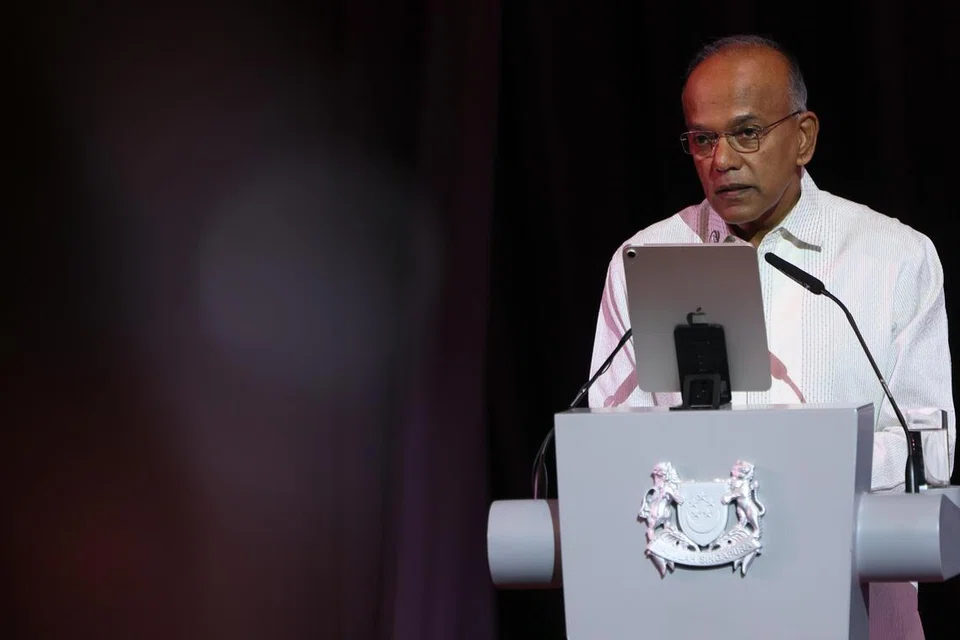
Senior Minister K Shanmugam said Singapore must ensure its law enforcement officers are “better equipped than the criminals” as drug syndicates become increasingly organised, well-funded and violent worldwide.
Speaking at the National Day Awards Investiture Ceremony on Tuesday (Nov 17), the Coordinating Minister for National Security and Minister for Home Affairs cited examples from Europe to illustrate the dangers faced by officers combating drug-related crime.
He added that the Government must continue supporting and protecting Home Team officers, pointing to Singapore’s anti-drug enforcement framework as a key example.
Global threats as lessons for Singapore
According to the latest World Drug Report by the United Nations Office on Drugs and Crime, 331 million people worldwide used drugs in 2024, up from 247 million a decade earlier. Nearly half a million deaths were linked to drug use that year, Shanmugam said.
Citing a Wall Street Journal article, he pointed to Spain as an example of criminals being better equipped than the authorities.
A single speedboat shipment can carry up to four tonnes of cocaine worth more than US$250 million (S$322 million), he noted, underscoring the vast resources available to drug cartels.
The syndicates also employ sophisticated technology including drones, radar and thermal imaging systems to evade detection, while fewer than 10 Spanish police boats can match the 60-knot speeds of the smugglers’ vessels.
Mr Shanmugam recounted a 2024 incident in which a drug-smuggling boat rammed an inflatable police vessel and ran over officers in the water, killing two of them.
“We must never let our officers be at risk in this way,” he said, stressing that Singapore “must never let the criminal gangs get so bold”.
The minister also highlighted developments in other European countries.
In Sweden, children as young as 13 have been recruited by drug gangs amid a rise in gang-related violence, with the army called in to help in 2023.
In Belgium, cartels have bribed or intimidated police officials into providing confidential information, while a former justice minister had to live and work out of safe-houses due to cartel threats.
“We should never get to a situation where our officers are recruited in large numbers by criminal gangs,” he said.
In France, some housing estates have reportedly fallen under the control of drug gangs, with teenagers used as lookouts and checkpoint operators.
Mr Shanmugam noted that all three are developed countries grappling with serious drug-related challenges.
‘Our officers must be better equipped than the criminals’
To protect officers from organised and heavily resourced criminal groups, Mr Shanmugam outlined a two-pronged approach.
First, Singapore must continue strengthening its physical armoury and capabilities to stay ahead of criminals.
The country’s approach is to ensure officers are better equipped, better armed and better trained than those they confront, he said.
“We have to make sure that we don’t send our officers into situations where we know they are likely to lose their lives,” he said, adding that Singapore must always operate from a position of strength.
Second, authorities must prevent criminal organisations from taking root in Singapore, warning that once entrenched, they become very difficult to deal with and will overwhelm enforcement.
Singapore’s tough anti-drug laws, strict enforcement regime and death penalty for certain drug trafficking offences help deter organised crime and protect frontline officers, he said.
He emphasised that Singapore achieved its current drug situation “not out of luck or coincidence”, but because of carefully considered measures.
Mr Shanmugam added that protecting officers is a guiding principle across the entire Home Team, not just within the Central Narcotics Bureau.
Nearly 1,000 Home Team officers received awards at the National Day Awards Investiture 2026.
Mr Shanmugam also thanked their family members, saying their support enables officers to carry out their duties effectively. ASIAONE