


ALI KASIM
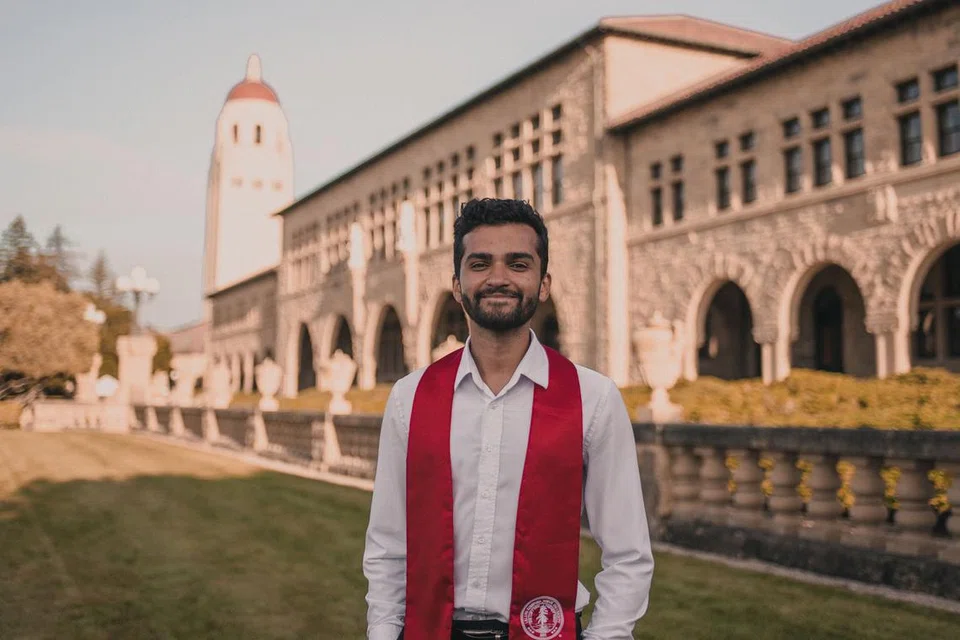
While a freshman at Stanford University in California, Pranav Gurusankar conducted a small social experiment in 2020.
Amid the zestful campus lifestyle in Palo Alto, where famous alumni such as Elon Musk and Mukesh Ambani probably walked the halls with a bottle of beer in hand while charting their course to becoming a billionaire, the 24-year-old Singaporean decided to abstain from alcohol – for the whole year.
“I wanted to see if there would be any drop in the fun I would have, and whether the drinking culture myth at US institutions was actually a thing. I was pleasantly surprised to find that I wasn’t precluded from anything,” he said with a wry smile.
Pranav, a computer science major, is Singapore’s latest and 29th recipient of the prestigious Rhodes Scholarship this year.
It is a scholarship programme established at Oxford University in 1903 which aims to select public-spirited leaders and promote international understanding through a community of scholars. Singapore has a conferment of one Rhodes Scholarship a year.
Pranav, who has ambitions to leverage cutting-edge AI technologies for medical treatment, was selected from among nine applicants. He will commence post-graduate studies in public policy and applied digital health at the University of Oxford in October this year.
The decision to create a hypothetical situation just to see the social outcomes it would yield is testament to Pranav’s curious and problem-solving nature.
“I always enjoy breaking down a problem into smaller parts and then figuring out how to solve it,” he said.
At Stanford, Pranav works as an undergraduate “peer educator” on campus, educating students on topics relevant to campus public health, and specifically as it relates to substance use, well-being, and consent and communication practices.
His proclivity for helping others undoubtedly stems from a piece of advice given to him by his parents when he was a child. “You must live a life in service,” they told him.
Not that they pushed him towards science or medicine at a young age – as many Indian parents are liable to do. “No, they simply told me to figure out what I want to do and do it well,” Pranav said.
Born in Chennai, Pranav moved to Singapore with his family when he was four years old.
While speaking to tabla!, his accent veered subtly from Singaporean to American – the latter a by-product perhaps of his education at United World College here.
But he is totally Singaporean, he pointed out, citing his national service in the Army as a key point in his life.
“My time in the Army elicited a lot of personal growth that I’m grateful for now,” he explained.
“The way I went about solving problems before was, in a way, through an engineering mindset. But when I first started in the Army, the physical and emotional challenges of training often didn’t have any immediate solution.
“When you’re in the trenches, mentally and physically, even if you feel the challenges are overwhelming, you can’t just quit. So that forces you to adopt a kind of calm resilience to weather the storm.
“I think that the unique environment of the military, where you live and serve alongside total strangers, teaches you to communicate with others and to lead people in ways not replicated elsewhere.
“Importantly, it taught me to lean more into my community – my peers and commanders in the Army, and also my family and friends – when things felt challenging.”
Pranav was commended for his excellent contributions during NS, and as a student in the US he leads national training and recruitment for the United Students for Veterans’ Health group, which organises weekly activities for nursing home patients with dementia.
Aspiring to be a medical doctor who also conducts research at the intersection of computation and medicine, Pranav hopes to one day bring large-scale improvements in healthcare delivery.
At Stanford University, he has applied his talents to conduct research in bioelectronics, cancer biology, and digital health interventions for chronic pain.
“I wanted to pursue a career of service in the broader sense,” he said.
“I saw this scenario in medicine where I could combine my scientific and academic interests with the humanity inherent in helping patients. I realised that was the area I wanted to serve in.”
Looking ahead, Pranav says the goal for him, after Oxford, is to return to the US for medical school.
After that, he said he’s “definitely hoping to return to Singapore” for work.
“My dream is to become a physician scientist, and also work on shaping AI policies as it pertains to healthcare in Singapore,” he said.
“I want to come back here when I’m able to change things. In the meantime, I’ll do whatever I can, even if it’s two years here and there, to maximise the impact of my career when I return.”
alikasim@sph.com.sg

