


On the outside, the Bendemeer flat belonging to Mr Ponnosamy Kalastree has the typical South Indian doorstep – a string of mango leaves suspended over the door, Deepavali bunting trailing down the doorway and the floor decorated with a colourful kolam.
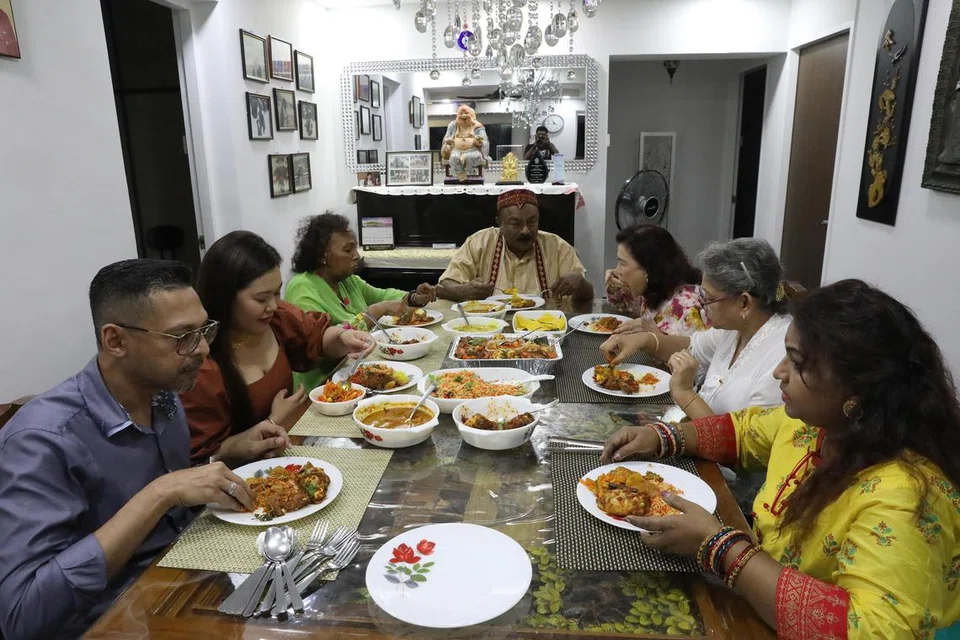
But the flat’s interior is not typical of a South Indian home. Mr Ponnosamy, 76, decorates his unit with Chinese paintings, Peranakan pottery and Islamic art. Matriarchs in kebaya sit on distinctively Peranakan chairs, the intricately-carved coffee table topped with a glass panel.
Malay kuehs such as koswee, lapis, putri salat and dadar are laid out in front of the guests. On the dining table were bowls filled with delectable dishes such as mutton rendang, prawn sambal and roti jala.
To Mr Ponnosamy, his home encapsulates the different cultures of Singapore, a mishmash just like Chitty Melaka.
The Chitty Melaka people, or Chettis, are descendants of South Indian merchants who first settled in Melaka around the 15th century and married women of Malay or Chinese descent. The Indian Heritage Centre estimates the number of Chettis in Singapore to be about 5,000.
“The Chitty Melaka community where I am from enjoys the best of Indian, Chinese and Malay cultures. In a way, we represent the whole of Singapore,” said the security business consultant, whose ancestors left Melaka for Singapore in the 19th century and settled in Upper Serangoon Road.
Dressed in a sarong, kurta top and topi, Mr Ponnosamy speaks fluent English and Malay, with a smattering of Tamil.
His cousins Merlin Pillay, 70, and Jaya Lakshini Gurusamy, 73, are more fluent in Tamil. “I speak English with my father and Tamil with my mother. They speak Malay to each other,” said Ms Jaya.
Leading up to Deepavali, the Chettis mark Naik Bukit, a tombstone sweeping festival derived from the Chinese Qing Ming tradition.
Traditionally, the Chettis are Hindus belonging to the Shaiva denomination. They celebrate Deepavali and Pongal. Unlike most Hindus though, the Chitty Melaka people traditionally bury their dead.
Similar to ethnic Malayan-Singaporean South Indians, the Chettis make food offerings for their dead in a ritual called Bhogi Parachu, typically serving nasi lemak with eight to 11 side dishes.
The Chettis also have a more varied wardrobe. The women wear kebayas as often as they wear saris.
“My husband is an Indian from outside our community. When I visit my mother-in-law, I wear a sari. When I visit members of my own community, I wear a kebaya,” said Ms Pillay.
Ms Dora Woo, who has been married to Mr Ponnosamy for 50 years and wears a pottu (or bindi) on her forehead, described the Chitty Melaka culture as “rich and interesting”.
But the Hindu faith remains a cornerstone of the community’s identity, explained Ms Merlin. She recalled how in her village of Gajah Berang, everyone would await the arrival of the deity procession during the Datuk Chachar festival every May.
Mr Ponnosamy, who is fluent in Malay and even won the top prize for a nationwide Malay oratorical competition, wishes he spoke more Tamil. He uses words such as sambar, murungai keerai (moringa leaves) and karuvadu (salted fish) when talking about food in Malay Chetti creole.
The Chitty Melaka Association, which Mr Ponnosamy presides over, will be releasing a cookbook, The Heritage Food Of The Peranakan Indians, on Nov 19.
Ms Merlin believes the elders in the community ought to speak more Tamil to their children. “Regardless of our fluency in Tamil, we are very much rooted in our Indian identity,” she explained.
“It is inevitable that communities here absorb one another’s cultures. This is where we want to promote our culture as truly Singaporean, with a Singaporean identity,” said Mr Ponnosamy, who feels that greater awareness of his community would add more colour to the Singapore brand.

