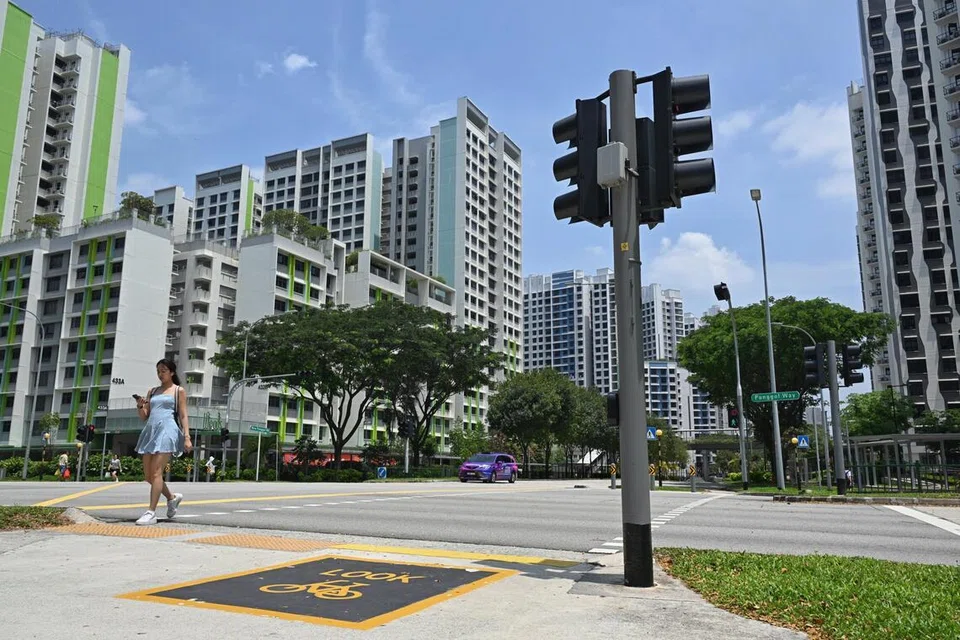
While Tampines is Singapore’s most populous planning area for the third consecutive year, the north-east towns of Sengkang and Punggol are growing faster.
Tampines had 296,060 citizens and permanent residents in June, ahead of Bedok (272,120), Sengkang (265,830), Woodlands (255,280) and Jurong West (250,890). Punggol ranked eighth with 204,490 residents.
The figures were included in the second edition of the Statistics Singapore Newsletter, published by the Singapore Department of Statistics (SingStat) on Oct 28.
Although Tampines has been the most populous since 2024, it is not among the top 10 fastest-growing planning areas.
Over the past decade, Sengkang averaged 1.9% annual growth – outpacing Tampines, which grew at about 1.3% a year. Sengkang added 46,450 residents over 10 years – compared with 36,950 for Tampines – and rose from sixth place in 2016 to third in 2026.
Neighbouring Punggol grew 4.6% a year and entered the top 10 most populous planning areas in 2026, adding 74,110 residents to the 130,380 it had in 2016.
Among the areas ranked by SingStat, Punggol’s growth rate was second only to Downtown Core, the central business district, where growth was partly due to a boundary change.
The other area that grew faster than Tampines is Bukit Batok (1.8%), which has ranked as the 10th most populous area since 2021. It had 165,680 residents as at June.
The geographical distribution was based on the Urban Redevelopment Authority’s Master Plan 2025, which divides Singapore into 55 planning areas that may differ from how people commonly perceive neighbourhoods.
For instance, the Paya Lebar planning area, which largely comprises Paya Lebar Air Base, has only20 residents according to the 2026 figures. Homes near Paya Lebar MRT station fall within the Geylang planning area, which has 121,350 residents.
Tampines, which was developed as a Housing Board town in the early 1980s, had 259,110 residents in 2016. It was third then, behind Bedok and Jurong West, and has since overtaken both as their populations shrank.
In addition, Tampines now has a higher share of children aged under 15 than most other planning areas, ranking eighth with 14.9% in 2026 – up from outside the top 10 a decade earlier.
The newer towns have the highest proportions of children below 15. Tengah recorded the highest proportion (20.3%), followed by Punggol (19.6%). Sengkang was sixth at 16.3%.
The data also showed that residents in Outram are the oldest on average, with 28.9% of residents aged 65 and above and a median age of 50. In Outram, Ang Mo Kio, Jurong East, Bukit Merah and Rochor, more than one in four residents were aged 65 and above.
In its newsletter, SingStat said Singapore’s population growth had been accompanied by changes in the demographic and socio-economic characteristics across the planning areas.
“The development of new housing estates, the ageing of older areas and shifting profiles of planning areas reflect Singapore’s dynamic geographical transformation,” the agency said.
Sing Tien Foo, provost’s chair professor of real estate at NUS Business School, said population distribution is “very much driven by HDB flat supply and also land availability”.
Christine Sun, chief researcher and strategist at Realion Group, agreed, saying HDB data showed that 23,643 homes were built in Tampines between 2007 and 2026. This was more than the 5,497 homes built in Bedok over the same period, but fewer than the 44,738 in Punggol and 34,512 in Sengkang.
Citing older towns such as Ang Mo Kio, Bukit Merah and Queenstown, Sing said: “We tend to find older towns reach the peak of their population size and also see slower growth over time.”
He added that areas designated as regional centres, such as Tampines, Jurong East and Woodlands, can hold a larger population as more land has been set aside for housing.
Mr Sing expects population growth to continue in Tampines, Punggol and Sengkang, where there is more land for housing.
“More amenities and better connectivity will be important to support larger towns,” he said. “More satellite neighbourhoods and town centres could be created to ease the high concentrations in the current neighbourhood centres.”
Ms Sun added that data on median ages in various planning areas could also inform the provision of healthcare and senior-friendly facilities. THE STRAITS TIMES