The Government announced a review of the 36-year old certificate of entitlement (COE) system in March.
Consumers hoped that a review will lower COE prices from the current elevated levels.
Since July 2025, the price of a Category A COE – meant for mass-market cars – has been in the six-digit range. At the most recent tender, it ended at S$130,001, compared with S$80,501 in 2022.
Some motor dealers hoped the review would shield Category A COEs from luxury car models. The argument is that higher-end cars, with their higher prices and fatter margins, push up Category A premiums.
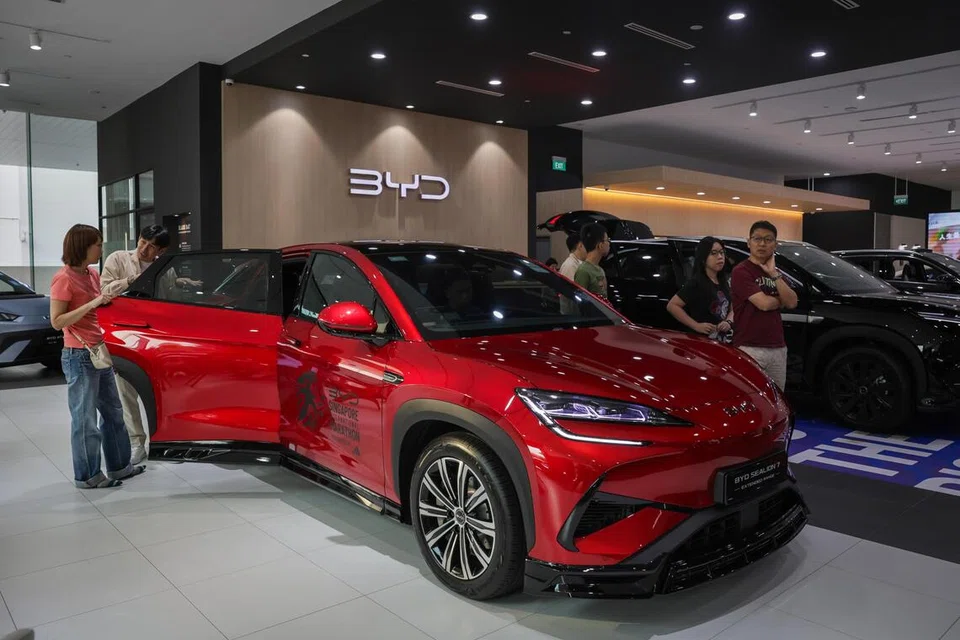
The ongoing transition to electric cars worsened the situation, with manufacturers tuning higher-end electric models – from BMW to Tesla – to meet Category A requirements.
This overcrowding of models has fuelled the premium hike, narrowing the price gap between Category A and Category B, which is the intended place for higher-end models.
The Category B COE price hit S$130,100 at the latest tender, just $99 more than Category A. In 2022, a Category B COE cost S$95,856.
This convergence undermines the original intent of the COE system to distinguish between mass-market and premium vehicles, which is what LTA wants to rectify in its proposed changes put up for public consultation on Oct 8.
Prices not subject of review
It said plainly in the consultation paper that COE prices will continue to be determined by demand and the available supply of certificates, and that prices are not the subject of the review.
This is consistent with the statements made since the review was announced.
The LTA has proposed merging the two car COE categories and subjecting the COE premium set during regular tender exercises to an adjustment amount based on the car’s open market value (OMV), or base cost before taxes.
A higher-value car will incur a COE surcharge, while a mass-market one will receive a rebate. Cars banded in the middle tier will see no adjustment to the COE price.
The OMV is a better benchmark than technical specifications. In the past, engine size and power output thresholds failed to keep up with technical developments, and the LTA has had to play catch-up.
More than a decade ago, luxury models with small engines slipped into Category A, driving up premiums. In response, the LTA introduced the power output threshold in 2014 to keep them out.
The arrival of electric vehicles triggered the tweak to the power threshold in 2022 to allow more mass-market options into Category A.
Using OMV as the benchmark anchors the system to a proven measure, as it is already the basis for vehicle taxes.
The mass versus higher-end distinction is far clearer through the OMV lens: The basic cost of the Tesla Model Y RWD 110 is $45,195, while the mass-market BYD Atto 3 is pegged at $27,889.
Under the current rules, both are Category A COE models with the same premium. But under the proposed change, the Tesla’s COE would incur a surcharge, while BYD’s would get a rebate.
This way, the COE cost difference between mass-market and higher-end cars is guaranteed and unlikely to be distorted down the road by market developments.
Separating mass-market and premium models does not mean lower COE prices
The idea to have a single COE category for cars was first mooted in 1999, when the then Government Parliamentary Committee for Communications reviewed the Vehicle Quota System – the foundation of the COE system.
The review resulted in the four car COE categories created in 1990 being merged into the familiar Category A and Category B regime.
The committee had wanted to combine them into one big category. The two-category set-up was meant as an intermediate step following concerns from the public that buyers of bigger and luxury cars would outbid those buying smaller cars if there were only one car category.
The current proposal of having an OMV-based rebate-surcharge amount applied to the COE price could go towards preventing premium car buyers from putting up overly high bids, leaving out the mass-market car buyer.
But the truth remains that buyers of higher-end cars, with deeper pockets, will be able to push up COE prices. So even with the applicable rebates to soften the blow, mass-market car buyers will likely still be bidding within an inflated baseline.
To help balance the scales, the surcharge has to be high enough to discourage luxury car buyers from overbidding. At the same time, rebate amounts should be significant enough to ensure a meaningful gap for the mass-market car buyer.
The LTA said it will take the historical price gaps between Category A and Category B COEs to determine the amount.
In its proposal, the maximum gap between the highest rebate and the highest surcharge was $30,000. In the middle are cars that are exactly the COE price, without a rebate or surcharge.
As it is, a $15,000 surcharge or rebate on either side of the neutral band will have a different significance, depending on whether the COE premium is closer to $130,000 or $90,000.
Having the quantum scale dynamically, as a percentage of the prevailing COE premium, may be a more responsive method. Another option is to use a rolling average of the COE premium over a few months to determine the discount and surcharge, to avoid big swings after every tender.
Supply trails demand, significantly
Clearly, COE prices are high because demand exceeds supply. But there is also a bottleneck in the COE supply, largely due to earlier policy decisions.
COE supply is set by the LTA and mostly driven by the vehicle deregistration rate.
There used to be an allowable growth included in the COE supply. In February 2018, the vehicle growth rate for cars and motorcycles was brought down to zero for 10 years, until Jan 31, 2028.
Based on estimates by The Straits Times, there will likely be around 55,000 car registrations in 2026.
This is a modest rise from the 52,381 units in 2025, but nowhere near enough to absorb the demand from the 87,302 car registrations during the 2016 peak. These cars will be in the final year of their 10-year COE lifespan.
Supply is also not keeping pace with demand because the LTA is using the four-quarter rolling average vehicle deregistration rate.
This rate – introduced in February 2023 to reduce the quarter-on-quarter volatility in supply and stem the steep drop in vehicle deregistration rate then – means there is now a 12-month lag between a vehicle being scrapped and its COE returning to the bidding pool.
Owners usually shop for replacements months ahead of the COE expiry, and the new car will take up a fresh COE before the old one is deregistered.
Deregistrations reached 44,364 in the first eight months of 2026, on track to exceed the 49,550 units for the whole of 2025.
Although deregistrations are on the rise, these COEs will enter the bidding pool only a year later. So while demand from existing car owners is now higher because more cars are due for scrap, there may not be a surge in COE supply coming just yet.
Factoring the OMV into the COE equation fixes the glaring flaw in the current system, where luxury and mass-market vehicles end up with the same price for their certificates.
But drivers holding out for more affordable COE premiums will be disappointed because the supply calculation remains unchanged.
So while LTA may have succeeded in making premium car buyers pay a “fairer” share, until something is done to make the COE supply more responsive to deregistrations, drivers may still have to pay an outsized price for their cars. THE STRAITS TIMES