From 2027, primary school pupils with high academic potential can attend advanced classes at 15 designated centres across the country, following the recent discontinuation of the Gifted Education Programme (GEP).
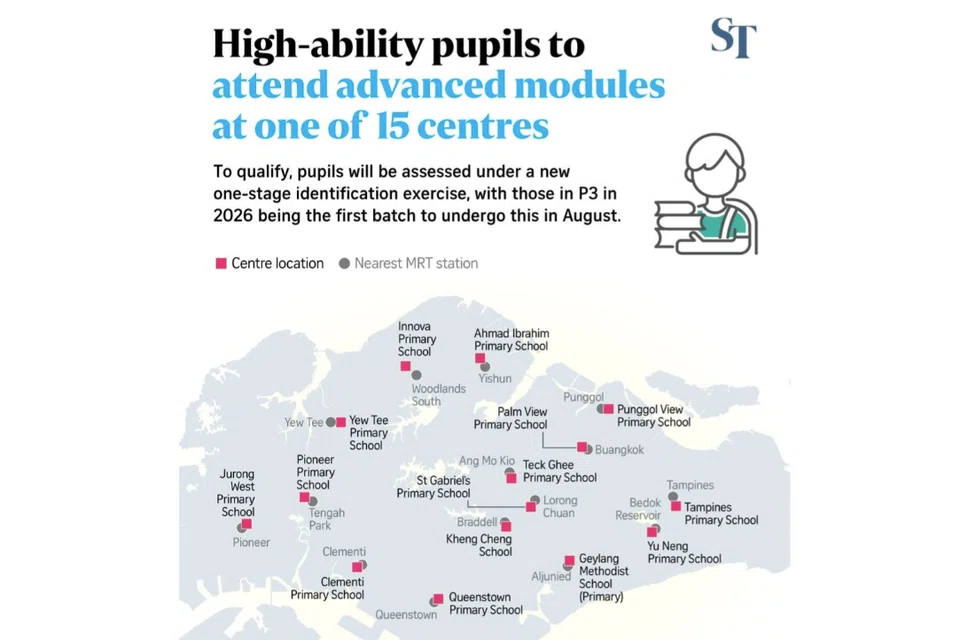
Announcing this on March 3 during the debate on his ministry’s budget, Education Minister Desmond Lee said that these centres will be located within primary schools selected for their “good geographic spread” and accessibility by public transport.
The centres will offer weekly after-school advanced modules for English, mathematics and science, while interdisciplinary modules will be conducted during the school holidays.
The modules will be taught by 20 specially deployed teachers from the Ministry of Education’s (MOE) headquarters, including former GEP teachers who do not belong to the primary schools the centres are based in. More teachers will be deployed as more pupils join the programme.
The 15 centres will be located in schools such as Ahmad Ibrahim Primary School, Pioneer Primary School and Yu Neng Primary School.
The centre locations will be periodically reviewed, said Mr Lee. Prime Minister Lawrence Wong announced in August 2024 that the GEP in its current form – where selected pupils transfer to nine specific primary schools – would be replaced by school-based provisions to stretch pupils with higher abilities across all primary schools.
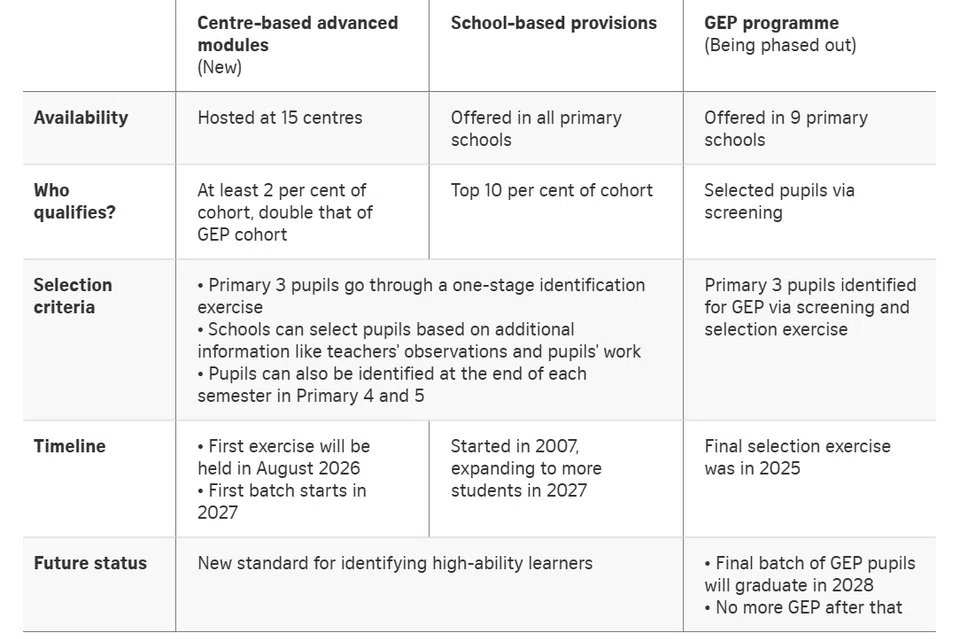
With the latest introduction of advanced modules, at least 2 per cent of primary school pupils will benefit from the new arrangement, up from the top 1 per cent under the former GEP, said Mr Lee. This is because the modules cater to those with strengths in specific domains, whereas the GEP selected pupils who were strong across several subject areas.
The curricula for these modules will also be delinked from the national curriculum, and are not intended to replicate the GEP curriculum, said MOE.
A trial of these modules was conducted in 2025, said Mr Lee, and was “well received”.
To qualify for the modules, pupils will be assessed under a new one-stage identification exercise, with those in Primary 3 in 2026 being the first batch to undergo this in August.
“Rather than having a single entry point at P4, students can also join at the end of each semester at P4 and 5, making it more porous,” said Mr Lee.
Selected pupils will be able to take school-based provisions, referring to enrichment classes held in their own schools, the weekly centre-based advanced modules or both, based on their subject strengths.
Mr Lee said: “To be clear, these modules are not intended to give students a leg up in examinations. Rather, they are designed to further cultivate curiosity, creativity and critical thinking.”
MOE said the identification test focuses on English and mathematics aptitude rather than school-based curriculum content, and will not be the only yardstick used to assess students.
“We’re looking for attributes like creativity, interest and talent in these academic domains,” the ministry said.
Schools can also identify pupils using teachers’ observations and pupils’ schoolwork, with guidance from MOE.
Mr Darryl David (Ang Mo Kio GRC) had suggested conducting after-school enrichment at “non-branded” neighbourhood schools instead of concentrating it in a few prestigious schools.
This approach will expose pupils to diverse backgrounds while allowing local schools to build distinct reputations for nurturing talent, said Mr David, who chairs the Government Parliamentary Committee for Education.
These modules – which could be in areas like financial literacy, literature and journalism – should “broaden and deepen engagement with subjects in ways the standard curriculum cannot, fostering curiosity, creativity and applied thinking,” he added.
“The aim of this new model should not be to separate students by ability, but to cultivate diverse strengths in every learner.”
These new centre-based advanced modules come on top of existing school-based provisions for learners with academic strengths and talents within every primary school.
From 2027, these school-based programmes will take in 10 per cent of all primary school pupils – about 3,000 each year, up from 7 per cent now.
Almost all primary schools have at least five teachers trained to teach pupils in such programmes, said Mr Lee, and more will be provided if needed.
Together, these school-based provisions and centre-based advanced modules will replace the GEP – whose last batch will be the Primary 6 cohort in 2028 – as the new standard of support for pupils with academic strengths and talents.
“Students can choose whether to attend based on their interests, holistic development and schedules,” said MOE, adding that neither programme is mandatory.
Pupils may also join both programmes. This allows for a tailored approach where, for example, a pupil might attend school-based English lessons while taking advanced modules in mathematics.
Those who qualify for interdisciplinary modules will be guided to make connections across subjects and contexts, and apply their learning to problems.
One example cited by Mr Lee is a module on playgrounds which integrates social studies, science and mathematics, to tackle challenges in designing playgrounds.
“This allows students to explore new ideas and topics beyond traditional classroom boundaries without curriculum time constraints or assessment pressures,” MOE said.
The ministry added: “We are trying to also move away from labelling students... to really seeing that every student has their own strengths and potential, and we want to develop them to the best that we can.”
Some schools ‘over-represented’ by high-SES pupils, P1 registration framework under review
Even with the changes made to Primary 1 admissions, like reserving up to 40 places in schools for pupils with no connection to the school, some schools continue to be “over-represented by students from higher-SES families”, said Mr Lee.
He was referring to families with higher socio-economic status, characterised by higher income, education and occupational status.
“Some of these schools are located in neighbourhoods that comprise mostly private housing, with fewer Housing Board flats,” he said. “If the school is popular with parents, it might be filled first by those living nearest in private housing, because of the home-school distance priority.”
Mr Lee added: “Schools cannot just passively reflect the neighbourhoods around them, but they must also actively create diverse environments for our students to mix and mingle and to learn from one another.”
He was responding to suggestions and concerns raised by various MPs about priority phases in the Primary 1 registration process as well as the “unfair advantages” enjoyed by those who can afford to buy or rent property near their preferred schools.
Mr Lee said the ministry will consider all suggestions, but a balance has to be struck between competing views and needs.
“There are a finite number of places in each school, and every change would affect different groups in different ways,” he said, assuring the House that MOE will review the framework to ensure primary schools remain open to pupils from different backgrounds.
The Straits Times