Trader Radiant World is attracting attention from the authorities after several major international banks and trading houses reportedly distanced themselves amid concerns over invoices it provided to lenders.
The Singapore-based company, which claims to be one of the world’s largest iron ore traders by volume, has denied wrongdoing in a statement on its website and said it remains well capitalised with healthy liquidity.
“As a longstanding policy, we do not comment publicly on confidential commercial relationships or the business of our counterparties.... We therefore will not comment on purported discussions involving specific customers, suppliers, lenders or other market participants,” it added.
When ST visited its corporate address at 6 Battery Road on Aug 20, security staff noted the office was “still operational”, but said that no one was around.
The police confirmed to ST that reports have been lodged against Radiant World and the authorities are looking into the matter.
Global lenders, major partners pull back
Commodity traders typically rely on trade finance to fund the purchase and shipment of cargoes before receiving payment from their customers, making access to financing crucial to their ability to trade.
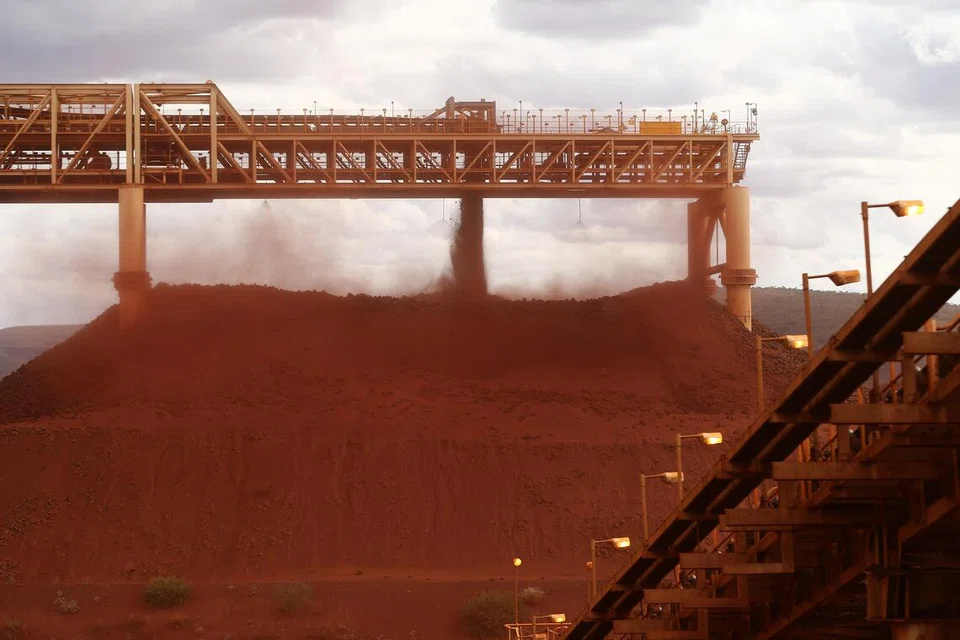
Bloomberg profiled Radiant World in October 2025, describing its rise as “breakneck”. Bloomberg said that its iron ore volumes had grown almost tenfold over the preceding decade, making the little-known company one of the world’s largest traders of the commodity.
Chinese media reported in 2025 that Radiant World’s iron ore trading volume was expected to reach 65 million to 70 million tonnes that year, approaching the 75 million tonnes traded by commodities giant Glencore in 2024.
The situation took a turn when Bloomberg reported on Aug 15 that the US Department of Justice was investigating the company. The US Commodity Futures Trading Commission was also examining trades involving the company and its creditors, according to the report.
The authorities in the United Kingdom are also said to be looking into the company, according to another Bloomberg report on Aug 20.
Previous reports said that Deutsche Bank and KBC Group had frozen some of Radiant World’s Singapore bank accounts, while other lenders had suspended credit lines.
Rio Tinto and Vale, two of the world’s largest iron ore miners, have also stopped doing deals with Radiant World. Major miners typically sell iron ore directly to steelmakers, but also sell cargoes on the spot market to commodity trading houses like Radiant World, which can then resell them to steelmakers or other trading houses.
Commodity trading houses Vitol Group and Cargill also stopped trading with Radiant World, while Glencore stopped doing new business with the firm. Bloomberg said that two of the three had seen invoices or other documents that Radiant World provided to its banks, that were not valid.
Glencore said: “(We have) ceased entering into new business with Radiant World and are working to exit existing contractual obligations… The exposure on our books is not material and well below our threshold of US$500 million (S$634 million).”
A Reuters report on Aug 11 named Mizuho, Societe Generale, Deutsche Bank, Barclays and Macquarie, which have operations in Singapore, among Radiant World’s lenders. Mizuho, Barclays and Macquarie declined to comment when contacted by ST, while Societe Generale did not respond to queries.
ST understands that Macquarie’s credit facility to Radiant World has already matured.
UOB was identified by Reuters as among Radiant’s new lenders registered in 2025. But ST understands that the bank is not a creditor of Radiant World and that the commodity trader instead maintains a deposit with UOB.
Firm grew to one of world’s biggest
Radiant World was founded by Indian national Pinkesh Nahar, 46, in the early 2000s, according to its website. Media reports said he was 23 years old when he started the firm and that he keeps a low profile.
He maintains an account on social media platform X, though his last post was in 2019. He also spoke at the Singapore Exchange’s (SGX) Iron Ore Week that year.
The event was rebranded as Singapore International Ferrous Week in 2021. Radiant World later described itself in a LinkedIn post as a “supporter” of the event. SGX declined to comment.
Corporate filings obtained by ST show that Radiant World, which also supplies other metals including aluminium, copper, nickel and manganese, generated revenue of US$9.6 billion and a net profit of US$140.9 million in the 2025 financial year.
Its revenue has more than tripled from about US$3 billion in 2021, rising to US$4.6 billion in 2023 and US$5.8 billion in 2024 before surging by about 65 per cent in 2025, according to the filings with the Accounting and Corporate Regulatory Authority.
The firm has a paid-up capital of about $61 million and lists Radiant World Holding in Hong Kong as its shareholder, with Pinkesh and two others as directors. Pinkesh is also listed as a director, shareholder or owner of about a dozen other entities registered in Singapore, according to business registry checks by ST.
Radiant World appears to be active in industry events, according to its LinkedIn profile, taking part in global forums held in Switzerland, China and Amsterdam up till 2026. It received an award from the Swiss-Chinese Chamber of Commerce for being a trusted partner of China earlier in 2026, according to the profile.
The firm lists offices in seven countries, including China, the US, India and the UK, and claims to employ more than 100 people worldwide, though Reuters reported on Aug 20 that the firm has laid off some operations staff. It is unclear where the layoffs occurred. ST understands that the company has no past or current engagement with trade unions in Singapore.
The job cuts come as lenders reportedly pull back from the firm, restricting the trade financing it relies on to fund its trades. THE STRAITS TIMES