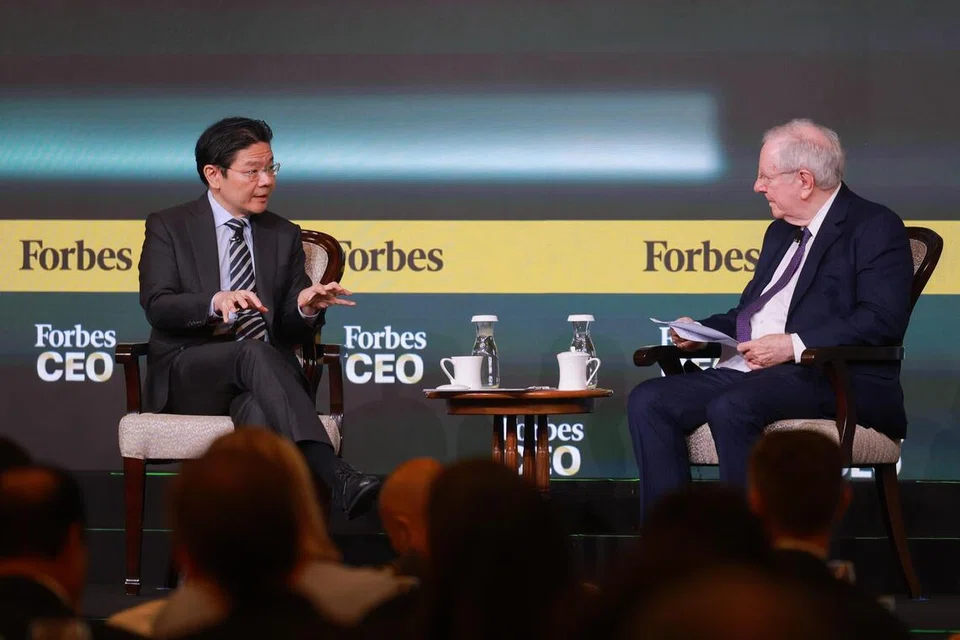

Singapore Prime Minister Lawrence Wong warned that the global economy is moving towards greater fragmentation as countries impose more trade barriers, while defending Singapore’s open-trade model, fiscal discipline and approach to artificial intelligence during an interview with Steve Forbes, President and CEO of Forbes.
“Unfortunately, I think the world is heading in that direction,” PM Wong said when asked about the outlook for global trade amid rising tariffs and the formation of regional trading blocs.
“Industrial policy is back in a fashion. Countries everywhere are looking to put up more barriers to protect their own industries.”
With trade at three times the size of its gross domestic product, Singapore cannot afford to turn inward, PM Wong said. “We will get poor very quickly if we do so,” he stated.
Instead, Singapore aims to deepen and diversify its international connections, strengthen integration within the Association of Southeast Asian Nations (ASEAN), and pursue opportunities in Latin America, Africa and the Middle East.
“In a fragmented world and a fragmented global economy region by region, these different regions still need to connect with one another and we hope to be one of these connectors,” Mr Wong said.
He added that Singapore will remain committed to openness despite the increasingly unpredictable global environment. “In a more unpredictable and messier world, stability and trust matter more than ever,” he said.
Energy security and freedom of navigation
Discussing the energy crisis linked to the conflict around the Strait of Hormuz, PM Wong said the worst-case scenario of severe energy shortages had not materialised, partly because businesses and countries had adapted.
Singapore’s refineries had sourced crude oil from outside the Middle East and adjusted their operations to accommodate different grades of oil, he said.
PM Wong cautioned however, that a prolonged conflict could keep energy prices elevated and increase inflationary pressures across food, materials and supply chains.
Singapore had already introduced two support packages for households and businesses, he said, adding: “If things get worse, we will be prepared to do more.”
“We are concerned that what’s happening in Hormuz may set a precedent for elsewhere,” he said, citing the strategic importance of the Straits of Malacca and Singapore.
He said Singapore, Malaysia and Indonesia were aligned on the principle that international waterways must remain open and that freedom of navigation and transit passage must be respected.
AI, jobs and worker protection
On artificial intelligence, PM Wong said governments should focus on protecting workers rather than preserving individual jobs.
“No boom is indefinite. Our approach is not to protect the job but to protect every worker,” he said.
He described Singapore’s partnership between government, employers and unions as central to managing technological disruption and ensuring workers benefit from AI adoption.
Under this approach, government grants support enterprise transformation, while unions help businesses retrain and upskill employees.
PM Wong added that companies should pursue retrenchments only as a last resort and, when necessary, treat affected workers fairly.
On AI safety, he called for international rules governing the development of advanced AI systems, potentially under the United Nations.
“Eventually we think the rules and standards for frontier AI development has to be international. It cannot be just confined to a single country,” he said.
He also stressed the need for sector-specific safeguards, with human oversight and regulatory requirements tailored to applications in areas such as healthcare, finance and transport.
Fiscal discipline and economic resilience
PM Wong defended Singapore’s approach to attracting talent into government, arguing that competitive salaries help recruit capable people from the private sector.
The government sought to attract people with “the right character and values” and appeal to “their sense of purpose and their sense of meaning and calling”, he said.
On economic management, PM Wong emphasised disciplined public finances and sound monetary policy.
“We run balanced budgets,” he said, pointing to Singapore’s fiscal position and investment income as resources that allow the government to respond to economic shocks.
He also outlined Singapore’s strategy for healthcare financing model, which combines individual medical savings accounts, insurance for large hospital bills and a safety net for those unable to pay.
Looking ahead, he stated that Singapore’s healthcare system needed to focus more on prevention and extending healthy life expectancy.
“It’s not just a matter of lifespan but extend health span,” he said. PM Wong concluded that Singapore’s ability to remain open, stable and trusted would be critical to its continued success in a more uncertain world.