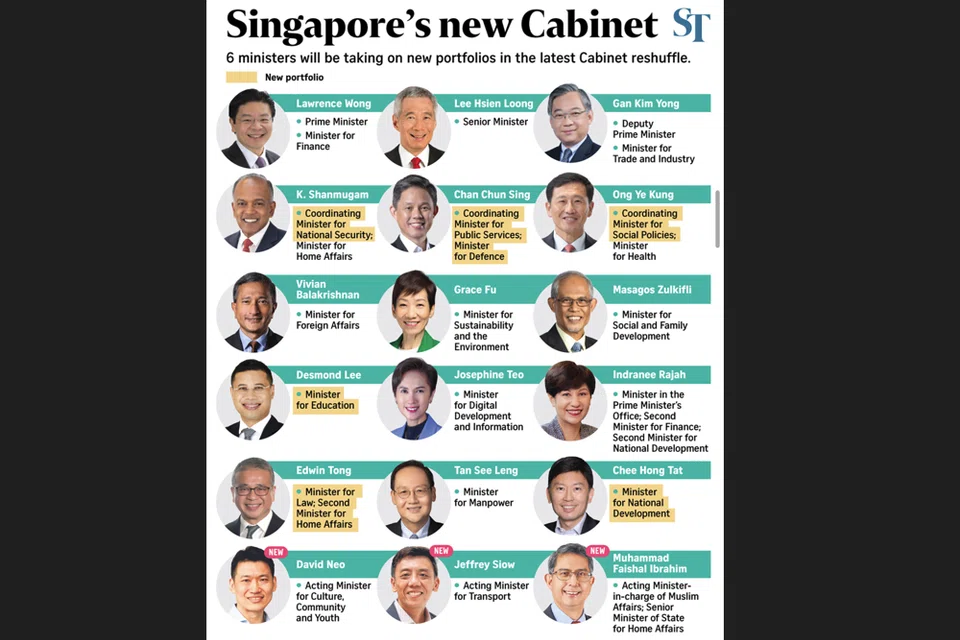

Prime Minister Lawrence Wong’s choice to have only one deputy prime minister and three coordinating ministers in the latest Cabinet changes creates a broader senior leadership team, said political observers.
They added that it leaves open the possibility for one of the fourth-generation ministers to be appointed as deputy prime minister in a future reshuffle, with Mr Chan Chun Sing and Mr Ong Ye Kung the front runners, having been appointed coordinating ministers in this round.
PM Wong announced his new post-election Cabinet on May 21, with a mix of experienced hands at the helm for key economic and external-facing portfolios amid the global uncertainty, as well as the injection of new blood to ensure renewal.
Among the more significant changes was the appointment of Home Affairs Minister K. Shanmugam as Coordinating Minister for National Security, as well as Mr Chan as Coordinating Minister for Public Services and Mr Ong as Coordinating Minister for Social Policies, who will boost what PM Wong described as his “core team”, which also includes Deputy Prime Minister Gan Kim Yong.
While it was widely expected that he would appoint a second deputy prime minister as has been the case for many of the previous terms of government, PM Wong did not do so.
Professor Terence Ho, an adjunct associate professor in practice at the Lee Kuan Yew School of Public Policy, said this can be seen as “an innovation to create a broader senior leadership team”.
Institute of Policy Studies (IPS) Social Lab research fellow Teo Kay Key, describing it as a “break from typical expectations”, said that with policies being more multifaceted now, having coordinating ministers can help to prevent overlaps or contradictions.
“In this sense, they might be more helpful to the overall operation of the Government compared to one more DPM, who would be playing more of a role to assist the PM in determining the overall direction of the country or overarching national policies,” she said.
Meanwhile, IPS senior research fellow Gillian Koh said the coordinating minister appointments will help to nurture the younger leaders and provide them the “pressure” to think holistically.
Sharing her sentiment was independent political observer Felix Tan, who saw it as a test for Mr Chan and Mr Ong, who are covering critical areas.
Mr Chan is also taking on another new role as Defence Minister and relinquishing his Education Ministry portfolio, while Mr Ong will retain his Health Ministry portfolio.
PM Wong does not appear to be in a hurry to appoint a peer as his deputy, said Singapore Management University law don Eugene Tan.
“The two 4G coordinating ministers may well be the front runners to be made DPM perhaps in a mid-term reshuffle,” he said.
Analysts also said PM Wong’s Cabinet choices signal his priorities in both continuity and renewal, with the ruling PAP’s 4G leadership now clearly in the driver’s seat.
Noting that only a handful of the 3G leaders remained to lend their experience and expertise, Prof Ho said the retirement of several party stalwarts in the recent election signals confidence that the team of younger leaders “is ready to steer the country forward”.
The Straits Times