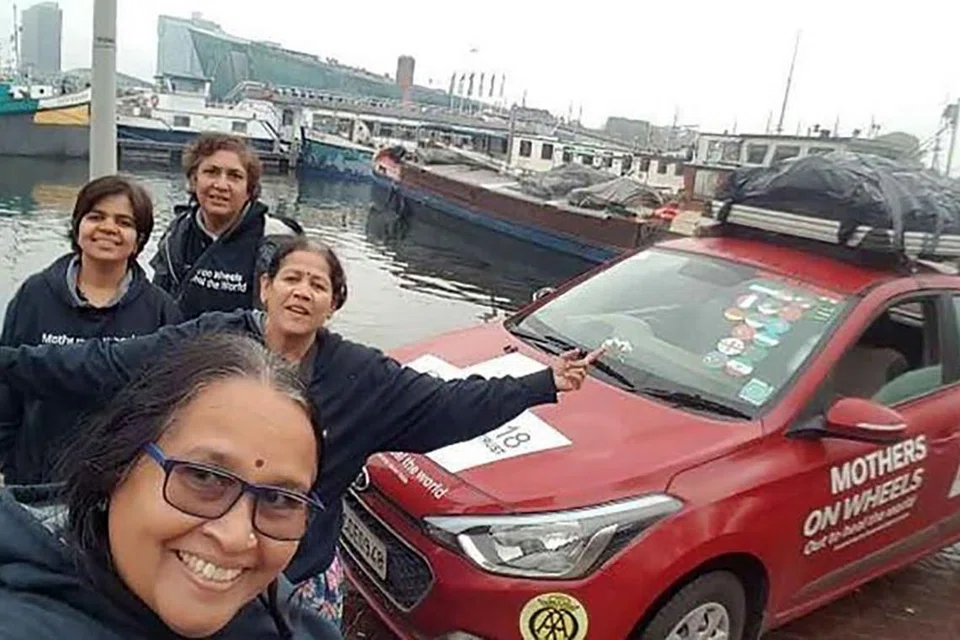
Three women from India – Madhuri Sahasrabudhe, Avanti Dixit and Urmila Joshi – arrived in Singapore last month on a mission that spans continents and cultures.
Their goal? To study the evolving role of motherhood in families across the globe through a project titled Mothers on Wheels Out to Heal the World.
Their journey, which began on March 4 in Bhutan, will cover 10 countries. The Singapore leg follows a re-route – they had initially planned to drive through Bangladesh and Myanmar but changed course due to political instability in both countries.
Instead, they flew into Singapore from Chennai on March 19. Their vehicle, a Tata Harrier SUV, is set to arrive by ship today. Once it docks, they’ll continue their expedition overland through South-east Asia, Australia and New Zealand.
This is their second transnational journey. The first was in 2018, a road trip from Delhi to London across 22 countries. That journey saw them meet over 300 mothers and sparked deep insights into global parenting cultures.
The Mothers on Wheels initiative is spearheaded by the Foundation for Holistic Development, a non-profit headquartered in Kolhapur, Maharashtra. It has operations in 18 Indian states and works with volunteers rather than formal members, with a core mission of strengthening “Matha Shakti” – the power of motherhood.
According to Madam Madhuri, the foundation’s genesis was in her experiences in the Kashmir Valley. In 2016, she observed how few boys were attending school and began personally visiting villages to motivate students.
With the help of government scholarship schemes and sustained engagement with students and their families, her work helped over 3,000 young people pursue higher education outside Kashmir.
“What I learnt was the impact of a motherly approach,” she said. “When spoken to with affection, children truly listen.”
Her experiences also revealed a deeper concern: The invisibility of mothers in some communities. “In Kashmir, mothers were absent from conversations. They were hidden away. That triggered me,” she said.
Another pivotal moment was the 2012 Nirbhaya rape case in Delhi. Madam Madhuri was troubled by the public defence mounted by the juvenile perpetrator’s mother. “What values had he grown up with?” she asked. “And what role did the mother play in shaping those values?”
It was then that the idea of studying motherhood itself – as a social institution – was born.
In 2018, Madam Madhuri and Madam Urmila, along with Madam Sheetal Deshpande and Madam Madhavi Singh Tomar, embarked on their first road trip: Delhi to London via 22 countries, 47 cities, and over 23,000 kilometres.
Their findings surprised them.
“Everywhere we went, mothers were taken for granted,” Madam Urmila said. “Governments talk about maternal health and nutrition, but the emotional and value-driven role of a mother is overlooked.”
Their journey culminated in an international conference back in India, where 32 mothers from eight countries, including Nepal, Germany, Iran and Kazakhstan, visited India to witness the Indian family system up close.
“One German mother cried after watching a 75-year-old man touch the feet of his 92-year-old mother,” Madam Madhuri recalled. “She said she was scared to even speak to her 10-year-old child.”
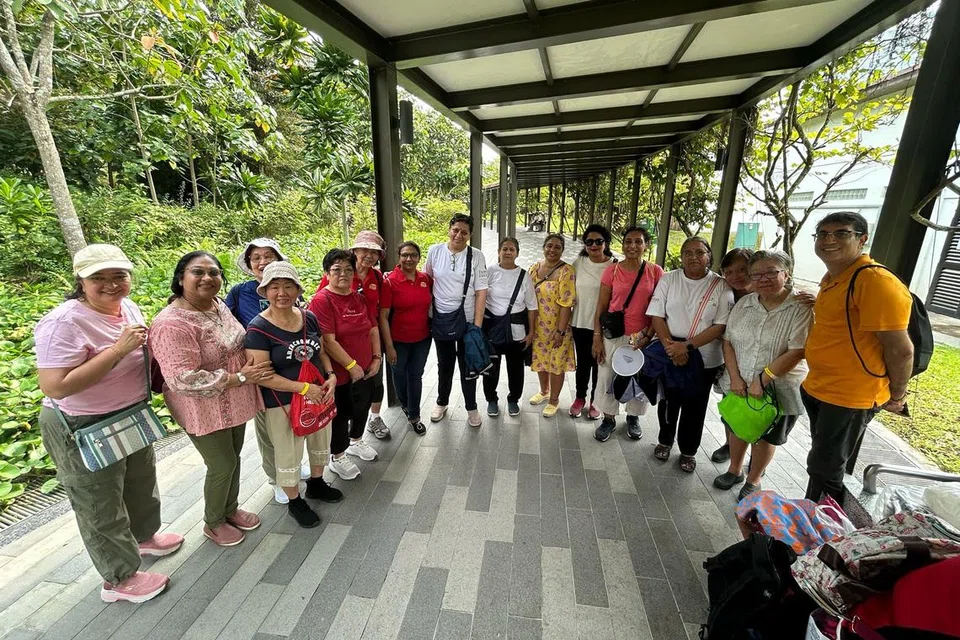
After landing in Singapore on March 19, the group met 70 mothers – 50 of them Singaporean Indians and the rest Singaporean Malay and Chinese – in two weeks. They also engaged with community organisations such as the Vivekananda Seva Sangh and parents from the Overseas Family School.
What they found was a society wrestling with familiar challenges: declining marriage rates, rising numbers of single mothers, and increasing divorce rates.
Mothers on Wheels have heard stories from local mothers about parenting in dual-income households, struggles with emotional connection, and concerns about youth growing up in emotionally detached environments.
“Spending quality time and nurturing open communication with children fosters confidence, emotional well-being and strong family bonds,” said Ms Maithilee Kale, a mother who participated in one of the discussions. “In Singapore, many dual-income households rely on day care or domestic help, which may impact children’s formative growth.
“Intentional parenting and presence are essential to support children’s holistic development and prevent low self-esteem stemming from lack of attention.”
Singaporean Chinmayee Bhandari, a working mother of a school-going boy, opened up about the daily struggle of balancing motherhood and work responsibilities.
“It’s difficult to fulfil all the roles of a mother with so many meetings and events scheduled throughout the day. I have to find time during the projects I’m working on,” she said.
Ms Chinmayee was deeply moved by the mission of the Mothers on Wheels team. “Meeting them was very inspiring. It’s unbelievable what they are doing. They are exchanging information and studying the changing role of mothers. They are on the road, travelling to different places to understand what needs to be done to keep motherhood strong.”
However, the three-member team stressed that these are early insights. A formal study is underway using structured questionnaires. “We’ve created detailed forms that we plan to distribute widely,” said Madam Madhuri. “We aim to collect about 100 responses from Singapore alone before drawing conclusions.”
Once the entire journey is complete, data from each country will be compiled, analysed and presented in an international conference in India later this year. Mothers from all visited countries will be invited to share their research papers and participate in cross-cultural dialogues.
“Last time, we lacked proper data collection. This time we’re better prepared,” said Madam Avanti. “Our ultimate goal is to create a global platform for mothers to collaborate and share insights.”
Back in India, the team is running a parallel initiative: Matrutva Shakti Ka Tandav. Through this programme, mothers across India learn the true meaning of motherhood and why a mother’s role is so important in a family.
The idea, says Madam Urmila, is to reconnect mothers with their traditional roles – not to restrict them, but to empower them with identity and value.
Modern challenges like children refusing marriage, avoiding parenthood or struggling with relationships are all part of the dialogue.
“Children today don’t understand sharing. They don’t understand relationships,” said Madam Avanti. “That’s because they’re growing up in nuclear families with minimal interaction.”
The answer, she says, lies in both tradition and dialogue. “We’re not advocating a return to the past. We’re proposing a rethinking of the future – with the mother at the centre.”