Political office-holders will get a one-off pay increase of up to 9 per cent, as the Government accepts the recommendations of a committee convened in December 2025 to review political salaries.
This means an MR4 grade entry-level minister getting the full adjustment will see his annual pay rise from $1.1 million to $1.2 million when the revised framework takes effect from Oct 15.
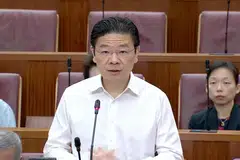
Speaking in Parliament on Sept 8, Prime Minister Lawrence Wong said the Government has accepted the committee’s recommendation to update the MR4 benchmark from $1.1 million to $1.8 million.
The salary range for ministers will also be widened. Beyond the one-off increase, PM Wong said, ministers’ salaries will continue to be adjusted based on performance, and that he expects most MR4 ministers to earn about $1.35 million – the lower end of the new salary range – by the end of this term of government.
The Prime Minister said he decided to act now given that ministerial salaries have fallen far behind both private sector and civil service salaries in the last 15 years.
While the gap is most obvious when compared with the private sector, even in the public service there are some senior permanent secretaries who earn more than ministers, he said.
Emphasising that good government did not come naturally to Singapore but was built deliberately over many years, Wong said his responsibility is to sustain the capacity for the city-state to have leadership that can plan ahead, take difficult decisions, and to deliver.
“It’s not simply about what we pay ministers today,” he said. “It’s about whether future prime ministers will continue to have a realistic chance of persuading capable Singaporeans – from the public service, the private sector and other walks of life – to step forward and build a first-rate team for Singapore.”
Salaries for political officeholders were last updated in 2012, with the changes backdated to 2011 when the new term of government started.
Since then, successive governments had decided to hold back on further changes due to reasons such as global instability, even though the salary framework remained relevant.
In 2017, a review committee recommended an upward adjustment, but the Government decided not to make any changes due to economic uncertainties.
The next review was scheduled for 2023, but was deferred.
“We cannot affirm a framework in principle but disregard it indefinitely in practice,” said Wong. “Otherwise, over time, the framework loses its meaning. Restraint cannot become neglect.”
While candidates looking to enter political service will still be expected to make a meaningful sacrifice, Wong said the revised salary structure will give him more room to differentiate pay according to performance, and crucially to bring in people with substantial experience from outside the Government.
This includes those already earning significantly more in the private sector, he added.
Under the framework, ministerial salaries are benchmarked to the median income of the top 1,000 earners who are Singaporean citizens, with a 40 per cent discount to reflect the ethos of political service.
The top 1,000 earners include people in senior management positions such as chief executives, chief operating officers and chief financial officers; people working in the financial services such as bankers, traders and asset managers; and professionals such as lawyers, doctors and accountants.
The median top 1,000 Singaporean earner now takes home slightly over $3 million a year, noted Coordinating Minister for Public Services Chan Chun Sing. The 40 per cent discount brings the updated MR4 reference annual salary to $1.8 million.
Wong said that the Government’s starting point is that good government depends on good leadership, and that institutions are only as effective as the people who lead them.
“Systems and processes matter. But they do not run themselves,” he said. “Especially at the top, the quality of leadership makes a decisive difference.”
Companies understand this very well, which is why boards spend so much time on succession planning, he noted.
Wong said he learnt this for himself when he was chief executive of the Energy Market Authority (EMA), and the authority was tasked with building the city-state’s liquefied natural gas (LNG) terminal.
As no one in EMA had the experience to do this, he had to search widely. A candidate was eventually found, but Wong said he had to offer a competitive package - far more than what he was earning as head of EMA - to bring him onboard.
“He proved his worth. He built up the LNG team from scratch, and delivered the LNG terminal safely – on time and within budget,” said Wong.
He noted that there are some who say ministers are different, given that the city-state already has a first-rate civil service.
But a strong civil service is no substitute for effective political leadership, said Wong. This is as ministers have to set the direction for their ministries, decide the priorities, and make the strategic calls.
“If those calls are wrong, even the best civil servants will struggle to deliver good outcomes,” he said. “They may execute efficiently – but they will be executing in the wrong direction.”
There are also decisions that civil servants cannot and should not make, he added.
This includes how the costs of stronger social safety nets are shared among individuals, the community and the Government, as well as how much to tax today and how much to leave for future generations.
“These are not just technical questions. They involve choices about priorities, interests and values,” he said.
Citing the reset of family policies that he announced at the National Day Rally, Wong said that civil servants could review each scheme and propose improvements.
But it was political officeholders in the Marriage and Parenthood Reset Workgroup who looked at the parenthood journey as a whole and helped shape the overall package, which included decisions on where support would make the greatest difference and how the costs could be shared.
Hence, a minister needs to have the character and commitment to serve, but also competence - the judgment, ability and leadership to do the job well, said Wong.
“This is where remuneration becomes relevant,” he said. “It does not determine who is capable, but it does affect whether enough capable people are prepared to step forward and take on the responsibility.”
While the challenge of assembling the best possible team to lead the country is not one that is unique to the city-state, Wong said Singapore has been an exception in putting together strong and stable governments.
“We have sustained these standards for so long that they can start to feel normal to Singaporeans,” he said. “But they are not normal elsewhere – and they are not guaranteed here either.”
This record of good government has been achieved through deliberate choices made over decades about how Singapore’s political system should work, and one of these choices was to deal with political remuneration openly.
“We recognise that highly able people have alternatives outside politics. So we pay political officeholders salaries that are competitive, but with a substantial discount to reflect political service,” he said.
In return, Singaporeans rightly expect much from their political leaders, including high standards of integrity, competence, and ultimately accountability to voters at the ballot box.
That same broad consideration applies to MPs, who carry substantial responsibilities in Parliament and in their constituencies, he added.
Wong said good leadership will be even more crucial as Singapore navigates a more uncertain and troubled world.
“So let us make the right decision – to keep the path open for capable and public-spirited Singaporeans to step forward, lead and serve,” he said.
The Straits Times