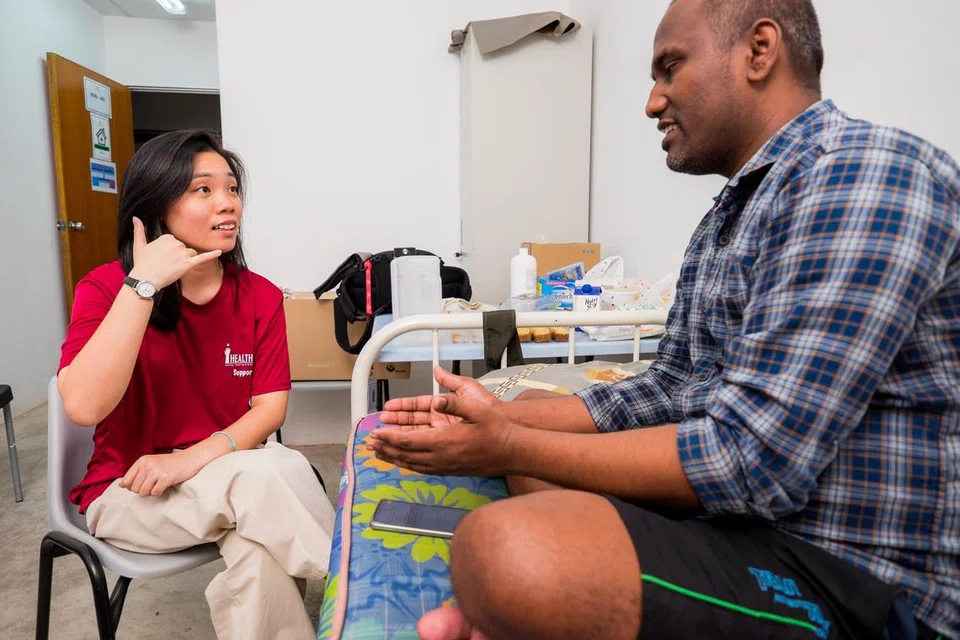

Ahmad, a Bangladeshi migrant worker, had been unable to work for more than a year after a heavy marble slab fell on him at work, injuring his leg and back.
When his work-injury case crossed the one-year mark, he could no longer receive wages while on medical leave. He then borrowed money from friends as he had to support his four children back home as well as his parents who were ill.
Eventually, after friends stopped helping him, he turned to HealthServe – a healthcare organisation committed to helping migrant workers – for help with his depression and insomnia. There, Ahmad found a safe space to process his grief and manage his stress.
Through counselling, he no longer views seeking help as a weakness but as a positive step. He continues to receive support from HealthServe’s casework team who accompany him for hospital visits and provide social assistance and counsel for his WICA (Work Injury Compensation Act) claims.
This was one of many examples of how HealthServe has lent a hand to Singapore’s one million low-wage migrant workers since its inception in 2006.
Operating out of a clinic in Geylang, HealthServe, which became a charity in 2011, tends to migrant workers with varying health and social needs.
“Our teams lend support to those who may be ill, injured, suffering from dental pain, in mental distress or require some form of social assistance,” said chief executive Benjamin Kuan.
“Patients with workplace injuries form a large proportion of clients. These range from slipped discs to more serious accidents, where some employers may not be supportive of their care and follow-up at the hospitals.”
The workers pay $5 for each visit, while those on a Special Pass who are unable to work after lodging an injury or salary claim need not pay.
Launched in 2019, HealthServe’s mental health programme is the first of its kind to support the mental and emotional well-being of the migrant worker community.
“Often, low-wage migrant workers struggle with various mental health issues, and have limited avenues to seek help,” said Dr Kuan.
HealthServe said it works closely with hospitals and dormitories to address and strengthen workers’ mental health via a three-pronged approach, which includes a 24-hour helpline (+65 3129 5000), counselling and group support sessions, and mental health education workshops.
This year alone, said Dr Kuan, at least 1 in 10 workers referred to HealthServe presented serious risk of self-harm.
“That’s a very worrying observation and signals the need for more to be done in the mental health space.”
As a lean charity, HealthServe’s work to meet migrant workers’ healthcare needs is underpinned by a pool of about 800 medical and non-medical volunteers, who range from pharmacists and dental assistants to helpline volunteers and translators.
“We’re always on the lookout for like-minded and passionate volunteers to support our clinic operations or regular health outreach, especially those who can speak Tamil, Bengali, Hindi, Burmese or Thai,” Dr Kuan said.
Interested individuals can visit https://healthserve.org.sg/volunteer