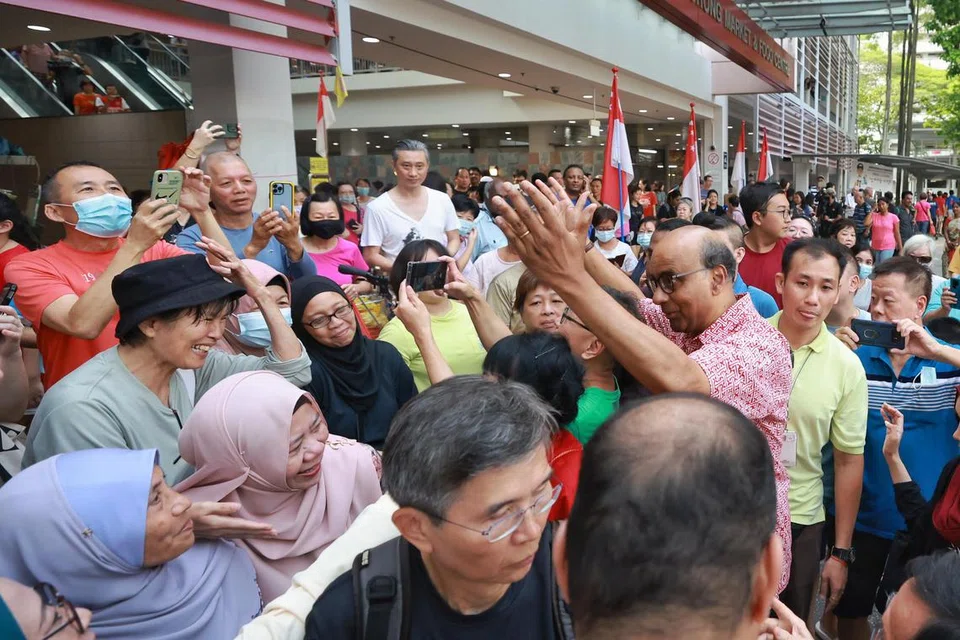
Former Senior Minister Tharman Shanmugaratnam last week became Singapore’s first non-Chinese presidential candidate to win a contested election.
He contested against two Chinese candidates but they together garnered only 29.6 per cent of the vote against his 70.4 per cent in a country where the Chinese comprise an overwhelming 74.3 per cent of the population.
The landslide victory represents a solid vote of confidence in a person of exemplary talent. Mr Tharman is a deeply moral and intellectual individual whose natural intelligence is matched by an equal degree of compassion for the disadvantaged and respect for those with alternative social views.
Clearly he was voted for as a person, not because of his ethnicity. Mr Tharman is from the Indian community, which accounts for 9 per cent of Singaporeans.
His activism during his student years, tempered by the realities of participating in the governance of a nation in an imperfect world, has produced that rare human being: a realist-idealist.
Mr Tharman led the People’s Action Party (PAP) team to a thumping victory that retained Jurong Group Representation Constituency (GRC) with 74.62 per cent of the vote in the 2020 General Election. In the previous hustings of 2015, he had led his team in Jurong GRC to win the highest vote share for the PAP, with 79.3 per cent.
Jurong GRC, a multiracial constituency like others, has turned out to be a microcosm of Singapore’s national politics.
What this says about Singapore is that the electorate is a mature and discerning one that is willing to look beyond race to talent in its choice of leaders.
Admittedly, race matters: That is why the GRC system exists in the first place – to ensure that ethnic minorities will always have a place in Parliament.
Every party, including PAP, is obliged to run a multiracial slate of candidates for the GRCs if it wishes to compete in them at all. Singapore is not post-racial, in which case there would be no need for GRCs.
Yet, Singapore is not race-bound either. The country stands at a transitional point where ethnicity is acknowledged as a reality but one which must not overshadow the larger project of nation-building, whose democratic basis is guaranteed ultimately by the legitimating process of general and presidential elections.
For Indian Singaporeans, Mr Tharman’s victory is not an ethnic one. He could not have won even if every Indian Singaporean citizen, to the exclusion of other ethnicities, had voted for him. He could not have won even if all Malay voters (whose community constitutes 13.5 per cent of the population) had rooted for him.
The Chinese vote made an overwhelming difference. His victory is a multiracial one.
Every Indian Singaporean would recognise that one of their own has won politically because other ethnic communities also considered him to be one of their own politically.
This is the magic of Singapore’s multiracialism. It accepts the reality of racial difference because, to not do so would lead to the cultural assimilation of minority Indians, Malays and Eurasians into a Chinese national sphere.
That would be a horrible price to be paid by the minorities for being Singaporean.
Integration allows various cultures and traditions to flourish within an expansive national framework. No one is subordinated to anyone else. Everybody is an extended function of everyone else.
The Indian diaspora, by which I mean not only Indians who have become citizens of their host countries but also Indians who retain their Indian citizenship while living abroad, have been buoyed rightly by the rise of fellow-Indians to high political office.
British Prime Minister Rishi Sunak, Irish Prime Minister Leo Varadkar and American Vice-President Kamala Harris are three among many illustrious persons of Indian origin who stand out.
However, in every case, they have done so by subsuming their ethnicity to their nationality. Only in that way have they drawn the trust of those who are ethnically different.
Mr Tharman’s victory is that of Singapore’s multiracialism. His Indianness is a part of that system and structure. May these verities never change.
Asad Latif is an editorial writer for The Straits Times