In surveys of newly minted lawyers in 2024 and 2025, around 60 per cent of respondents said they were likely to leave legal practice in the next five years.
The commonly cited reasons were excessive workload or poor work-life balance, a higher salary or compensation package elsewhere, the impact work had on their mental well-being, a lack of flexibility in their working arrangements and poor workplace culture.
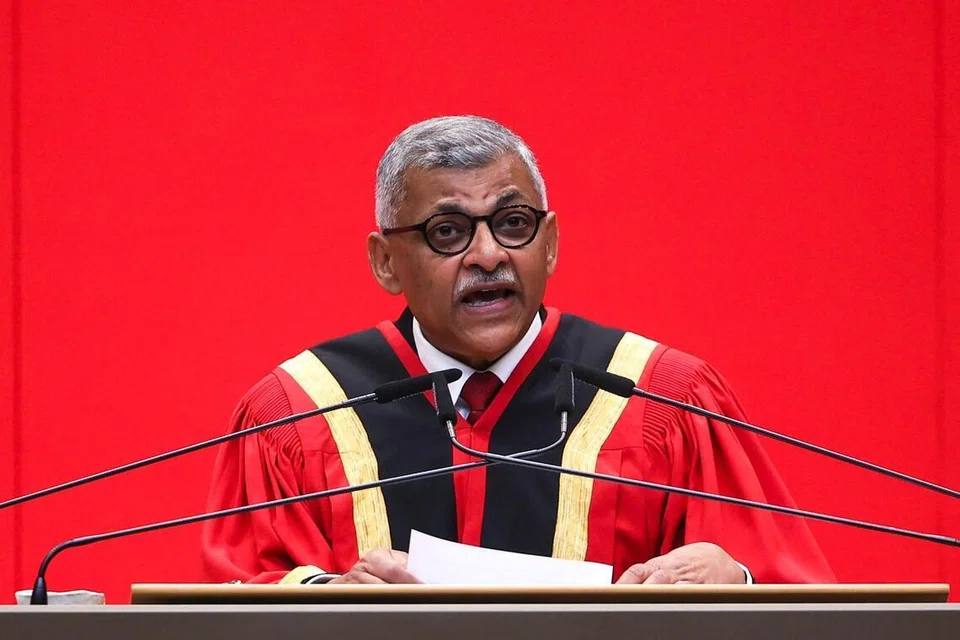
To address this, Chief Justice Sundaresh Menon said on Jan 12 that he and Law Minister Edwin Tong have committed to co-lead the direction of a committee to help the legal profession meet challenges such as attrition and the impact of AI on legal work.
Speaking at the annual opening of the legal year ceremony held at the Supreme Court auditorium, Chief Justice Menon said: “The Minister for Law and I have discussed this issue on a number of occasions, and we are very much aligned in our view that we must help our profession to meet these challenges.”
The committee will comprise representatives from the judiciary, the Attorney-General’s Chambers, the Ministry of Law, the Singapore Academy of Law, the Law Society of Singapore, the Singapore Corporate Counsel Association and academia, he said.
In his speech, Chief Justice Menon noted that 2026 marked the 200th anniversary of Singapore’s legal system, which was established in 1826 when the Second Charter of Justice was enacted.
He unveiled a series of initiatives and events to celebrate the bicentennial, including the launch of a commemorative medallion and a year-long exhibition at the Supreme Court building.
He also announced the formation of a judicial precinct, comprising the Octagon, the State Courts Towers, and the building formerly occupied by the Family Justice Courts, which will be repurposed to house the Syariah Court and other related judicial institutions.
He added the bicentennial was also an opportunity to reflect on what lies ahead.
One key challenge was attrition, driven by changes in legal practice, he said.
The digital age expanded cross-border interactions, removed limits on document processing and increased the pace of engagements, with clients demanding higher quality work and more responsive lawyers, he said.
Generative AI is also challenging a rethink of the function of a lawyer and the nature of legal work, he added.
While AI tools can help lawyers, it risks compromising the development of foundational skills such as legal research, analysis, drafting and reasoning.
“We should expect skills degradation to take place, which may even impact our ability to check the accuracy of AI-generated work product,” he said.
The implication of AI on the work of lawyers was also covered by Attorney-General Lucien Wong and Law Society president Tan Cheng Han in their speeches.
Mr Wong said AGC officers have access to many commercial AI tools.
“However, because of reasons of national security and the unique nature of AGC’s work, our needs cannot be met by commercial products alone,” he said.
Mr Wong said an in-house team has been instrumental in developing tools tailored to the organisation’s needs.
These include a judgment summariser, a chatbot to generate answers to questions on criminal law and procedure, and a treaty analyser that helps assess the litigation risk of proposed government policies touching on international agreements.
However, Mr Wong said core values such as fairness and honour, and uniquely human skills, such as interviewing a witness, cross-examination in court and negotiation, cannot be replaced.
“AI may be able to answer your questions, but it cannot tell you when you are asking the wrong question,” he said.
Professor Tan was concerned that technology is likely to shrink the need for the type of work many junior lawyers did today.
He added if lawyers do not understand or cannot access technological tools, this would affect their clients’ access to justice.
None of the speeches mentioned the controversies surrounding the Law Society that made headlines in December 2025.
That month, a group of Law Society members called for an extraordinary general meeting following unhappiness that Mr Dinesh Singh Dhillon, a ministerial appointee, was elected as the society’s new president in an internal vote by council members.
The brouhaha ended with a resolution passed for Prof Tan to lead the society, with
Mr Dhillon holding the vice-president post. An investigation is also under way at the Law Society over allegations of workplace bullying.
In his speech, Prof Tan paid tribute to past president Lisa Sam for connecting the Singapore legal profession to bar associations in Asia and signing memorandums of understanding with other professional bodies and trade associations.
He also paid tribute to the continued good work by ProBono SG, the society’s charity arm, under Mr Dhillon’s leadership.
The Straits Times