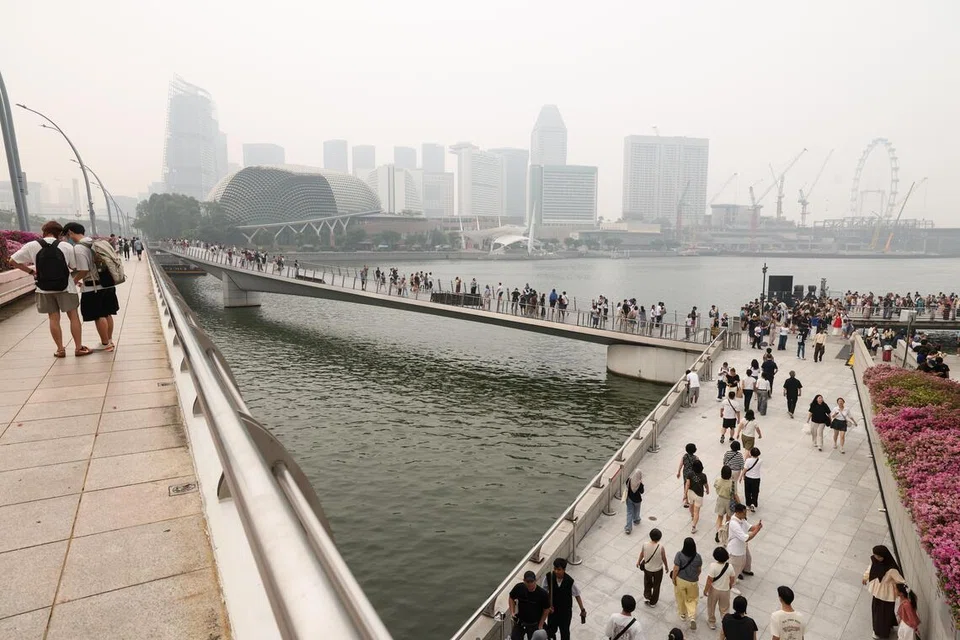
“With the shift from persistent southeasterly or southwesterly winds to light and variable winds in the surrounding region, smoke haze is less likely to be transported from fires towards Singapore,” said the Meteorological Service Singapore (MSS) said on Thursday (Oct 29).
MSS said that inter-monsoon conditions have been progressively setting in over Singapore and the surrounding region with the weakening of the south-west monsoon.
Together with wetter conditions over Singapore and the nearby areas, the smoke haze situation for Singapore is expected to improve, it added in its fortnightly weather outlook.
The National Environment Agency said showers are expected over Sumatra, Kalimantan, Singapore and the surrounding region on Oct 30, which should help to keep the haze situation suppressed for Singapore.
In the first two weeks of November, moderate to heavy thundery showers are expected over parts of the island in the afternoon on most days, said MSS.
The showers may extend into the evening on a few of these days. The total rainfall for the next two weeks is forecast to be slightly above its long-term average over most parts of the island.
It is expected to remain warm, as the daily highest temperatures are expected to range between 33 deg C and 35 deg C on most days, with the mercury slightly exceeding 35 deg C on a few days.
Since Oct 26, Singapore has been seeing clearer skies with the 24-hour Pollutant Standards Index (PSI) within the good to moderate range in all parts of the island.
While wind conditions may be favourable for Singapore, fires are still burning in Indonesia. Straits Times checks on the ASEAN Specialised Meteorological Centre’s (ASMC) website still show hot spots in Kalimantan.
Over the past few days, however, the number of fires in Indonesia seems to have dropped due to long-awaited rainfall.
On Oct 24, Palembang in South Sumatra – one of the regions alongside Kalimantan where forest fires have been raging for months – saw its first heavy downpour in three months.
ASMC said the hot spot and smoke haze situation may improve in areas experiencing showers but also continue to stay elevated in places with prolonged periods of dry weather.
The monsoon season is characterised by winds blowing from the south, which had pushed the pollution from the fires in Indonesia to Singapore over the past two months. The south-west monsoon season started around June.
Singapore has two main monsoon seasons, the other being the north-east monsoon season, which occurs between December and early March.
Inter-monsoon periods between the two dominant monsoons are characterised by lighter, more variable winds. Increased showers and higher lightning activity are also common features of the inter-monsoon periods.
In 2026, the ongoing super El Nino climate phenomenon appears to have extended the dry south-west monsoon by a month.
The inter-monsoon period usually sets in around early October.
Minister for Sustainability and the Environment Grace Fu had said in mid-October that when the rainy north-east monsoon brings wind from the north around early December, any haze from Sumatra and Kalimantan will blow in the direction away from Singapore.
Giving an update on the weather over the past two weeks, MSS said short-lived thundery showers fell over parts of the island over several days, with a few days of widespread moderate to heavy thundery downpours.
Temperatures also exceeded 34 deg C on most days, with the highest reading of 36.1 deg C at Woodlands on Oct 23. THE STRAITS TIMES