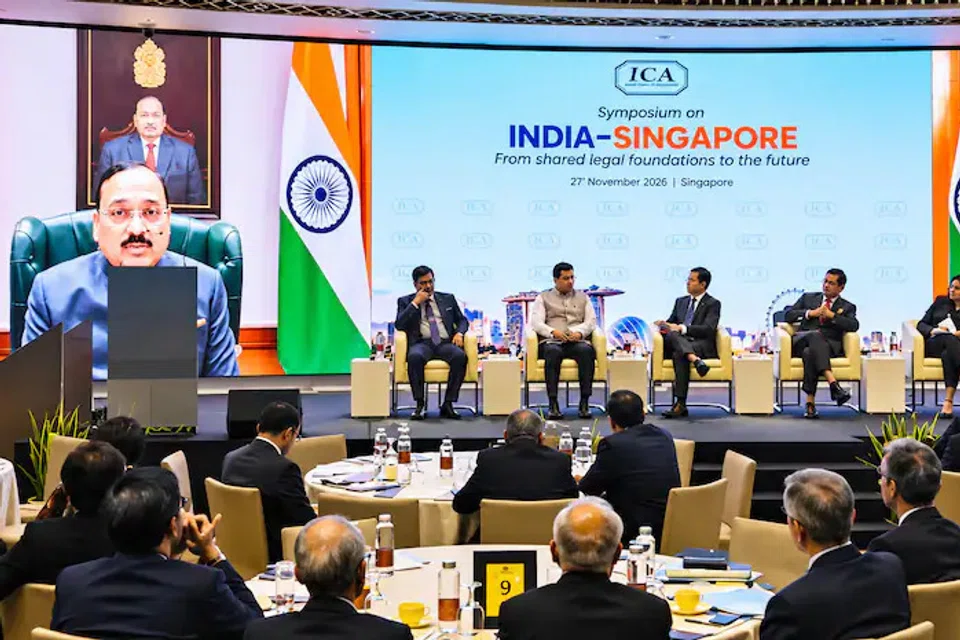
India and Singapore should strengthen cooperation in arbitration, mediation, professional training and legal technology to support their expanding economic partnership and enhance investor confidence, Chief Justice of India Surya Kant said on Nov 27.
Delivering a video address at a symposium organised by the Indian Council of Arbitration (ICA) at the Fullerton Hotel, Singapore, Justice Surya Kant stressed that predictable dispute resolution was fundamental to sustaining commercial relationships between the two countries.
“Predictability in dispute resolution is not an afterthought to commerce, it is part of the confidence that enables it,” he said.
Titled “India-Singapore: From Shared Legal Foundations to the Future”, the symposium marked the 200th anniversary of Singapore’s Second Charter of Justice of 1826, which extended the Court of Judicature to Singapore.
It brought together Singapore’s Minister for Law and Second Minister for Home Affairs Edwin Tong, Indian High Commissioner to Singapore Dr Shilpak Ambule, senior legal practitioners, business leaders and representatives of arbitration institutions.
Highlighting the growing economic interdependence between the two countries, Justice Surya Kant noted that Singapore was India’s largest trading partner within ASEAN, with bilateral trade increasing from US$6.7 billion (S$8.6 billion) in 2004-05 to US$34.3 billion in 2024-25.
Singapore also accounted for approximately 24 per cent of India’s cumulative foreign direct investment (FDI) inflows between April 2000 and March 2025, amounting to US$174.88 billion.
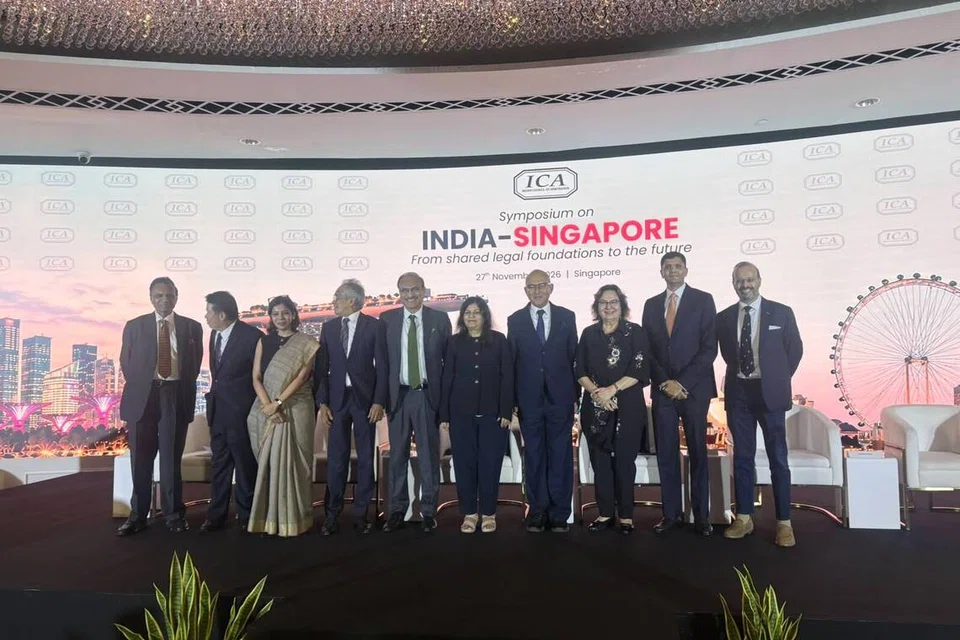
Justice Surya Kant said India’s expanding alternative dispute resolution ecosystem, including the establishment of the Mediation Council of India, presented fresh opportunities for bilateral cooperation.
He advocated the early use of mediation and the inclusion of multi-tiered dispute resolution clauses in commercial contracts to preserve business relationships.
“Sometimes the best outcome is not a victory for one side, but an agreement that enables both sides to move forward,” he said.
Referring to the 2024 Memorandum of Understanding on Cooperation in Law and Dispute Resolution between India and Singapore, he emphasised that future collaboration must be based on reciprocity.
“Neither needs to replicate the other’s institutional model. The opportunity is to learn from each other. The corridor must be a two-way channel for expertise, professional opportunities and institutional knowledge, measured by the confidence it creates on both sides,” he said.
Mr Tong highlighted India’s growing importance in Singapore’s international arbitration landscape.
With 178 Indian parties involved in Singapore International Arbitration Centre (SIAC) proceedings in 2025, India ranked as its third-largest foreign user jurisdiction. Indian lawyers and arbitrators also participated in numerous cases involving parties from other countries.
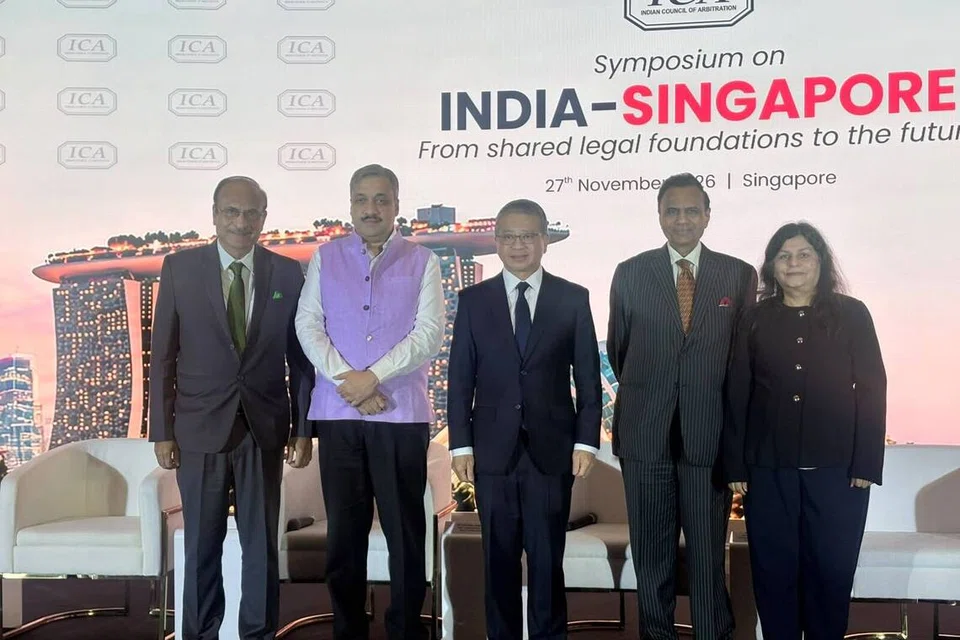
Mr Tong stressed the importance of resolving disputes fairly, transparently and predictably, while addressing challenges arising from increasingly complex commercial transactions involving multiple contracts and interconnected parties.
Such disputes could end up before different forums, potentially producing inconsistent outcomes.
“Arbitration is built on party consent. So how do we preserve that principle whilst ensuring that interconnected parties and their disputes can be resolved effectively?” he asked.
“India and Singapore should aspire not merely to succeed in international arbitration, but to make international arbitration better.”
Dr Ambule highlighted the diversification of bilateral economic cooperation into sectors such as semiconductors, aircraft maintenance, digital payments, skills development, energy and healthcare.
He noted that more than 12 visits by Indian chief ministers to Singapore had taken place over the past two years, while Singaporean companies were increasingly investing beyond traditional business hubs such as Bengaluru and Hyderabad.
ICA president and senior advocate Dr N.G. Khaitan attributed Singapore’s economic success partly to predictable regulation, effective commercial dispute resolution and strong enforcement of laws.
ICA director-general Arun Chawla emphasised that legal cooperation must facilitate future business partnerships.
“Commerce needs confidence, investment needs certainty, and both need assurance of justice,” he said.
The symposium also featured a panel discussion on commercial continuity beyond litigation, moderated by senior counsel Francis Xavier, and a conversation on the future of the legal profession, moderated by international arbitration specialist Avinash Pradhan.
Established in 1965, ICA represents more than 6,500 members and maintains collaborative relationships with over 50 arbitral institutions and international organisations worldwide.
The symposium underscored how the two countries could leverage their shared legal heritage to develop more effective dispute resolution mechanisms for an increasingly interconnected global economy.