
The High Commission of India has found a new home at 54 Stevens Road, after 78 years at its current premises on Grange Road. Construction is slated for completion by the end of 2028, when the new complex will become the home-base for the High Commission’s officials.
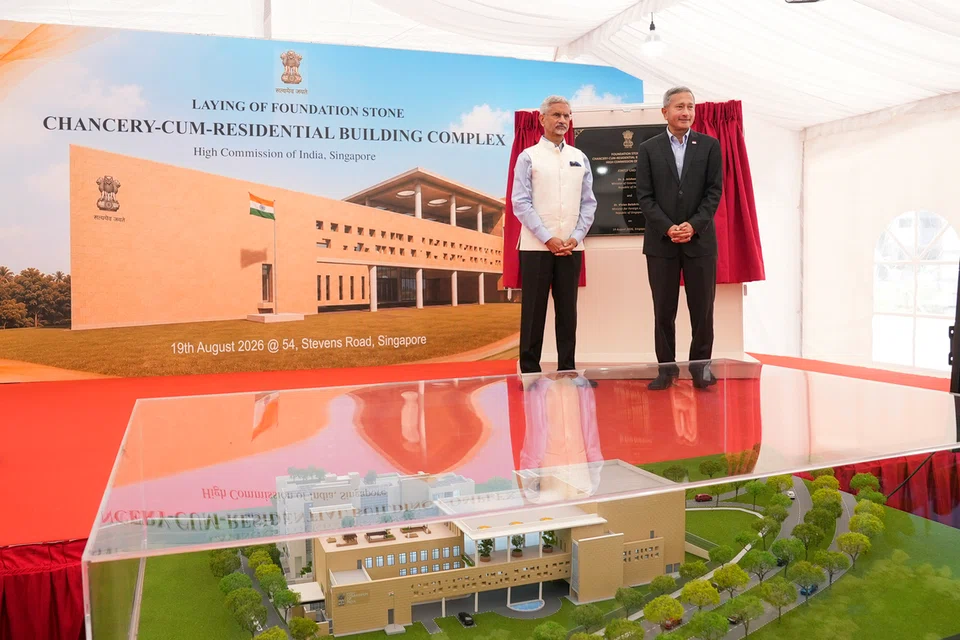
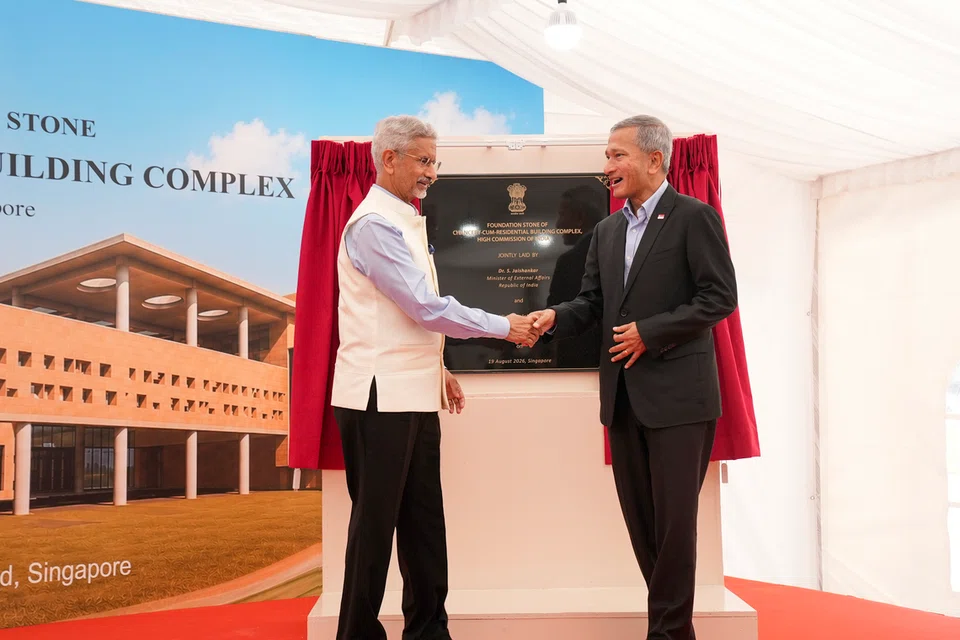
To mark the commencement of construction, a foundation stone-laying ceremony was held on Aug 19 at the site, bringing together India’s External Affairs Minister S. Jaishankar and Singapore’s Foreign Minister Vivian Balakrishnan.
Dr Jaishankar, who attended the ceremony with his wife, reflected on India’s long history of diplomatic properties in Singapore.
Recalling the first time he presented his credentials to then-President S R Nathan, the latter told him: “Singapore is a country where people judge you by how you take care of your property”.
The remark then set Dr Jaishankar on the task of restoring the High Commission’s property on Pierce Road – which is now the official home of the high commissioner, Dr Shilpak Ambule.
Taking stock of nearly two decades of engagement, Dr Jaishankar said the partnership has been steadily deepening – a rare constant, he added, “in a world which is very uncertain, very fragile,” where “so many relationships become more transactional and unpredictable.”
Citing the India-Singapore Ministerial Roundtable (ISMR) which was held on Aug 20, that brought together four ministers from each country to discuss the state and direction of bilateral relations, Dr Jaishankar thanked Dr Balakrishnan for his continued support and cooperation.
Dr Balakrishnan, meanwhile, credited India’s early diplomats for their great foresight in choosing prime locations for the country’s diplomatic properties over the decades, and described the new chancery as “an icon” of a relationship that is “focused on the current times and opportunities of the future.”
On the economic front, he noted that bilateral trade has doubled since 2005 and Singapore has been India’s top source of foreign investment since 2018, accounting for nearly a quarter of all FDI into India.
Dr Balakrishnan also spoke warmly of the ISMR, joking about the logistical challenge of coordinating eight ministers’ schedules, but stressing that the “trust and openness in which we can share both our concerns and ambitions is unique and essential.”
“As we navigate what is an increasingly turbulent, volatile, and complex world, our relationship has grown significantly over the decades, underpinned by robust institutional linkages, strong people-to-people ties, and a recognition that we’re in this together,” he said.
He also noted that Singapore looks forward to strengthening the ASEAN-India strategic partnership as the island-nation is set to assume chairmanship next year, especially since “Asia and India are two of the world’s fastest growing regions.”
There is, he added, “great potential (with scope to) deepen our partnership in all the pillars, connectivity, energy, digital economy, and the green economy.”
He rounded out his speech with a nod to the cultural exchange between the two countries – from joint dance productions in Chennai to a Singapore food festival in Mumbai featuring Singapore’s most beloved dishes, as well as our own biryani festivals.
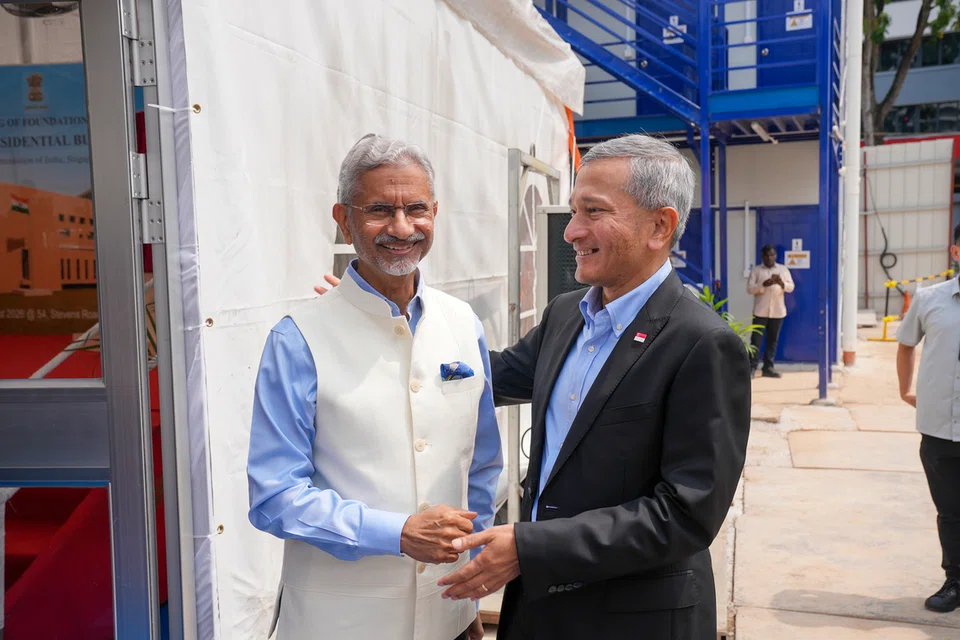
Dr Ambule, who chuckled at the mention of the biryani festivals, had opened the ceremony by welcoming guests to an event that, he said, “carries a significance that goes beyond bricks, concrete and architecture.” He added that the presence of both countries’ foreign ministers made the occasion a historic one, as they were the “torch-bearers of the (Singapore-India) bilateral relationship.”
Architect Steven Siow then walked guests through the design, describing his goal as creating “a contemporary building that is unmistakably Indian in character,” but attuned to Singapore’s tropical climate.
The design draws on the “majestic forts of Rajasthan”, he noted, with warm sandstone tones and a “contemporary reinterpretation of the traditional Jali screen” – a hallmark of Indian architecture that filters light through the building.
Spanning roughly 8,700 square metres, the complex will include a four-storey chancery, a five-story residential block with 17 apartments for diplomatic staff and a 500-seat multipurpose auditorium, equipped with retractable seating.
“Our vision is to create a High Commission that honours India’s architectural legacy while embracing contemporary design,” he added.