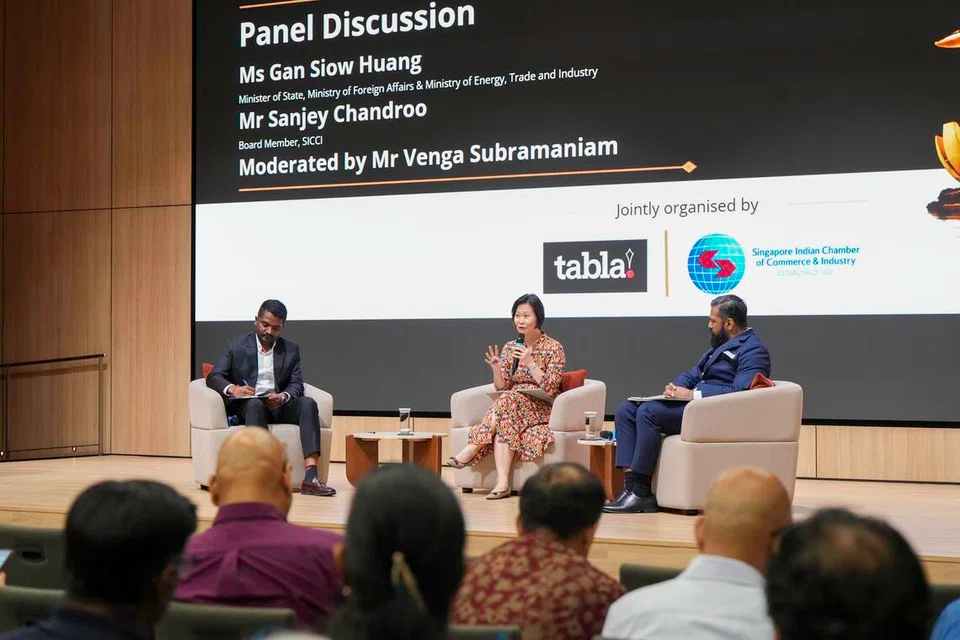

Singapore’s Indian business leaders came together Wednesday evening (Oct 21) to share and discuss how to navigate the challenge of myriad regulations and a complex business environment in India at the first edition of the tabla! Leadership Exchange Series.
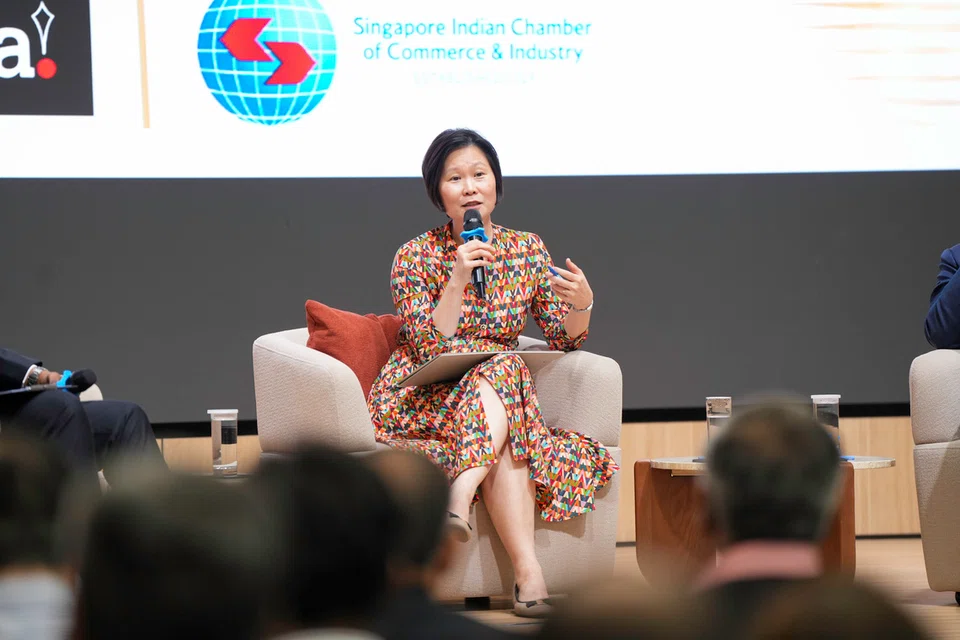
They also heard from Ms Gan Siow Huang, Minister of State, Ministry of Foreign Affairs & Ministry of Energy, Trade and Industry, who was the guest of honour at the dialogue that focused on strengthening Singapore-India trade and bilateral relations.
Kicking off the event, the Supervising Editor of tabla! Mr T. Raja Segar noted that the dialogue ties in nicely with the recent launch of tabla!’s Business section to “highlight prominent business figures, spotlight emerging entrepreneurs, cover trade developments, and showcase stories of innovation and leadership within the community”.
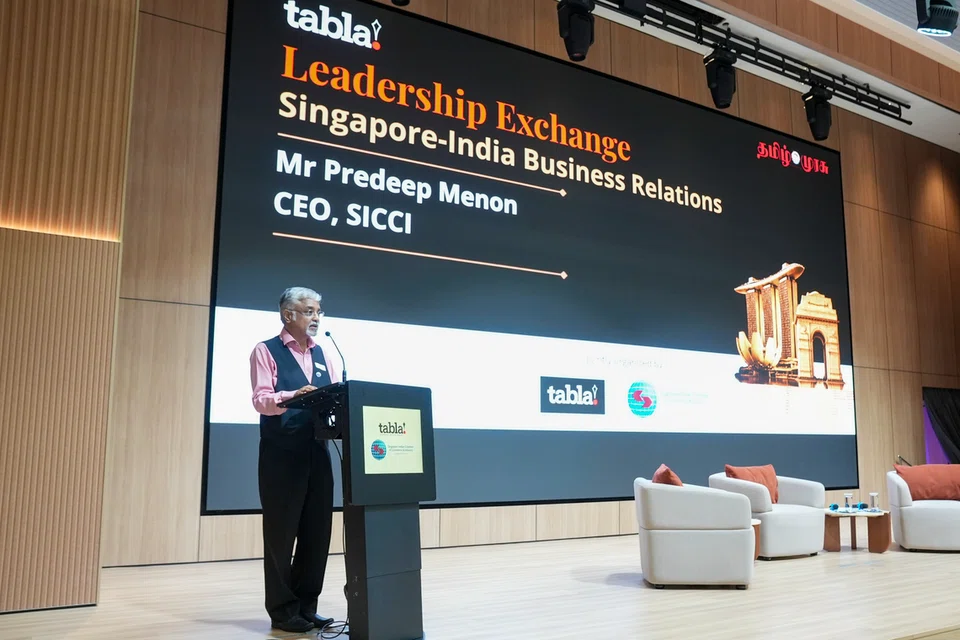
Following him onstage, Singapore Indian Chamber of Commerce and Industry (SICCI) Chief Executive Officer (CEO) Predeep Menon welcomed the collaboration with tabla!. He added that the inaugural dialogue underscores SICCI’s priority thrust to keep enhancing its extensive network of economic and multi-sectoral business linkages in India.
The dialogue is a joint effort by tabla! and SICCI. Noting that the world has changed and unilateral policies, tariffs and wars that impact major trade flows pose strong challenges to the business community, Mr Predeep said it was vital for businesses to stay updated about economic developments and be aware of government thinking and policies.
His remarks set the stage for MOS Gan and the dialogue that was to follow.
MOS Gan Shares Government Thinking
In her speech, MOS Gan said that the relationship between India and Singapore has been growing very well, and there was a desire to do more at the government level.
“India is a big market and one with a lot of potential, but not an easy one,” she said, adding that “as a country, there are actually many different states, and each state operates by itself quite autonomously, and has different sets of regulations, business landscape and culture.”
MOS Gan added: “And it’s not easy for locals, Singaporeans, coming from a very small population, to be able to understand, navigate and adapt quickly. Hence, at the government level, we commit to create more bridges between business communities on both sides.”
She also encouraged Singapore businesses interested in finding out more about the operating environment in India to check out the new business centre that the Singapore Business Federation (SBF) has established. In November last year, SBF opened a Singapore Enterprise Centre in Bengaluru. The centre is expected to engage more than 470 companies in the two years since it started through initiatives such as overseas business missions, roundtables, seminars and programmes.
At the government level, the relationship has grown, with ministers from both countries coming together to talk about areas of collaboration at the fourth India-Singapore Ministerial Roundtable (ISMR) in August. A parallel business forum - the India-Singapore Business Roundtable (ISBR) runs alongside the ISMR to connect business leaders from both nations.
Beyond bilateral trade, Singapore is also looking to improve the region’s trade with India when it becomes chair of the Association of Southeast Asian Nations (ASEAN). There is an existing ASEAN India Trade Agreement (AITIGA) that has been around since 2009.
“Officials are working very hard to upgrade this trade agreement. I’m optimistic. Eventually, it will unlock even more opportunities. And by that, I mean lowering trade barriers - tariff and non-tariff type of barriers - and open up more markets for businesses on both sides,” MOS Gan explained.
The event’s other guest was Mr Sanjey Chandran Chandroo, SICCI Board Member and Investment Director at CSD Ventures focussing on digitalisation, entrepreneurship and sustainability. His group has been in the education business in India for more than 20 years.
Headquartered in Gurgaon, it operates more than 70 pre-schools. He stressed the importance of working with a good partner, especially in a changing market such as India.
Adaptability and Resilience Key For Businesses
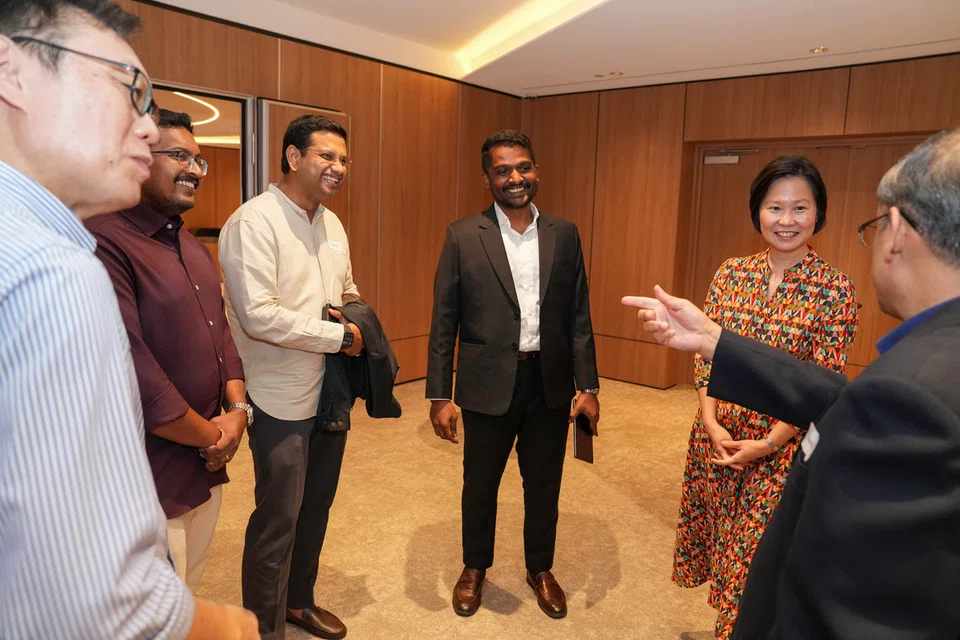
In the following dialogue moderated by tabla! Editor Mr Venga Subramaniam, participants were keen to know about how they overcome regulatory and other hurdles when seeking to enter the Indian market.
Adaptability and resilience, as well as seeking to complement existing business, were the key solutions that emerged, especially since different states often have different rules and policies that may change when state governments change.
Another suggestion was to explore areas India is interested in, with some noting the Indian government’s aim to scale its semiconductor and display ecosystem and Singapore’s expertise in that area.
Speaking after the event, Prudent Shipping Investments chief investment officer Mr Divay Goel, 53, said: “The dialogue was very useful. We now know to look out for more longer term opportunities for Singapore into India, rather than short-term or seasonal ones with the change of governments.”
On key takeaways, business development executive Mr B M Adithyan, 30, noted: “One of them would be how the current interactions between Singapore businesses, the Government and India have gone so far. It helps us plan how to move forward when we expand into India.” He works for St. James Place Singapore, a UK-based wealth management and financial advisory firm.
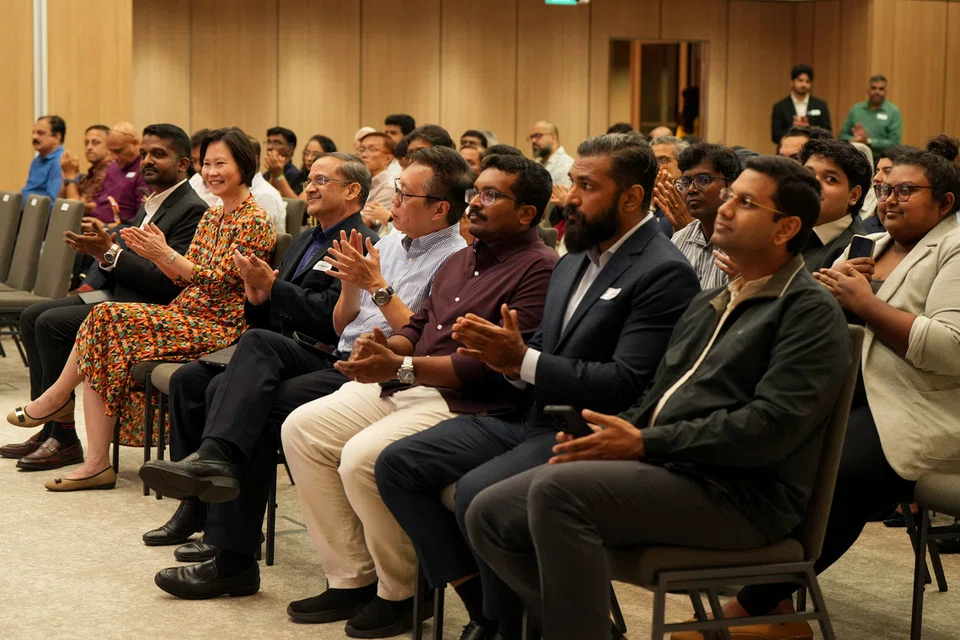
The event, which marked tabla!’s 18 years in publication, attracted around 90 attendees, including senior executives, captains of industry and entrepreneurs.
In addition to its free weekly print edition, Singapore’s leading English-language news provider for the Indian community delivers daily digital content via its refreshed website (tabla.com.sg) and maintains an active social media presence across Facebook, Instagram, TikTok, and YouTube.
Following a major revamp in 2025, the newspaper expanded its coverage with features including: Singapore in 2 Minutes - a concise weekly roundup of local news; Arts & Culture section - highlights local heritage and creative voices; Spice in the City - a dedicated weekly food column; tabla! Talks - a monthly podcast series highlighting key community discussions; and most recently, a dedicated Business section to showcase local entrepreneurs and enterprises.
Page views have crossed 1 million, while views of the digital e-paper have more than doubled to above 230,000. Print strength has also remained strong at nearly 15,000 copies a week.