Not only does the Indian Association (IA) have a long history, it has also played a special role in Singapore society over the years.
Founded in 1923 with the aim of promoting the social, physical, and cultural welfare of its members, the club has over the years brought together Indians from various social strata and encouraged them to form life-long bonds.
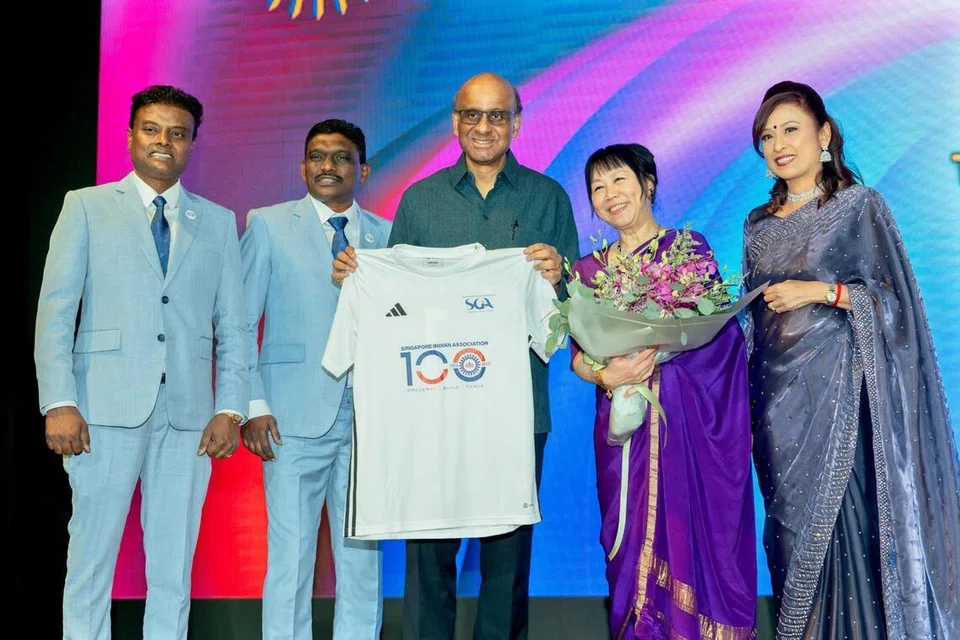
As it celebrated its centenary with a gala dinner at the Ritz-Carlton Millenia on Saturday, the guest of honour, President Tharman Shanmugaratnam, said it was “a moment worth celebrating”.
“You have gone through ups and downs, but here we are celebrating a hundred years, and with a very strong membership base as well,” he said. “Congratulations to the leadership, and the advisers. I also want to express gratitude to your past leaders.”
An exhibition of artefacts and trophies at the ballroom foyer exemplified IA’s important and colourful history.
Situated at Short Street in the very beginning, the association initially served to build kinship among Indians living here, regardless of language spoken or the region in India from which they originated.
In the 1940s, it turned into a centre for Indian youth to meet socially and engage in sporting activities. The club acquired land on Balestier Plain for use as an open playing field.
While moving its premises from Short Street to Owen Road and then to Race Course Road, it raised funds to build a clubhouse in Balestier Road; its foundation stone was laid by India’s first prime minister Jawaharlal Nehru on June 17, 1950. His daughter Indira Gandhi, who later became India’s prime minister, was also present.
On July 21, 1951, the clubhouse was officially declared open by Commissioner-General of South-east Asia Malcolm MacDonald. It continues to be the centre of IA’s activities after a few rounds of refurbishments.
However, the efforts to establish IA as the premier Indian organisation in Singapore gradually began to wither in the 1970s and 80s, as it was unable to connect with the new generation of Indians, and failed to attract most of the professionals in the community.
In 1988, when a new management committee took over, its finances were greatly depleted, and its membership was at an all-time low of 300.
The committee used sporting activities such as hockey, cricket, darts, billiards and tennis to raise the number of members to more than 1,000. The return of social events and an active women’s wing also enlivened the association.
IA, which has produced several sportspersons of national calibre since the 1950s, continued to produce more, especially in cricket and hockey.
But then it again experienced a decline in the early 2000s, when infighting and poor management made many Indians hesitant to join the organisation.
“When I took over as president in 2011, the clubhouse was in a dilapidated condition,” said former ambassador K. Kesavapany, who was at the helm for eight years. “I, along with a few others such as Haider Sithawalla, Shabbir Hassanbhai, Prof Kamal Bose, Eddie Raj and V.P. Jothi, raised more than $500,000 and got the association going again. It was tough, but we stood on the shoulders of those who went before us to lift the fortunes of IA.”
In 2022, IA went through another upheaval, before a young committee led by Mr Tamil Marren, a former national footballer, stepped up to run it.
“Your history has not been without challenges, but each time the leadership managed to revive the association, rebuild support from members and embark on a promising path,” said Mr Tharman. “The histories most worth remembering and reminiscing over are those that involved difficulties, not just those where everything went swimmingly well.”
He acknowledged the contributions of several past leaders including Mr S.A. Nathan, Mr S.S. Dhillon, Mr Leslie Netto, Mr Eddie and Mr Kesavapany, and the role played by IA in grooming sportspersons who went on represent the nation.
At the gala dinner, the likes of Shanti Pereira and Maimoon Abu Bakar (athletics), Imran Khwaja (cricket), M. Jeevananthan (hockey) and R. Suria Murthi (football) were honoured with scrolls and mementos.
“IA was of course not just about sports,” said Mr Tharman. “The bonds you have built among your patrons and your members are really what has kept the association going. It explains how we’ve come to 100 years.”
In his speech, IA president Marren said: “The challenges and adversities have come and been faced bravely. But possibly the next 25, 50, 100 years will be even more challenging for IA to remain relevant to the community and nation.
“The management committee is committed to working harder and coming out on top. We want to take IA forward and our efforts to connect with every level of the community is a work in progress.”
He identified five areas that require more attention: Community building, sports excellence, cultural activities, sustainable revenue stream and grooming of next-generation leaders.
In keeping with future goals, a new logo was launched with the letters SGIA prominent.
While commending the IA management for thinking about the future, Mr Tharman said: “IA must continue the recovery trajectory in the next few years – consolidating the gains you have made, growing your membership, if possible, but making the association a place where people want to be a member, and they want to meet each other there – that is important.
“I think you have to stay relevant to a changing Singapore because it is going to change dramatically, not just in the next 100 years, but in the next 25 years we will be an older society and we should have activities for the older population.
“Senior citizens who want to remain young at heart, even playing sports, engaging in games and having a fraternity that keeps them going. At the same time, you have the challenge of attracting more young members, (through) sports, music, and other ways. So I encourage you to do that as well.”