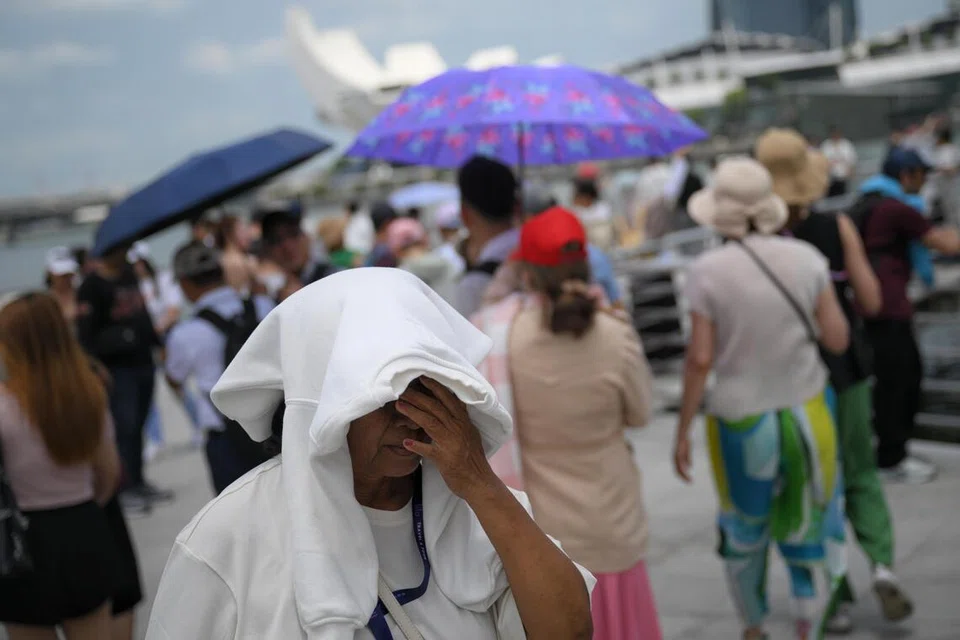
Cooling centres which are air-conditioned with seats in places such as community centres, selected Residents’ Committee or Residents’ Network centres, and some indoor sports halls are part of than 300 such facilities planned to be opened islandwide if a heatwave hits.
Their locations will be revealed once a heatwave response plan is activated, said Calvin Chong, divisional director of the energy and climate policy division at the Ministry of Sustainability and the Environment (MSE), said recently.
He added that the public will be alerted to an impending heatwave at least four days in advance via the national weather app myENV. If a centre is nearly full, priority will be given to vulnerable folk, such as elderly people, Chong said.
Rising heat is the most clear and evident climate change impact affecting Singapore.
The Republic is currently experiencing a “double whammy” of hot weather drivers, with the dry south-west monsoon season coinciding with an El Nino weather phenomenon, which brings hotter, drier weather over Singapore.
According to the National Environment Agency (NEA), based on nine heat stress monitoring stations, 17 days of high heat stress were recorded this year, compared with five days for the same period in 2025.
A heatwave is declared in Singapore when the daily highest temperature averages 35 deg C for three consecutive days, with a daily mean temperature of at least 29 deg C.
The El Nino is intensifying into a “Godzilla” event, scientists say. For the already sweltering island-state, extreme temperatures could be recorded when the El Nino event weakens, which could be March to May 2027, the NEA has warned. That coincides with the hottest period of the year.
“That’s something we are studying quite closely, and we are prepared to activate the heatwave response plan if it hits that level,” added Chong.
Singapore experienced its last heatwave in April 2016, at the tail end of a powerful El Nino episode.
In early 2025, Singapore’s first national heatwave response plan was announced by the MSE. The plan laid out the steps that various sectors must take when a heatwave is declared.
For example, schools may go on either partial or full home-based learning during a heatwave. Pre-schools and nursing homes should not have outdoor activities between 11am and 4pm, usually a period of high heat stress.
Subsequently, a Heat Resilience Policy Office was set up under the MSE to orchestrate the plan and oversee heat management efforts across the country for the long term.
Mr Chong, 43, oversees the new Heat Resilience Policy Office, as well as three other divisions including nuclear safety and radiation protection.
Mr Chong said that previously, the heat office was parked under MSE’s climate adaptation division. Adaptation refers to shielding the country from climate impacts such as rising seas, extreme rainfall and hotter weather.
But over time, there was a growing realisation that heat is going to be a pressing issue, with many domains impacted by rising temperatures, said Chong. It is not just a health problem, but can also affect workers’ productivity, for instance.
So the heat office was spun off as its own division and it is currently staffed by five MSE employees.
In his first interview representing the new office, Mr Chong fleshed out more details about the heatwave plan, which previously did not have information such as the number of cooling centres.
Since a heatwave response plan has never been rolled out before, he said the office is working to ensure that the response plan can be rolled out smoothly.
For example, not everyone may know how to seek help when a heatwave is declared.
This is where community touchpoints are needed to check in on vulnerable groups like seniors and direct them to the nearest cooling centre, said Mr Chong.
“There are limits to how many general broadcasts and myENV alerts we can do. Perhaps some of the unevenness will come at the local level,” he said.
For vulnerable groups, agencies will work with community partners such as Social Service Offices to conduct outreach and provide support during a heatwave. The specific forms of support will be tailored to the needs of each group, he added.
Additional personal fans could be given to senior care residential centres if needed.
During the interview, Mr Chong also set out the new office’s immediate priorities.
For example, it will develop a heat resilience action plan across the infrastructure, health, economic and social sectors, and also extend proven cooling solutions to other sectors.
On how heat could impact critical infrastructure, Mr Chong cited the recent European heatwave that led to cracked roads and buildings, and melted road surfaces.
He explained: “(Heat is) of course very physiological, very real. But infrastructure is something we are keeping a close watch on.
“What if pipes break or crack? Are our buildings and critical systems up to scratch? What future investments might we need?”
The office will also coordinate and oversee research on heat in Singapore.
“We are working with researchers to have a better understanding on the thresholds for heat on the various groups, and what more might need to be done,” said Mr Chong, pointing to vulnerable groups such as seniors and children.
This could translate to more specific and targeted heat stress advisories for the vulnerable populations, building on the national advisory for prolonged outdoor activities rolled out for the public in 2023.
Under that advisory, people should take more frequent breaks under shade and wear lightweight clothing during periods of high heat stress, which is indicated on the NEA website or myENV app.
The heat office will also oversee a heat resilience research and development (R&D) programme that will be launched under Singapore’s Research, Innovation and Enterprise 2030 plan.
Under the programme, a new $40 million “Adapting to Heat Impacts” funding initiative will focus on managing the economic, public health and social impact of heat on society, said Mr Chong.
An open call for research applicants will be put out by the end of 2026.
Mr Chong noted that studying heat in the tropics has been an underexplored area, but researchers in Singapore have been conducting a wide range of studies in recent years.
This includes tracking the heat strain faced by construction workers and how it affects productivity, finding out that indoor temperatures of most households may be hotter than the outdoors, and even looking into traditional chinese medicine practices to beat the heat.
“We can build a body of knowledge about how to understand heat from a Singapore context and make meaningful intervention measures. It will benefit the region as well,” said Mr Chong. THE STRAITS TIMES