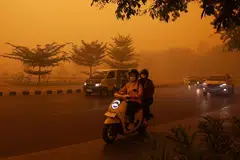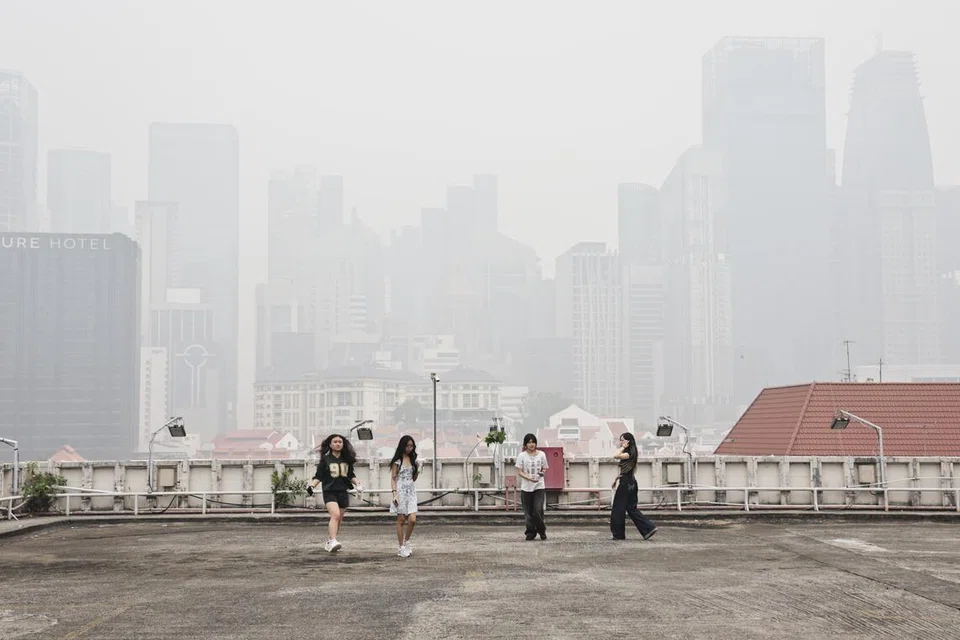

Unhealthy air quality, respiratory complaints and disruptions to outdoor activities are raising concerns as Singapore braces for weeks of transboundary haze.
The country’s worsening haze is disrupting daily life, triggering respiratory complaints and raising concerns about how long the polluted air will linger, as unusually dry conditions fuel forest and peatland fires in neighbouring Indonesia.
The haze has persisted since September, with the 24-hour Pollutant Standards Index (PSI) reaching unhealthy levels across the island.
On Oct 14, Singapore experienced a severe surge, causing air pollution metrics to reach their highest peaks of the year. Dense smoke plumes carried over from intense forest fires in Kalimantan and southern Sumatra by prevailing southeasterly winds heavily blanketed the island.
At 9pm on that day, the PSI in western Singapore crossed into the “Very Unhealthy” band (201-300) for the first time in 2026, hitting a peak of 203. The peak climbed slightly further to 212 by noon the following day.
While the west bore the brunt of the pollution, the PSI across the rest of Singapore hovered deeply in the Unhealthy band (101–200), spanning between 110 and 184 depending on the region.
The prolonged episode has been linked to exceptionally dry conditions associated with El Nino and regional weather patterns that have made vegetation and peatlands more vulnerable to fires.
The unusually strong El Nino, sometimes described as a “Super” or “Godzilla” El Nino, has raised concerns that the haze could persist into November or December, depending on rainfall and prevailing winds.
Unlike previous episodes, the pollution has affected Singapore over an extended period, prompting residents to adjust their routines, reduce outdoor activities and monitor air-quality readings more closely.
Health concerns grow
Health Minister Ong Ye Kung announced on Oct 11 that the Government would activate the Haze Subsidy Scheme (HSS) and Public Health Preparedness Clinic (PHPC) scheme from Oct 12.
The decision followed an increase in patients seeking treatment for respiratory conditions at hospitals and polyclinics.
“I think it is not just due to haze, but also because the haze season this year coincided with Influenza A season (and) compounded each other,” Mr Ong said.
He urged patients with less serious symptoms to seek treatment at clinics rather than hospital emergency departments.
“Go to a clinic – your family physician can take care of you,” he said. “Leave emergency department facilities for those with very urgent, very serious conditions.”
Under the subsidy scheme, Singapore citizens seeking treatment for qualifying haze-related conditions at polyclinics will pay no more than S$10.
Eligible children, seniors and Community Health Assist Scheme (CHAS) cardholders can receive subsidised treatment at participating clinics. Pioneer and Merdeka Generation seniors pay a maximum of S$5, while Public Assistance recipients receive fully subsidised care.
Qualifying illnesses include asthma, bronchitis, allergic rhinitis, conjunctivitis and upper respiratory tract infections.
Family physician Dr Sujatha Sathiamurthy of East Coast Family Clinic advised residents to minimise exposure to polluted air.
“The most effective precaution would be to reduce inhalation of polluted air, especially when you undertake prolonged or strenuous outdoor activity,” she said.
The physician recommended monitoring PSI and hourly PM2.5 readings, wearing N95 masks when necessary, avoiding strenuous outdoor exercise, using indoor air purifiers and staying hydrated.
Residents respond differently
For some Singaporean residents, the haze has brought back unpleasant memories of India’s heavily polluted cities.
Mr Jitesh Sinha, president of sales and business development (ASEAN) at Vardaan Global, said the situation was particularly worrying for families with young children.
“Living in Singapore, we are accustomed to relatively clean air, so any noticeable deterioration in air quality is concerning,” he said.
“Having experienced Delhi’s smog, I know how overwhelming it can be when poor air quality becomes part of daily life.”
Writer and poet Neetu Gujral similarly recalled Delhi’s winter pollution but praised Singapore’s response.
“The Singapore government’s proactive Haze Task Force and transparent hourly data instantly cut through the panic,” she said.
Marketing and media expert Anurita Kher said she and her family had fallen ill during the haze episode, experiencing dry coughs and flu-like symptoms.
Others are taking a more relaxed approach.
Financial services professional Dhruv Jain said the haze was unpleasant but temporary.
“It is there. It is annoying. But it will go away. There is no point worrying about it,” he said.
He observed that East Coast Park on Oct 14 appeared unusually deserted but he continued walking outdoors without a mask.
Why the haze may persist
Singapore’s National Environment Agency (NEA) has traced the smoke to fires in Kalimantan and southern Sumatra, carried towards the island by easterly and southeasterly winds.
The combination of El Nino and a positive Indian Ocean Dipole has contributed to warmer, drier conditions, making fires harder to contain. Indonesia is experiencing its worst wildfire season in more than a decade, with degraded peatlands presenting particular difficulties for firefighters.
Indonesia has deployed tens of thousands of personnel to fight the fires and is experimenting with additional suppression techniques.
The haze has also affected Malaysia and other neighbouring countries, renewing debate about land-clearing practices and corporate accountability.
Singapore’s Transboundary Haze Pollution Act, introduced in 2014, allows action against companies responsible for haze affecting the Republic. However, enforcement across national borders remains challenging.
The immediate outlook remains uncertain. NEA warned on Oct 13 that dry conditions in parts of Indonesia could continue despite occasional showers in Singapore, with unhealthy air quality likely to persist.
Mr Ong said the haze could last several more weeks, although the Government does not expect pollution to reach the extreme levels recorded during the 2013 crisis when the PSI hit 401.