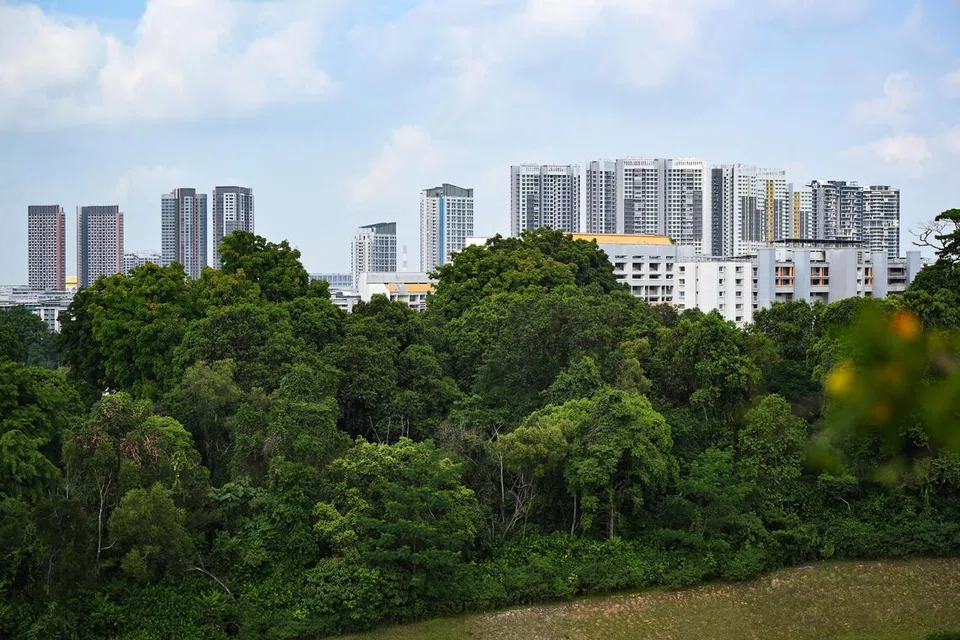
Under revised plans following public feedback, more greenery will be retained in Maju Forest and Gillman Barracks which will reduce the the number of homes to be built there by 1,200 – an estimated 400 less in Maju Forest and 800 less in Gillman Barracks.
Announcing the revised plans on Oct 28, HDB said it took into account earlier studies for both sites, public feedback and broader planning considerations such as housing needs and the availability of alternative sites.
For the 23ha Maju Forest, about 10ha of greenery will be retained, up from 8ha under plans unveiled by the HDB in July.
The area, which is currently largely forested, is expected to yield 4,000 flats. Land preparation works are slated to begin from the first half of 2028, and public access to the site to be restricted from then.
At Gillman Barracks, about 12ha of the 40ha estate will be set aside for greenery, up from 8ha that was originally planned.
The former British military camp will be redeveloped for about 7,000 homes, of which about 5,500 will be flats and the remainder will be private housing.
Site works are expected to begin with the demolition of buildings from the second half of 2027, and land preparation works will start in 2029.
Speaking to the media on Oct 28, Minister of State for National Development Alvin Tan said HDB will build taller blocks where possible to intensify use of the remaining development area.
HDB’s revised plans follow several months of public debate over the plans for both sites, with some of the areas’ residents and nature advocates upset over plans to redevelop the green sites, and keen to have more say on the sites’ future use.
From July 10 – when plans for the two sites were first announced – to Aug 6, the board received about 7,200 feedback submissions for Maju Forest and 2,300 for Gillman Barracks.
HDB said about 1,000 people were also engaged “to better understand the concerns raised and hear from different segments of the community”.
The Ministry of National Development and public agencies held engagement sessions with nature groups, youth, academics, planning and built environment professionals, and members of the public. MPs also organised sessions for residents living near the two areas.
Mr Tan said many residents requested to retain more greenery where possible, during door-to-door engagements and closed-door sessions.
“Many have also told us that they understood the need for more housing and also shared with us constructive feedback and suggestions on what they would like to see in the future estates,” he added.
HDB said there were also questions on whether more housing was required at the two sites, and suggestions to explore other brownfield sites, intensify existing developed areas, or reduce the proposed development footprints.
Residents had also submitted alternative proposals for Maju Forest and Gillman Barracks, which HDB reviewed.
One, called A Better Plan for Gillman, proposed that some of the homes planned for the area be built instead at Alexandra Park, so forested areas in Gillman would be left untouched.
An HDB spokesperson said the proposal to concentrate housing development only within brownfield areas at Gillman Barracks and Alexandra Park could not be adopted as the latter area is currently occupied, and will not be available for redevelopment within the timeframe in which housing supply is needed.
As for the plan’s call to preserve more of the forest and make the site’s natural and heritage assets more accessible, the spokesperson said the HDB’s revised plan sets aside more greenery, reduces the development footprint and strengthens ecological connectivity.
Meanwhile, Sunset Way residents proposed to fully retain Maju Forest as a climate resilience centre that would serve research and recreation purposes.
The HDB spokesperson said doing so would not address housing needs. “However, the revised plan responds to some of the underlying concerns about conserving a larger, more connected forest and retaining its ecological functions,” he added.
The board said planning for national needs – such as housing, nature and heritage – requires “difficult but necessary trade-offs”.
It added that alternative brownfield sites were considered for development, including locations suggested by members of the public and residents.
Some of these sites are already planned for housing and will contribute to future supply – such as the Protective Security Command in Ulu Pandan Road, HDB said.
Other sites that had been looked at, including Maju Camp and the former Central Manpower Base in Depot Road, are required for existing uses, and cannot be freed up within the timeframe in which new homes are needed.
“Taking into account all of the considerations, we have found – as best as we can – a landing spot and also a right balance,” said Mr Tan.
“These engagements also allow us to also explain our planning considerations as we need to juggle between retaining greenery, preserving heritage, and also meeting the housing aspirations of Singaporeans.”
HDB said housing demand in recent years has been strong, with larger cohorts of Singaporeans, who were born in the 1980s and 1990s, now looking to buy their own flats.
The board added that demand is also driven by decreasing household sizes, as more couples, singles and seniors choose to live on their own instead of with their extended families.
It noted that recent Build-To-Order projects in Clementi and Bukit Merah – where Maju Forest and Gillman Barracks are located – drew “significant interest”, with about 2,000 applications received for Clementi Emerald’s 420 four-room flats, and 5,300 applications for Berlayar Rise’s 988 four-room flats.
HDB said agencies “sought to strike the balance between developing the sites as sensitively as possible, while meeting the housing needs of Singaporeans” as they reviewed plans for the two sites.
Asked if the development plans shared on Oct 28 are final, Tan cited the cumulative 9,500 feedback submissions received, as well as the engagements with more than 1,000 persons – some of whom were engaged multiple times.
He said the Government has looked into many of the suggestions, and made its decision after “wide and deep consultations”. “We will have to proceed with the development as I mentioned, and I thank all of the stakeholders for giving us their views.” THE STRAITS TIMES