Losing his wife to cancer more than a decade ago, taking care of his son who has kidney failure and surviving a massive heart attack.
Dr Ramam Akkipeddi, who has endured several life-changing events over the years, published his experiences in the form of a memoir titled Memorabilia: Living Amidst Tempest Life.
“It was to share my experiences and provide optimism to people who face difficult situations. I consider this as a small contribution to society,” the 64-year-old said of his book.
Dr Ramam, a director in the president’s office at Nanyang Technological University where he coordinates research administrative matters, lost his wife Vijaya Bhanu to lymph node cancer in 2011. She was only 44.
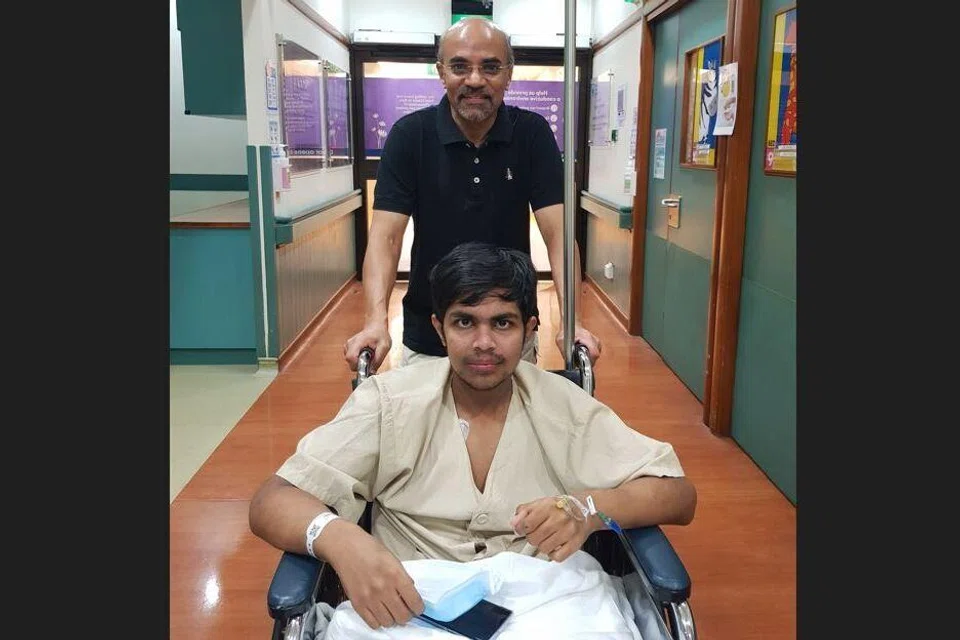
His youngest son Sudhakar Akkipeddi, 29, was barely two years old when he was diagnosed with focal segmental glomerulosclerosis – a rare kidney disease in which scar tissue develops on the glomeruli, the small parts of the kidneys that filter waste from the blood.
Mr Sudhakar’s condition was classified as end-stage kidney failure, a lifelong dialysis.
Dr Ramam’s older son Lokesh who works as an engineer, is married and settled in the United States. He helps with his family’s matters and stands as a strong pillar of support for Dr Ramam.
“Before my wife passed away, my daily routine was to get ready for work and send Sudhakar and her to National University Hospital (NUH) for their dialysis and chemotherapy sessions respectively. During lunch time I will get food for them and fetch them back once I end work,” said Dr Ramam, who also cares for his 87-year-old mother.
Dr Ramam, a Singapore permanent resident, used to work as a scientist before entering NTU. With a background in engineering, he worked at The Agency for Science, Technology and Research where he contributed to semiconductor research and was deeply involved in the development of LED technology.
In 2015, he suffered a heart attack but pulled through after undergoing stent-placement surgery.
“Even when I was admitted to hospital, I was thinking only about Sudhakar. I have to live for this boy. It is not the time for me to go yet,” he said.
“I am surviving all alone with a hectic work schedule and managing the domestic chores by myself. It took me some time to move on from Vijaya’s passing.
“I could not cry in front of my sons as they have only me. I have to be strong and take this as an assignment given to me.”
Dr Ramam, who is also a certified yoga practitioner, follows a strict routine to keep his health in good shape. He takes long walks daily, plays tennis during his free time and even teaches yoga for free to some of the residents who stay in his condominium at Lakeside.
Time and worry aside, the costs involved in Mr Sudharkar’s treatment has been another concern.
“Hospitalisation costs have soared to $70,000 each year, while dialysis costs another $40,000. Fortunately, my workplace and personal insurance helped to cover some of these medical bills. I am blessed to have earned well from my investments to continue footing the medical bills that have soared over the years,” said Dr Ramam.
When his son needed a kidney transplant to survive without dialysis, Dr Ramam tried to donate his kidney – but was rejected as he was a single parent.
In 2014, Mr Sudhakar underwent a kidney transplant in Chennai. The transplant was successful initially and Dr Ramam and Mr Sudhakar returned to Singapore, but the kidney became unresponsive for a week.
“His underlying condition rejected the kidney. Despite so much effort, I started to wonder if this transplant might lead to another tragedy. Most of my salary went towards Sudhakar’s medical expenses in Singapore and towards funding Lokesh’s education in the United States during that time, ” said Dr Ramam.
Mr Sudhakar had to undergo a nephrectomy – a surgery to remove the transplanted kidney, merely a year after the transplant. He had his second emergency kidney transplant at NUH last month.
Kidney transplants have the risk of one’s body rejecting the new organ and Mr Sudhakar is not new to this. As a major surgery, it carries risks such as blood clots, infection, stroke, failure of the donated kidney and heart attack.
“Some complications have come up. It’s a complex issue,” said Dr Ramam. “But I will brave through the storm to make sure Sudhakar stays in this world.”