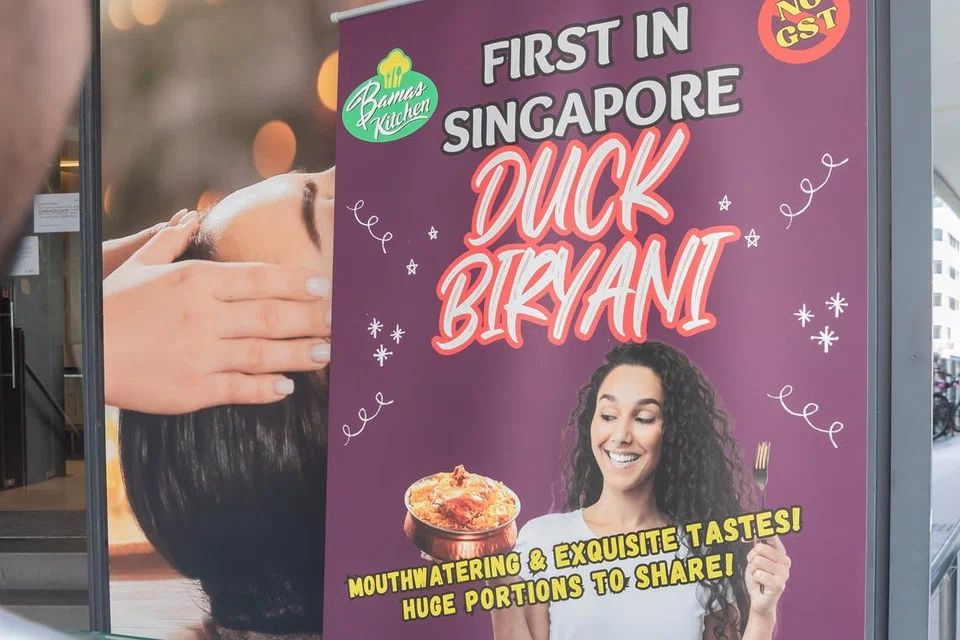

The pink life-sized banner belonging to Bama’s Kitchen outside the Trio shopping mall in Sam Leong Road on the outskirts of Little India grabs your attention from metres away. On it is the striking bold claim: “First in Singapore: Duck Biryani”.
It’s enough to pique my interest.
While I am no stranger to duck – being born and raised in the all-encompassing food paradise that is Singapore – I am cognisant of the fact that duck meat is rarely an option in Indian cuisine.
Cultural factors, availability, taste preferences – whatever the reason, the fatty bird just isn’t consumed in India as much as other meats like chicken, mutton and fish.
Duck is particularly prominent in Chinese cuisine, most notably in the form of Peking duck, where the crispy roasted skin is wrapped with scallions, cucumbers and hoisin sauce in a small spring pancake.
Perhaps just as popular is the French duck confit, where the duck leg is slow-cooked in duck fat until the meat is meltingly tender, and the skin crisped to golden succulence.
Peking and confit, yes. But duck biryani? What would the Mughals, who introduced biryani to India more than 100 years ago, have thought?
From the exterior, Bama’s Kitchen looks more like a pub than a restaurant, what with its well-decorated (and stocked) bar overlooking no more than eight or nine tables.
There are no customers at 11am, though the owner, who wishes to be known only as Ms Bama, 77, tells me that many of her customers are from tour groups. Indeed, her duck biryani recipe was made with such patrons in mind.
“We get a lot of Chinese customers, and they are mostly the ones who order the duck,” she says. “Indians, no. They don’t eat it.”
We Indians are a people of many quirks and traits, I tell her. But being adventurous with food has never been one of them.
She nods in agreement.
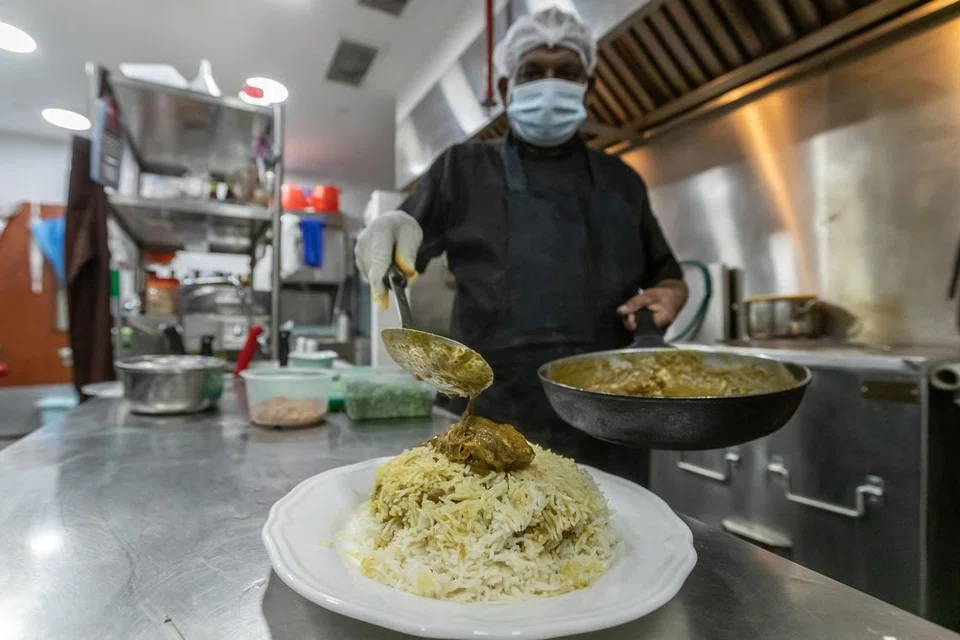
At first sight, Bama’s duck biryani looked like basmati rice slathered in korma. At first bite, however, there was no mistaking the biryani fragrance and spices. The rice is cooked separately, then mixed with the masala-stewed duck inside a pot during the final cooking phase.
This was a very light style of biryani, almost a “healthy version of it” – if such an oxymoron could even exist. There is no MSG, preservative or artificial colouring (saffron isn’t always necessary) to the dish, and the green chilli masala complements the flavourful breast meat.
There are some who opine – in hyperbolic fashion – that duck is closer to steak than chicken. The meat is darker and drier than chicken, and the fat content is quite rich.
I like to think of duck meat as the best of both worlds. And while some duck dishes – especially those served at French restaurants – may have a gamey flavour, Bama’s duck biryani has no such issue.
“We’ve had this dish on our menu since we opened in 2019,” said Ms Bama, who also runs Lady Fair Beauty Centre in Upper Dickson Road. She has been in the salon business for over 30 years.
“It was our best-selling dish before Covid hit, but everything’s on and off now. It’s still popular though, especially with the tourists.”
Some 2km away in North Bridge Road is a restaurant almost a century older than Bama’s Kitchen. Self-styled as the “great-grandfather” of biryani in Singapore, Islamic was founded in 1921, and was one of the first restaurants to serve the dish here.
The cosy two-storey shophouse space is adorned with heirlooms from Singapore’s colonial history and photos of owner Kalil A. Wahab’s grandfather and father, who started and ran the business respectively.
Interestingly, Mr Kalil, 62, who took charge of the business in 2008, also collects replicas of ducks – his favourite animal.
“I like ducks because when you see them in a pond, they look calm and peaceful and happy. But underneath the water, they are paddling furiously; we don’t see their struggles,” the well-spoken Mr Kalil explains.
“Sometimes it’s like that with people too – we see them happy and successful, but beneath the surface they’re working hard and struggling, and we don’t see that.”
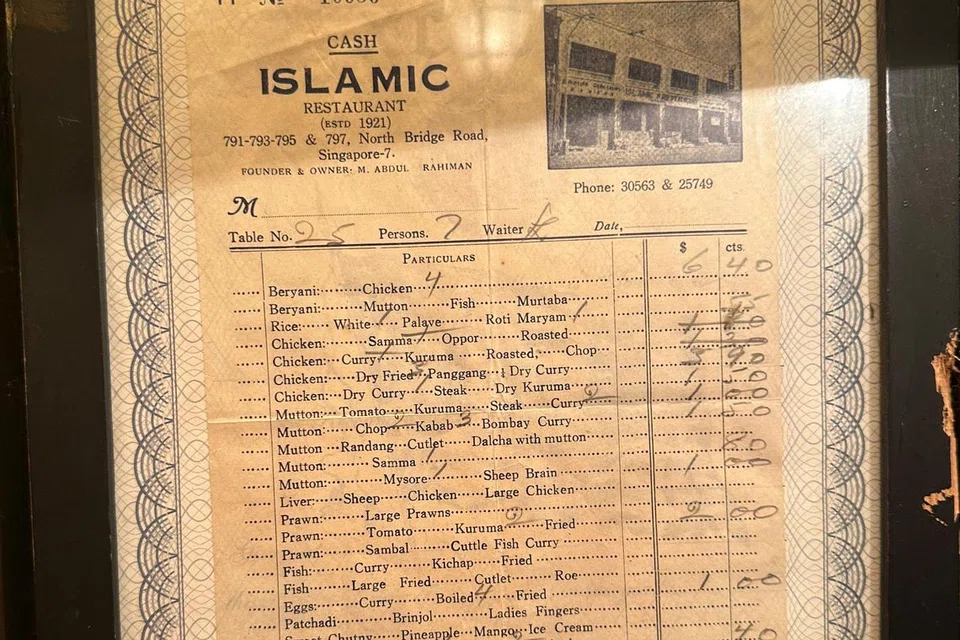
Mr Kalil furrowed his brow when I told him of the unique and rare combination of duck and biryani found at Bama’s Kitchen. He then points to a receipt on the wall from 1962, that shows “duck” on the menu.
“We’ve been serving duck biryani here since then,” he says. “During Covid-19, we made it available just once a week on Fridays; but now it’s back on the menu every day – both here and our Desker Road branch.”
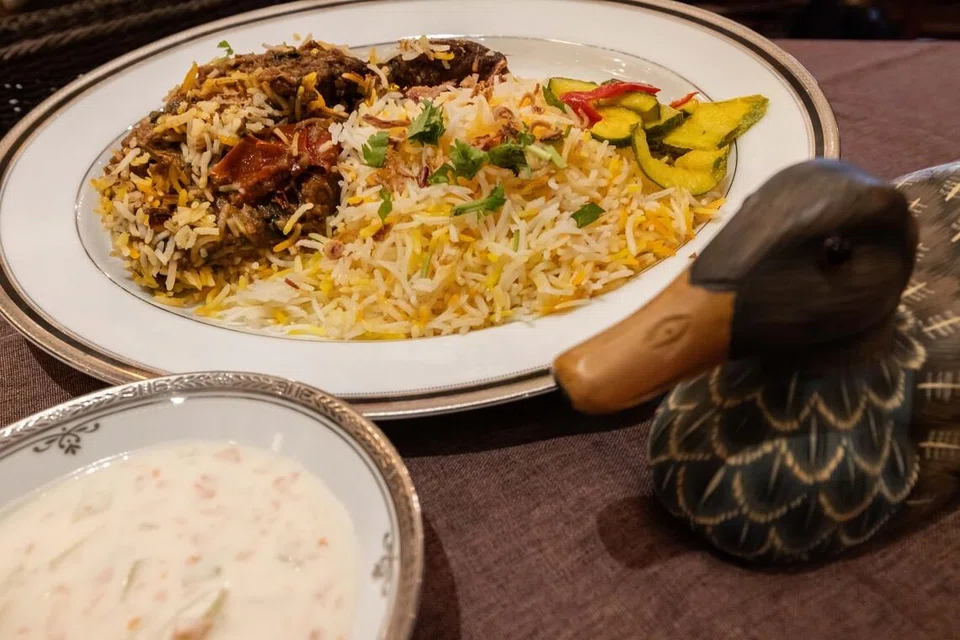
Islamic’s nasi biryani is not as rich and fiery as the Indian version. Instead, it draws on Middle Eastern influences for its secret blend of about 25 spices for the meat marinade.
The duck is slow-cooked in an oven overnight “for consistency” Mr Kalil informs. Perhaps more significantly, the version served here keeps the skin on the bird.
Duck fat, or skin in this instance, is called gold by everyone who knows its powers. It has a flavour profile not replicated by any other meat, and to serve duck without it would be akin to playing football without the goalposts – you could still have a kickabout, but really what’s the point?
For that reason alone, Islamic’s duck biryani, with its thicker and spicier masala, gets the nod over Bama’s – though the latter’s rice was just as tasty if not slightly better.
After the last scoop of rice, I am reminded of the current hubbub over butter chicken between two restaurants in India, where both lay claim over its origins during the 1940s. The dispute has even gone to the courts in New Delhi.
In the case of the duck saga here, Islamic has a receipt to back up its claim.
“Our customers know that we serve duck biryani, and many do order it – Malays, Chinese, even Indians,” says Mr Kalil.
“It’s the same with our Mysore mutton,” he adds. “My grandfather created it in 1921, while Apolo Banana Leaf and Muthu’s Curry started serving their versions in the 70s.”
I felt obliged, of course, to update Ms Bama on the situation. If anything, to see if she would withdraw her claim of serving the “First Duck Biryani in Singapore”.
“That’s a joke man, nobody’s heard of it before,” was her reply over the phone.
“(Islamic) only started selling it recently. Maybe, they sold it back then, then stopped and restarted again recently, but nobody heard of it even in the early 2000s.
“When we introduced our dish, people also reacted in a way that indicated we were the first.”
If anyone’s thinking of starting a squid or scallop biryani dish, they best copyright it.