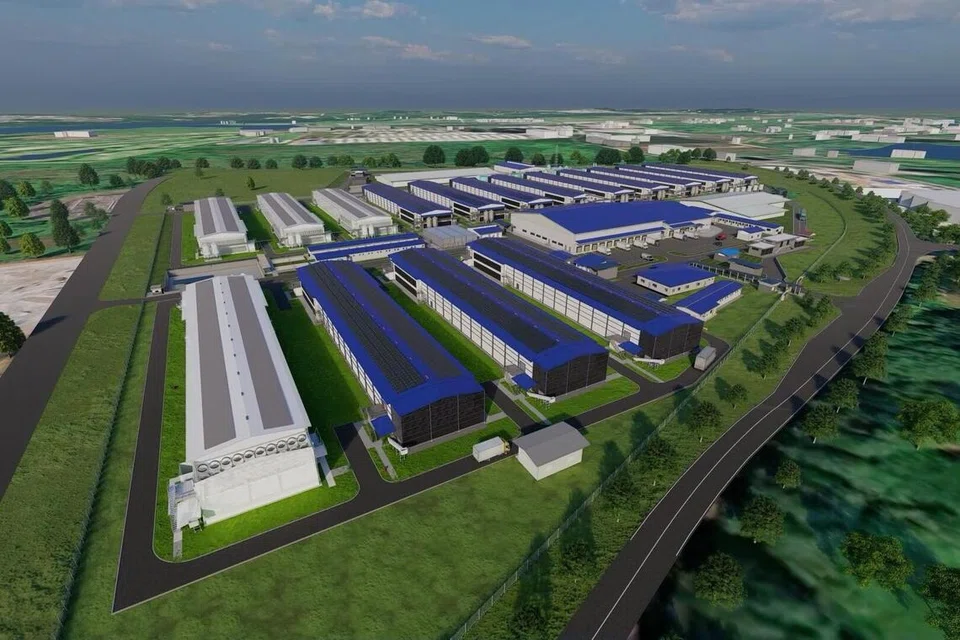
Singapore’s fourth egg farm is targeting to become operational in 2028 - four years behind the initial start date of 2024.
DoMo Farm aims to bring Japanese-grade eggs – which have deep orange yolks and are safe to eat raw – to consumers in Singapore by that year.
Construction was delayed so the farm could put adequate biosecurity measures in place without compromising its production targets, its owner, ISE Foods Holdings.
Higher construction costs amid post-pandemic supply chain shocks and the Russia-Ukraine war also contributed to the delay, its executive director Kenneth Ho said.
“We had a lot of time to do detailed (planning and design), so we are able to cap the cost from what we had budgeted in the earlier days, but with a higher production capacity now,” he said, adding that the farm’s delay ended up being a blessing in disguise.
“We believe that food security and commercial sustainability should go hand in hand.”
ISE Foods Holdings is a subsidiary of engineering and service solutions firm Ellipsiz, where Mr Ho is also chief executive.
He was speaking ahead of the S$110 million farm’s ground-breaking ceremony in Lim Chu Kang yesterday. Minister for Sustainability and the Environment Grace Fu was the guest of honour.
Singapore currently has three egg farms: Chew’s Agriculture, Seng Choon Farm and N&N Agriculture. In 2025, they produced more than 736 million eggs, and the country’s total egg consumption that year was more than 2.2 billion eggs.
When it begins operating in 2028, DoMo Farm will be able to produce about 380 million eggs a year.
Ho said it plans to expand production to more than 500 million eggs a year. If that target is reached, local production would exceed half of Singapore’s 2025 egg consumption.
Ho said DoMo Farm’s eggs will be priced competitively with those from local farms. Eggs from those farms were listed at between $3.35 and $7 on the FairPrice and Cold Storage websites.
Delay first reported in 2024
In 2024, ST reported that ISE’s review of biosecurity measures and development costs could require modifications to the farm’s design or layout and delay its completion.
The delay was discovered through Ellipsiz’s update to the Singapore Stock Exchange in September 2023 and its half-yearly results report for the 2024 financial year.
The farm declined to comment at the time, leaving it unclear what the proposed biosecurity measures were.
Ho revealed more information in the interview, saying that the initial 10ha farming plot allocated in Kranji Way was too small to meet biosecurity requirements while achieving the initial annual production target of 360 million eggs.
At that time, the farm – which would be the first in Singapore to have a hatchery and breeder facility to reduce reliance on imported chicks – was planned for four locations. The plan included a 10ha egg-laying facility and a 0.6ha hatchery in two Lim Chu Kang sites.
The previous plan also included a farm in Tuas to raise chicks from the hatchery into laying hens, and a parent breeder facility in Sungei Tengah to produce fertilised eggs for the hatchery.
One biosecurity requirement is to separate the egg-laying houses by a distance usually equal to the width of each house, Ho said.
This is to maintain ventilation and prevent contaminated air – such as in the case of a disease outbreak in one house – from entering another house.
Trucks transporting “clean” items, such as chicken feed, and those carrying “dirty” items, such as manure, cannot use the same road, he added, pointing to the farm’s need for more space.
To meet those biosecurity needs, Ellipsiz and ISE Foods Holdings requested more land from the Singapore Food Agency and eventually received a new 15ha plot.
The move also consolidated the farm’s operations at two sites instead of four.
The 15ha site will host the egg-laying houses and pullet houses, where chicks from the hatchery grow into egg-laying hens. It will also host a manure treatment facility using fermentation to turn waste into organic fertiliser, Ho said.
The hatchery and the chicken breeder facility to produce fertilised eggs will be housed on a separate 4ha parcel of land in Neo Tiew Crescent, in DoMo Farm’s next phase post-2028.
Mr Ho declined to give a specific timeline for these two facilities and the location of the 4ha plot, adding that the focus was on completing the egg-laying facilities.
As the hatchery will not be built by 2028, DoMo Farm’s initial eggs will be produced by hens imported from Malaysia as day-old chicks – similar to the other three farms.
Overcoming rising costs and supply chain shocks
In 2024, it was reported that ISE Foods Holdings was exploring cost-effective options for equipment and materials in the light of rising construction costs due to heightened geopolitical tensions and inflationary pressures.
Ho told ST that the farm was announced during the post-pandemic period when the Russia-Ukraine war and the resulting energy crisis occurred. That also led to economic uncertainties and supply chain disruptions.
But one silver lining of the delay was that it allowed artificial intelligence technologies to mature, allowing them to be more applicable to farming operations, Ho said.
For example, the egg-laying houses will have patrol robots that will run up, down and across the cages to keep an eye on the hens’ health. Each house will have 150,000 hens in six rows of 10-tiered cages.
The robots will have AI-powered predictive health monitoring capabilities, heat-detecting sensors and cameras to monitor the hens’ condition continuously. The monitoring will allow prompt intervention to limit disease spread.
In 2022, Seng Choon Farm, one of the three egg farms, had a Newcastle disease outbreak, which caused egg production to fall temporarily.
The highly contagious H5 strain of bird flu remains a threat as it has spread to all continents, devastating poultry farms and even infecting more than 50 species of mammals.
In late 2025, DoMo Farm applied for and received a grant from the Singapore Food Agency’s second Agri-Food Cluster Transformation Fund.
The fund helps local farms offset the cost of energy-efficient infrastructure and invest in advanced technologies. Ho did not disclose how much funding was received.
At the ground-breaking ceremony, Ms Fu highlighted that the farm will rely on solar power and have an automated egg warehouse, alongside climate-controlled facilities.
“As a country that imports most of our food, events around the world are felt on our food shelves. Strengthening our food resilience is therefore not a matter of choice but a matter of necessity,” she said. THE STRAITS TIMES