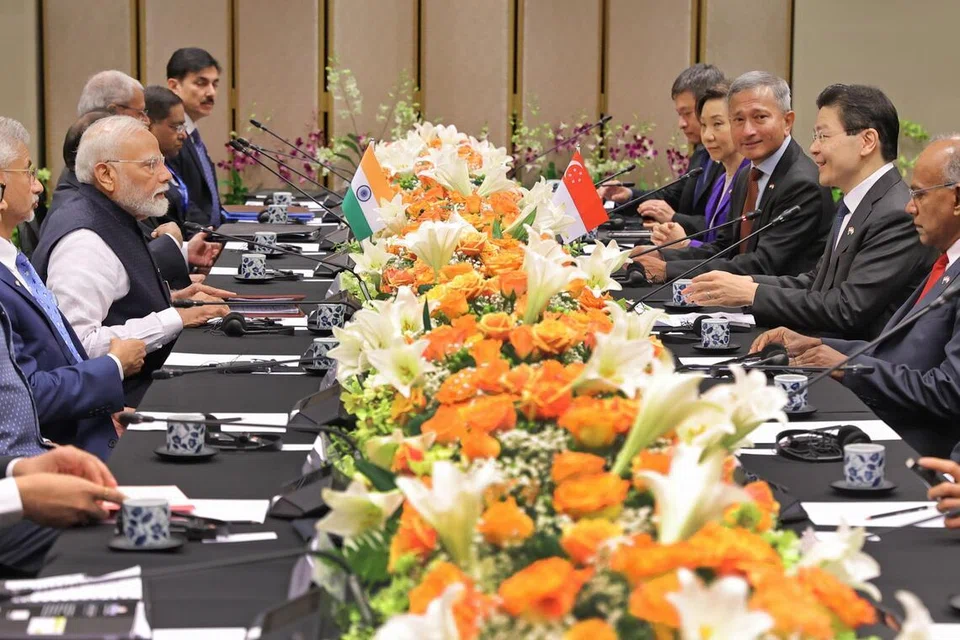
Indian Prime Minister Narendra Modi’s visit to Singapore on September 4 and 5 resulted in a decision to upgrade the bilateral relationship from a strategic partnership to a comprehensive strategic partnership. The new agreement would deepen existing areas of cooperation and enable new areas.
Details of the economic agreements that would enhance the partnership have been widely publicised. What is important is to sense the implications for Singapore’s and India’s place in the flux of international affairs.
Let us begin with the historical perspective. Both countries are products of the period of decolonisation that followed World War II. Both achieved independence through the largely peaceful transfer of power from the British. Their adherence to this day to the rule of law and parliamentary democracy is derived from their political experience of colonialism.
Their international paths diverged during the Cold War, with non-aligned India veering close to the erstwhile Soviet Union and non-aligned Singapore hewing a more centrist line in global affairs. Singapore’s views were vindicated when the Soviet Union imploded in 1991, leaving the global terrain exposed to the expansion of what is known as the liberal international order, in which the world is safer the freer trade is.
India came to embrace that order in its essentials with the liberalisation of its economy in the 1990s. Singapore welcomed that development, which reintroduced India as a major power in global affairs, to the extent that former prime minister Narasimha Rao of India announced his country’s Look East policy (since upgraded to the Act East policy) here in 1994.
Thirty years since then, India has globalised itself with a vengeance. Today, the India Story is sounding similar to the China Story, in which the political desire for economic change uplifts millions out of poverty and marginalisation in a fraction of the time that it took the West to achieve the same incremental improvements.
Singapore is associated closely with the China Story. Chinese supremo Deng Xiaoping’s visit to the city-state in 1978 opened his eyes to what was possible back home on a vastly larger scale should China look outwards.
In short, Singapore is an economic interlocutor for much larger and more powerful Asian nations in their strategic relations with the rest of the world. Singapore’s anchored and anchoring place in Asean gives this country the regional heft with which to argue for economics as an underpinning of peace. Singapore is a trading state, after all.
Today, the global order based on the twin legs of prosperity and peace, from which both India and Singapore benefit, is under pressure. A wide-ranging joint statement touched on one source of tension: the South China Sea. It underlined the need to maintain and promote “peace, security, stability, safety and freedom of navigation in and overflight above the South China Sea, while pursuing the peaceful resolution of disputes in accordance with international law, particularly the 1982 United Nations Convention on the Law of the Sea (UNCLOS), without resorting to the threat or use of force”. The rejection of force is an explicit concern.
The South China Sea is an arena where the maritime claims of the contending parties – Brunei, China, Indonesia, Malaysia, the Philippines and Vietnam – overlap dangerously with the great-power rivalry between China and the United States. Given the sea’s crucial position in world trade, it is natural for countries such as India and Singapore to be concerned about the consequences of the waterway turning into a flashpoint of armed conflict.
In the circumstances, it does help for like-minded countries to reaffirm their joint commitment to a global system in which nations both large and small can survive and thrive.
The Modi visit contributed to that vision.