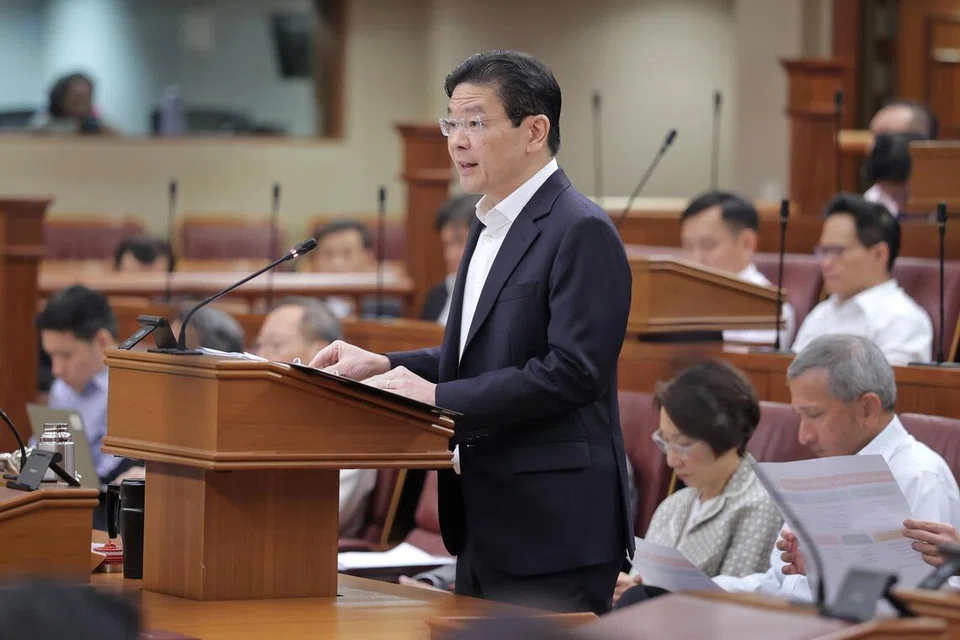

Prime Minister and Finance Minister Lawrence Wong on Feb 12 unveiled a wide-ranging Budget focused on accelerating artificial intelligence (AI) adoption, strengthening workforce resilience and easing cost pressures for households. It was his first Budget since the 2025 General Election.
In his Budget 2026 speech in Parliament, PM Wong laid out plans to tackle a range of issues, from cost-of-living concerns to helping Singapore businesses expand overseas.
Budget 2026 lays the groundwork for how Singapore will navigate its next phase of development, said PM Wong, who is also Finance Minister.
His speech covered six areas: refreshing Singapore’s economic strategy, harnessing artificial intelligence, building a more resilient and skilled workforce, support for families, protecting Singapore’s security and sustainability, as well as strengthening the Singapore spirit.
Here are 10 key takeaways from Budget 2026:
1. Fast-tracking AI adoption across the economy
A new National AI Council, chaired by PM Wong, will steer Singapore’s AI strategy, alongside national AI “Missions” in advanced manufacturing, connectivity, finance, and healthcare. A new “Champions of AI” programme will help companies overhaul operations and train workers.
AI spending will be added to the Enterprise Innovation Scheme, while the Productivity Solutions Grant will support more digital and AI tools. A larger AI park at one-north will build on the Lorong AI pilot, and professionals in sectors such as law and accountancy will receive targeted AI training. Singaporeans enrolling in selected AI courses will also enjoy six months of free access to premium AI tools.
2. Stronger support for firms going global
Funding support for internationalisation will rise to 70 per cent for SMEs and 50 per cent for non-SMEs. The Market Readiness Assistance grant will be enhanced, more overseas activities will qualify for double tax deduction, and the claims cap will be raised to S$400,000 per year. Loan limits under the Enterprise Financing Scheme will also be increased.
3. Fresh growth capital for start-ups and listings
The Startup SG Equity scheme will receive a S$1 billion injection and expand beyond early-stage funding to support growth-stage companies. A new S$1.5 billion Anchor Fund tranche, co-invested with Temasek, will back high-growth firms preparing for listings. The Financial Sector Development Fund will be topped up by S$1.5 billion to support Singapore’s equity market.
4. More help for lower-wage, mid-career and senior workers
The Local Qualifying Salary (LQS) will rise to S$1,800 in 2026. Government co-funding under the Progressive Wage Credit Scheme will increase to 30 per cent in 2026 and be extended to 2028. From 2027, the minimum wage increase to qualify for support will rise to S$200. Workfare Skills Support will be enhanced, while mid-career workers will see expanded courses and part-time training allowances under SkillsFuture Level-Up. The Senior Employment Credit will be extended to end-2027.
5. Foreign worker policy refinements
Minimum qualifying salaries will rise for both Employment Pass and S Pass holders, with higher thresholds for the financial sector. Older applicants’ salary requirements will increase in tandem. Levies for basic-skilled workers in the marine and process sectors will go up, and levy structures in manufacturing and services will be simplified from 2028.
6. New CPF investment option
CPF members will be offered a new voluntary investment option using a life-cycle investment approach, allowing younger members to take more risk while gradually shifting to safer assets as retirement nears. Fees will be kept low, and only two to three providers will be appointed.
7. Higher vehicle taxes to encourage cleaner transport
The Preferential Additional Registration Fee (PARF) rebate will be cut by 45 percentage points, and the rebate cap lowered to S$30,000, to encourage earlier deregistration of petrol cars and support electric vehicle adoption.
8. More vouchers and cash support to ease cost pressures
All households will receive S$500 in CDC vouchers in January 2027. Eligible adults earning up to S$100,000 will receive a one-off Cost-of-Living Special Payment of S$200 to S$400. Additional U-Save rebates will be provided, and families with young children will get more LifeSG credits.
9. Carbon tax path may remain lower for longer
Singapore will review its carbon tax trajectory carefully. If global momentum weakens, the tax could stay at the lower end of S$50 to S$80 per tonne by 2030. At the same time, the national solar target will rise to 3 gigawatt-peak by 2030, and energy efficiency grants and green financing schemes for businesses will be extended.
10. S$500 Child LifeSG credits and expanded family support
All families with a Singaporean child aged 12 and below will receive S$500 in Child LifeSG credits per child. PM Wong said the Government will continue strengthening pre-school subsidies and family support, acknowledging that the cost of raising children remains a key concern for young couples.
In his address, PM Wong said how Singapore harnesses AI will be “a decisive factor for success” in a more uncertain global economy, and stressed that workforce transformation and family support would remain central to Singapore’s long-term strategy.
He added that while inflation has eased, many Singaporeans still feel cost pressures, and the additional vouchers and cash support are intended to provide near-term relief alongside longer-term economic restructuring.
santosh@sph.com.sg