
For Mr Nikesh Mehta, the British High Commissioner to Singapore, the Gujarati way of life is more than just heritage – it is an identity woven into his very being.
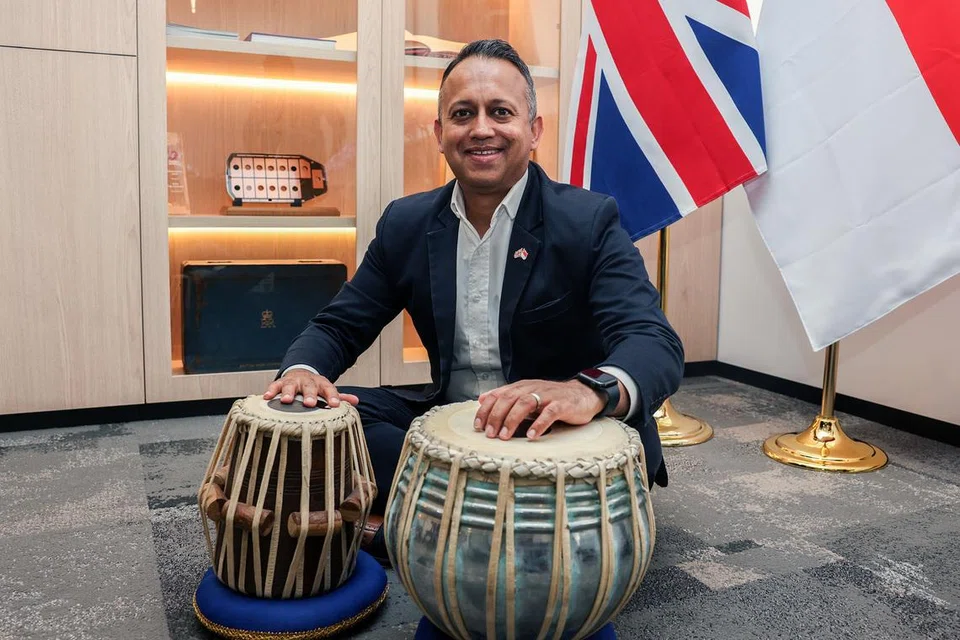
“My mum made me go to a Gujarati school in Wembley every Saturday,” he recalls. “I hated it, but I had to take Gujarati lessons in the morning and music lessons in the afternoon.”
Music was a family affair, albeit a reluctant one.
While Mr Mehta learnt the tabla under a renowned teacher, his brother was trained in the harmonium. Their mother would enthusiastically encourage – sometimes force – them to play together, singing along herself.
“It was horrible,” Mr Mehta says with a laugh, “but I love the sound of the tabla and Indian musical instruments.”
Though he no longer plays, the memories remain, as does his fluency in Gujarati, a language he was required to master, especially to communicate with his grandmother, who “professed not to speak English” – though Mr Mehta suspects otherwise.
The 47-year-old High Commissioner’s connection to Gujarat traces back to his great-grandparents, who hailed from a small village called Gunda in Jamnagar.
Like many Indians, they migrated to East Africa in the early 20th century, when the British were building the East Africa Railway. They later established businesses, with his mother growing up in Uganda and father in Kenya.
Then came 1972.
Under Idi Amin’s rule, 80,000 South Asians were ordered to leave Uganda within 90 days. Mr Mehta’s mother, then a young woman, witnessed the brutality firsthand.
“His soldiers came to my mum’s house, put a gun to her head, and demanded money and jewellery,” Mr Mehta recounts. “They made it clear the family had only weeks before they were thrown out.”
Like 27,200 others, Mr Mehta’s mother and grandparents fled to the United Kingdom, leaving behind everything they had built.
But starting all over in the UK was far from easy. The 1970s and 80s were rife with racism, and integrating into British society was a challenge.
“For anyone from an ethnic minority, life was tough,” Mr Mehta said. “Many people feared immigration would disrupt the UK, but my mother always felt deep gratitude that Britain gave them a home.”
Determined to rebuild, she secured a place in a nursing school near Newcastle and later worked for the National Health Service for 40 years, mostly in the same hospital.
Like many Indian families at the time, the Mehtas lived together in one house with 15 relatives. Mr Mehta, his parents and his brother shared a bedroom until they could afford to move to Harrow.
Life as a British-Indian child was complex. Football matches at Wembley Stadium could be terrifying, as he and his family were often the only ethnic minorities in the crowd. His father would warn them to be careful – one wrong word could lead to trouble.
Yet, the expectation at home was clear: Success.
“Growing up, the dinner table conversations were always about becoming a doctor, lawyer, accountant – never about civil service, let alone diplomacy,” he says. “We thought it was a career for the white majority, not for immigrants like us.”
Mr Mehta pursued a degree and master’s in chemistry at University College London and had a PhD lined up. But an advertisement caught his eye – a teaching job in Japan.
“I wasn’t sure I wanted to spend my life in a lab coat,” he admitted.
His time in Japan changed everything. Teaching in a rural town, he found himself acting as a de facto ambassador for British culture. His passion for international relations grew, as did his realisation that diplomacy could be a path for him.
Encouraged by a friend, he looked into the Foreign Office.
“I had no idea what it was,” he said with a laugh. “But the more I read, the more excited I became.”
In 2002, Mr Mehta passed the exams and joined the British Foreign Service.
The Foreign Office was intimidating.
“I felt like a fish out of water,” he said. “The grand buildings, the formal language, the way people dressed – I didn’t see anyone who looked like me in senior roles.”
Desperate to fit in, he used his first pay cheque to buy a pinstripe suit and a long umbrella, mimicking the stereotypical British diplomat.
But his perspective changed in Iraq, his first posting. There, he realised that his diverse background was a strength, not a weakness.
“Some of the hang-ups were my own,” he said. “There were times when some seniors didn’t accept me in the way that I would have liked, but I definitely felt that I was self-censoring. I didn’t express my true views, didn’t challenge, because I almost wanted to hide in the corner. It took a long time to lift that cloak, and to have the confidence to express my views.”
Over the next 22 years, Mr Mehta climbed the ranks, serving in Uganda, Malaysia and South Korea. In Uganda, he took his mother and grandmother back to their ancestral village for the first time in 30 years – a deeply emotional journey.
“Every time I met President (Yoweri) Museveni, he would say, ‘You’re really Ugandan’. And I’d say, ‘I’m British’.”
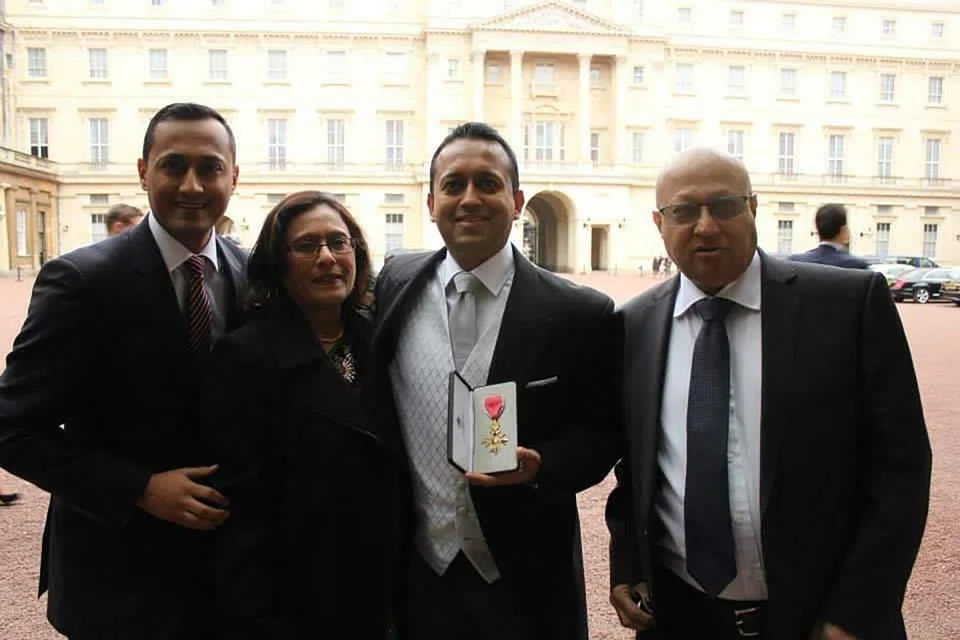
In July 2024, Mr Mehta was appointed the British High Commissioner to Singapore, becoming the first non-white to assume the post.
“It’s the best job I’ve ever had,” he said.
Singapore is a natural fit for Mr Mehta. The UK and Singapore now have a Strategic Partnership, a Digital Economy Agreement, and a Green Economy Framework, with bilateral trade worth £22 billion.
“This year, we celebrate 60 years of UK-Singapore relations. We were the first to recognise Singapore’s independence, and now we’re building a modern partnership for the future,” he said.
Beyond work, Mr Mehta, who lives here with his Australian wife and two children, immerses himself in Singapore’s culture and history, engaging with the Indian, Chinese and Malay communities, exploring heritage sites, and indulging in local cuisine.
He has also brought his Gujarati roots to his official residence. Eden Hall is now a vegetarian-only space.
“It’s part of my upbringing, but it’s also about sustainability,” he explains. “We’re trying to reduce our carbon footprint.
“I’m immensely proud of being a British High Commissioner, but your heritage is important. I will always feel deeply passionate about the connection between the UK and India and between the UK and Singapore through the Indian community.”
Mr Mehta is also a die-hard Liverpool fan, watching matches regardless of time zones. Cricket, too, remains a passion.
He is proud of how far Britain has come in diversity and inclusion.
“We have one of the most diverse parliaments in the world,” he said. “Rishi Sunak was prime minister, David Lammy as foreign secretary, and so many ethnic minorities in leadership – it’s proof that if you’re talented, you can rise to the top.”
Even in business, some of Britain’s wealthiest and most successful individuals are from ethnic minority backgrounds.
“The UK isn’t free from challenges in integrating communities, but I’m proud of the journey we’ve taken on race,” said Mr Mehta.