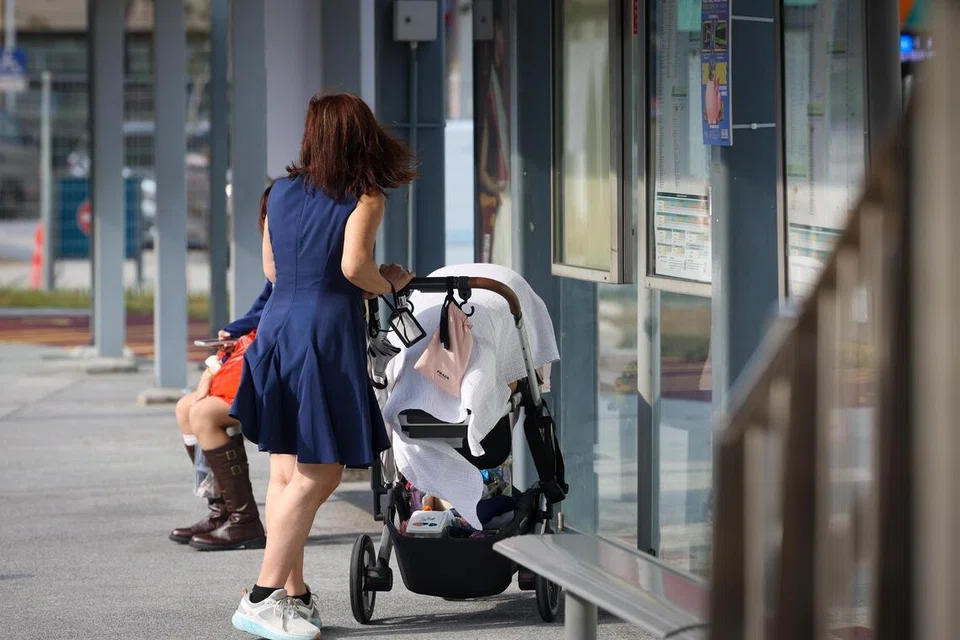
At a time when fewer Singaporean women are having children, more of those in their 40s are bucking the trend.
In 2025, 9.6 babies were born per 1,000 women aged between 40 and 44, up from 8.9 babies in 2015 and 6.2 babies in 2005.
The increase in the age-specific fertility rate (ASFR) for women in this age group is also seen in those aged between 45 and 49 – 0.5 babies were born per 1,000 women in this age group in 2025, up from 0.4 babies in 2015 and 0.2 babies in 2005.
ASFR refers to the number of babies born to women in a specific age group per 1,000 women in that group.
In sharp contrast, the ASFR has been falling for younger women.
For those aged between 25 and 29, 38.3 babies were born per 1,000 women in 2025, down from 68.7 babies in 2015 and 80.7 babies in 2005.
For those aged between 30 and 34, 70 babies were born per 1,000 women in 2025, down from 98.5 in 2015 and 89.2 in 2005.
The data for 2025, which was released in late February, is preliminary, said a Department of Statistics spokesperson.
Professor Jean Yeung, director of social sciences at the A*STAR Institute for Human Development and Potential, said that over the past few decades, women have been delaying marriage and motherhood as they spend more time pursuing their education and interests, and establishing their careers.
The later age at which they marry and become parents has led to an increase in the ASFR for older women, while it has fallen for those in their 20s and 30s, said Prof Yeung, who is also a professor at the NUS Yong Loo Lin School of Medicine.
The median age of women who gave birth to their first child rose from 29.3 years in 2004 to 31.9 years in 2024, the latest figures available show. The figures are for babies born to at least one parent who is a Singaporean or permanent resident.
Dr Tan Poh Lin, senior research fellow at the Institute of Policy Studies (IPS), noted that the sharp fall in the number of babies born to women in their early 30s has a huge impact on birth rates, as these women are the core contributors to births here.
Singapore’s total fertility rate, which refers to the average number of babies each woman would have during her reproductive years, fell from 1.26 in 2005 to a record low of 0.87 in 2025.
Dr Kalpana Vignehsa, a senior research fellow at the IPS, said it is no longer a given that married couples will have children. And among those who want children, it is increasingly a deliberate and conditional decision, based on factors such as career stability and division of labour between the couple, before they have children.
She said: “So, even if a couple married young, it is increasingly likely that they will wait a longer period before deciding they feel ready to have a child.
“In this context, more couples are open to trying or actively trying to have children in their late 30s or early 40s.”
Ms Simran Toor, vice-president of Fertility Support SG, a non-profit group that organises support groups and events related to fertility issues, said that as more women marry in their mid-30s or later, they realise what their fertility challenges are only when they start trying for a child one or two years after tying the knot.
The Straits Times