The National University of Singapore will give all students and staff free access to ChatGPT Edu as it makes AI courses compulsory.
From August, NUS requires all undergraduates to take at least two compulsory courses in artificial intelligence before graduating, regardless of their field of study, including a new introductory AI course for all incoming students, alongside changes across schools’ common curricula and majors. Existing and incoming students as well as staff will also get free access to ChatGPT Edu – a version built by OpenAI for universities and schools to use.
The moves are part of a new AI strategy announced by the university on Aug 11.
Under the plan, AI will be built into how each discipline is taught and used in students’ day-to-day work, while ensuring they still develop distinctly human qualities like judgment and communication.
“The core business of a university is really to develop the human, not to develop the AI,” said NUS deputy president (academic affairs) and provost Aaron Thean, speaking to media ahead of the announcement on July 27.
He added that the goal is for all students to be “AI fluent” by the time they graduate, while a smaller group specialising in the field would go on to master it.
NUS has about 29,600 undergraduates across 15 colleges, faculties and schools.
From the August 2026 intake, all undergraduates must complete a new compulsory module, “Applied Generative AI: From Prompting to Evaluation”.
Students across the College of Humanities and Sciences, the College of Design and Engineering, the Business School, and Healthcare Professional Education will also take compulsory AI-related courses as part of the common curriculum. These students make up over 85 per cent of NUS’ undergraduate population.
Business students, for example, will need to take a course called Decision Analytics using Spreadsheets and AI.
Every major across every faculty and school will also introduce at least one compulsory course examining how AI is transforming that profession, such as Artificial Intelligence and Public Policy for political science majors.
Students with deeper interest can pursue new minors or second majors in applied AI fields, including two new programmes starting in August – a Bachelor of Science in Geospatial Intelligence, and a second major or minor in Applied AI (Design and Engineering).
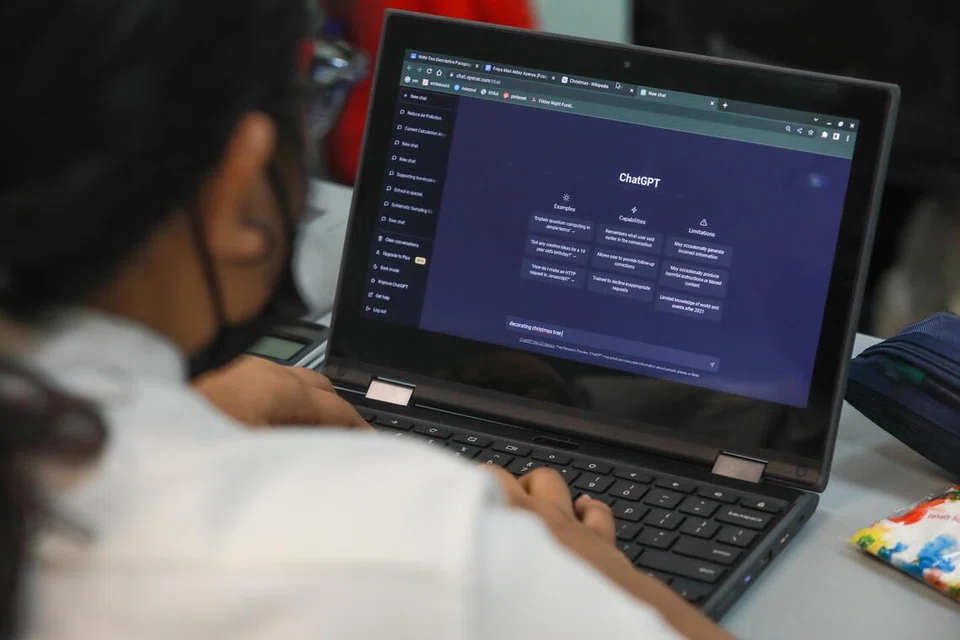
Access to AI tools will also be expanded. From Aug 31, all students, faculty and staff will get baseline access to ChatGPT Edu, a university-controlled version of ChatGPT with higher message limits and greater privacy than the free version.
As part of the OpenAI collaboration, more advanced tools will be piloted in select courses that need deeper AI use, like computing.
NUS is also developing seven in-house AI tools for teaching. These include a “scenario generator” that lets students practise with AI-powered simulations, and another that acts as a Socratic coach, prompting students with questions rather than answers.
Other tools in the works will help instructors flag learning gaps and track class participation, or help students with research and challenge them to spot gaps in AI-generated answers.
Mr. Thean said: “Our AI strategy is centered around one thing, which is to build up human potential.”
Nanyang Technological University (NTU) in April also rolled out a similar policy, mandating AI literacy lessons for all students from August, built into a compulsory first-year course.
NTU students will also get free access to a suite of premium Google AI tools, including ones for workplace automation and building AI agents.
At NUS, nursing students have started using AI as part of their learning.
Before fourth-year nursing student Nicholas Lau, 29, steps into a real patient’s room, he goes through five layers of simulation training.
It starts with getting students to practise clinical skills such as bandaging, followed by simulations involving real-life actors who are hired to play patients and their distraught family members.
Students then move on to AI-powered simulations that Lau said almost feels like a video game: they check on a patient in a hospital bed, take his vitals and ask how he is feeling.
As the “story” unfolds, the patient’s condition worsens, requiring students to assess the situation, make decisions and explain their reasoning. The AI asks follow-up questions and challenges decisions, “forcing you to explain your thinking instead of memorising answers”, said Mr. Lau.
Training then progresses to a timed virtual-reality simulation, where students assess patients alongside peers from other institutions, before culminating in a team-based assessment.
Lau said this step-by-step approach has made him more confident during clinical attachments at local hospitals.
He recounted caring for an initially stable patient who turned drowsy and unresponsive overnight. The patient had a mild stroke, but the symptoms differed from what Lau had expected.
The AI training helped him prepare for the stress of such situations, he said. It taught him to stay calm, think through his reasoning and make decisions under time pressure, he added. THE STRAITS TIMES