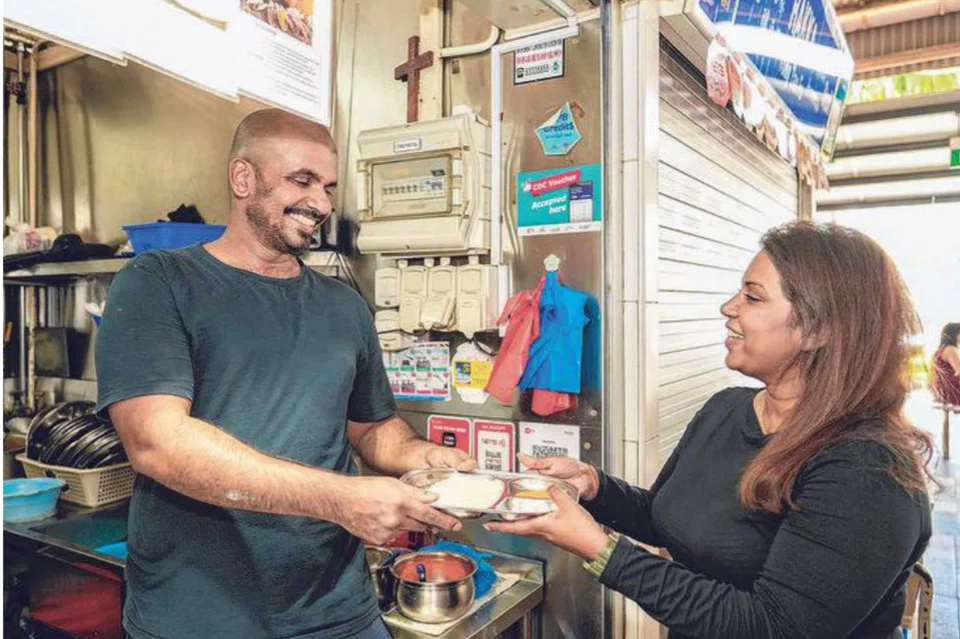

As Daniel Surendran pours thosai batter in loops on a sizzling skillet, he has one hand on his waist and his eyes on a customer who has joined the queue during the busy lunch hour at Ghim Moh Food Centre.
“The red one finished already, sorry,” he courteously tells an elderly man who has just been handed his order of thosai on an aluminium tray, referring to the spicy red chutney condiment.
His Heaven’s stall, which sells thosai, appam and putu mayam – using family heirloom recipes – is slated to close in 20 minutes, at 1pm, having been open from dawn. But there are still five people queueing for their “breakfast” orders.
“This is the low period; my rush hour is before 10am,” Suren, 37, says.
He notices me watching him add ingredients to the thosai, and remarks: “Nothing much to it, bro. Just need to add a bit of love, that’s all.”
The friendly and tall (1.82m) Suren is of a rare breed – a young Singaporean hawker who took the reins of a thosai stall from his mother, Madam Letchmi, who started the business in 1992.
It wasn’t even at his mother’s urging. In fact, Suren had begun his own business – selling similar food items at Simpang Bedok a little over a decade ago – right after he completed his national service (NS).
In 2020, after moving his business from place to place, Suren felt his mum needed a break, and took over Heaven’s.
“When my mum handed me the keys, that same evening the circuit breaker was announced. We could only laugh,” he recalls.
“So I had to pivot – that was a word I didn’t know until that point. I got ideas from friends who ran bars and other F&B (establishments). For example, I had friends who were driving Grab during that period, and so I got them to deliver the food islandwide for a flat fee of $10. In the end, we made it work.”
Initially, after graduating from poly, Suren aimed to further his studies at the Singapore University of Social Sciences. He needed an A level certificate for admission, so he sat for his exams while serving NS and passed.
But by the time he was done with his two-year military stint, he decided the F&B scene was his true calling.
“My siblings and I used to help my mum at the stall when we were younger, but they never really showed an interest in the trade. I liked it, and I helped my mum with the cooking,” Suren says.
“After NS, I had the opportunity to start a business at Simpang Bedok. I asked my mum about it and she said ‘just try – if it doesn’t work out, you can always go back to your studies’.
“I have never thought about studying since then.”
Though business in Bedok was “good” for Suren, the food court shut after two years. He then moved his business around for a bit – by the time he was 29, he worked at five different outlets, including Changi Airport.
Assisting him at Heaven’s are his cousin and aunt. His mother, 62, is retired, though she still helps out occasionally.
“She’s worn out, her arm locks, her nerves hurt – from all her hawker years,” Suren explains. “That’s the toll of this job. But she still wants to come and help sometimes.”
To someone outside the F&B industry, Suren’s daily routine may seem hectic. He gets up at 3.45am daily and reaches the stall just before 5am.
A football fan and Liverpool supporter, on days when there’s a vital Champions League match during the wee hours, he has to watch the game on his phone, while setting up shop.
“I’ll have like five or six burners going on at the same time; I turn to the screen only when a goal is scored.”
When I remark that I couldn’t imagine waking up and working so early every day, Suren grins as if he’s heard that line a million times.
“It’s not that hard, 4am. I mean, you’re comparing that to other jobs, but I can show you an even tougher one – the fish (monger) fellas head into work at 1am. The prawn mee seller (also at Ghim Moh) comes in at 1.30am. So there are tougher jobs, but you shouldn’t compare,” he says.
“My mental stress is very low. I’ve worked in an office before and I know how it was working under another person barking orders, and with targets to meet. Here, I don’t have all that. I get to dictate the way things are run and decide my own hours.”
Married for the past 11 years, Suren is also a new father after his wife gave birth to twin girls last August.
With such working hours, does he even have time for family, or a social life?
“I’m very strict with my working hours – by 2pm, I’m out of here,” he says. “I sleep at around 9pm, so from 2pm till then I have a lot of time to do things. I can have beers with friends, dinner with my wife and spend time with my kids.”
Suren wasn’t always savvy with his work hours. At Simpang Bedok, he ran his stall from 6am to 10pm.
“That time, I wanted to squeeze every dollar I could, and so I did it the old school hawker way. Then I realised, why am I doing this? In the long run, I’d be exhausted and without a life.
“Seeing my mother have trouble with her arm also made me think. I figured I needed to work smart; there was no need to suffer every day for 14-16 hours.”
Though he may have his working hours and routine sorted, there are still some issues Suren has to contend with from time to time, such as hawker centre closures.
The Ghim Moh Food Centre will close for renovations from today (March 1) till May 11.
“I might drive a taxi or Grab in the meantime, or I could take up an offer to do a pop-up stall,” he says, referring to a temporary thosai and appam station at various events.
After his venture at Simpang Bedok closed, Suren set up such stations during functions organised by banks and companies, and once even at the prime minister’s house.
“That all stopped during Covid, but I might start one up again until my stall can reopen.”